

Trading
Explore a wide range of markets with competitive pricing, deep liquidity, and advanced trading tools.
Learn More 
Platform
Trade seamlessly with TMGM's powerful platform, built for speed, precision, and a superior trading experience.
Learn More Trading Platform
Academy
Learn the fundamentals of trading with beginner-friendly resources, including guides, webinars, and market insights.
Learn More News & Analysis
Get real-time market updates and expert analysis to stay ahead of trading opportunities
Learn More News & Analysis
About
Learn what sets TMGM apart — our global presence, regulatory strength, and commitment to innovation in trading.
Learn More Why Choose TMGM
Sponsorship
20-day EMA: AUD/USD consolidates above key level as focus turns to Fed policy
- Near 0.7020, AUD/USD edges higher as the Australian currency leads most peers.
- Wednesday’s Australian Q3 CPI release and Fed policy decision are in sharp focus for investors.
- Expectations are for the Fed to maintain its interest rate range at 3.75%-4.00%.
AUD/USD trades marginally higher around 0.7020. During Tuesday’s European session, the Australian Dollar (AUD) gains slightly against the US Dollar (USD), supported by its outperformance against other currencies apart from the New Zealand Dollar (NZD).
Australian Dollar Leads Euro in Today’s Trading
Today’s percentage moves in the Australian Dollar (AUD) against the major currencies listed appear in the table below. Its largest gain was against the Euro.
| USD | EUR | GBP | JPY | CAD | AUD | NZD | CHF | |
|---|---|---|---|---|---|---|---|---|
| USD | 0.19% | 0.17% | 0.16% | 0.04% | -0.09% | -0.17% | 0.08% | |
| EUR | -0.19% | -0.01% | 0.02% | -0.14% | -0.27% | -0.37% | -0.09% | |
| GBP | -0.17% | 0.01% | 0.02% | -0.12% | -0.26% | -0.33% | -0.07% | |
| JPY | -0.16% | -0.02% | -0.02% | -0.13% | -0.27% | -0.35% | -0.10% | |
| CAD | -0.04% | 0.14% | 0.12% | 0.13% | -0.14% | -0.22% | 0.05% | |
| AUD | 0.09% | 0.27% | 0.26% | 0.27% | 0.14% | -0.08% | 0.19% | |
| NZD | 0.17% | 0.37% | 0.33% | 0.35% | 0.22% | 0.08% | 0.28% | |
| CHF | -0.08% | 0.09% | 0.07% | 0.10% | -0.05% | -0.19% | -0.28% |
Percentage movements between major currencies are displayed in the heat map. Select the base currency in the left-hand column and the quote currency in the top row. For instance, choosing the Australian Dollar on the left and following that row across to the US Dollar gives the percentage change for AUD (base)/USD (quote).

With financial markets awaiting Wednesday’s monetary policy decision from the Federal Reserve (Fed), however, AUD/USD is expected to trade flat.
2027 tightening outlook: RBC sees gradual hikes after expected Fed hold
An unchanged policy stance at this week’s meeting is the expectation of analysts at Royal Bank of Canada. They say the “Federal Reserve … expected to hold the fed funds target range unchanged on Wednesday after hiking for the first time since 2023 in September.” September’s increase restarted the tightening cycle, though RBC highlights the likely measured pace: “FOMC members continue to signal that more hikes will follow, but comments after the last decision suggest a gradual approach.” The bank maintains its forecast, stating that “we expect two 25-basis-point rate hikes ahead before the end of Q1 2027.”
Also on this week’s agenda are Thursday’s Q3 Gross Domestic Product (GDP) figures and September Personal Consumption Expenditure (PCE) Price Index data. Investors will closely monitor these releases alongside Q3 results from hyperscalers including Amazon, Alphabet and Microsoft.
Australia’s Q3 Consumer Price Index (CPI), due on Wednesday, is another focus for investors. Inflation is forecast to accelerate to 1.3%, compared with the previous reading of 0.6%.
0.7021: AUD/USD Technical Outlook Remains Mildly Bullish
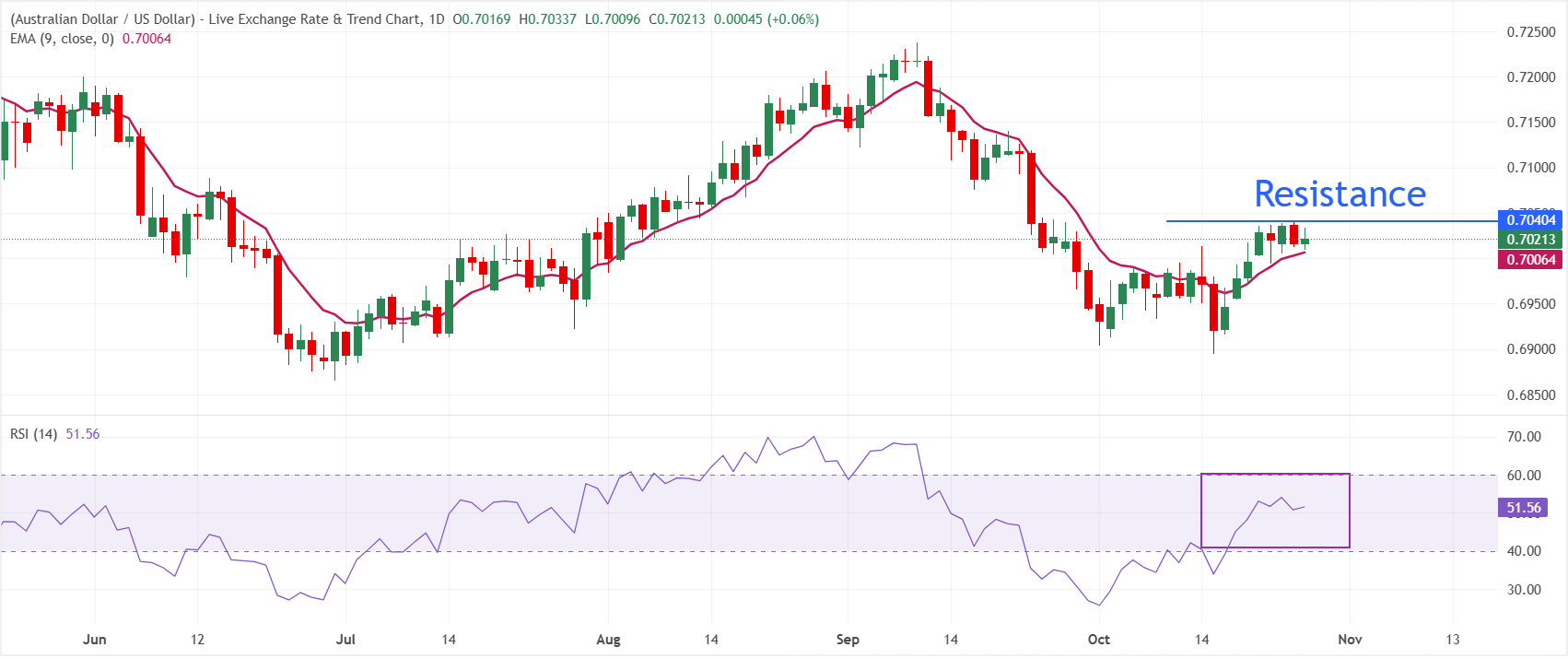
At 0.7021 on the daily chart, AUD/USD retains a slightly positive near-term outlook. Trading just above the 9-period exponential moving average (EMA) of 0.7006 points to an early recovery following the recent retreat. A Relative Strength Index (RSI) reading of 51.5, marginally above neutral, signals modest upward momentum while remaining outside overbought territory.
Immediate downside support lies at the 9-period EMA of 0.7006. On the upside, the high of 26 October at 0.7040 represents the main barrier. A break above 0.7040 would mark the start of another upward leg.
(The technical analysis of this story was written with the help of an AI tool. Know more.)
Economic Data Release
Consumer Price Index: Quarterly Change (QoQ)
Published quarterly by the Australian Bureau of Statistics, the Consumer Price Index (CPI) tracks price movements in a fixed basket of goods and services purchased by households. Each quarterly CPI figure is the average of the three corresponding monthly CPIs. The QoQ measure compares prices with those in the preceding quarter. A higher reading is regarded as positive for the Australian Dollar (AUD), whereas a lower reading is regarded as negative.
Explore further.Next publication: Wed 28 Oct 2026 00:30
Release frequency: Every quarter
Consensus forecast: 1.3%
Previous reading: 0.6%
Published by: Australian Bureau of Statistics
The data is published nearly 25 days after quarter-end. Issued quarterly by the Australian Bureau of Statistics (ABS), the Consumer Price Index (CPI) significantly influences markets and the AUD’s valuation. To fulfil its inflation mandate, the Reserve Bank of Australia (RBA) monitors the measure closely, giving it major implications for monetary policy. Higher consumer prices typically support the AUD, as the RBA could raise interest rates to keep inflation at its target.
POPULAR ARTICLES
1US Dollar under pressure from AI equity risks – TD Securities2Japanese Yen faces further downside risk against US Dollar amid BoJ caution – MUFG3Top Altcoins Price Forecast: Persistent selling pressure drives further losses in Ripple, Cardano and Solana4Below $80,000: Bitcoin (BTC) price forecast amid consolidation, Middle East tensions and looming tech earnings5Australian Dollar: Upside momentum fades near recent highs versus US Dollar – UOB6Silver price today: FXStreet data show prices falling7Near recent lows: Gold faces two-way risks – OCBC81.3320 Area, 38.2% Fibo.: GBP/USD Price Forecast as stronger USD pushes pair to one-week low9Above 102.00: US Dollar Index Price Forecast Following Move Past Nine-Day EMA
LIVE QUOTES


Get Started!
Sign up and access the Global Markets in less than 3 minutes

Connect With Us












The information provided on this website is of a general nature only and does not constitute personal financial advice. Before acting on any information on this website, you should consider the suitability of the information in relation to your objectives, financial situation and needs. Investing in CFDs and FX Margin Contracts carries significant risks and is not suitable for all investors. You may lose more than your initial deposit. You do not own, or have, any interest in the underlying asset. We recommend that you seek independent advice and ensure you fully understand the risks involved before trading. It is important that you read and consider the disclosure document before you acquire any product listed on the website. The information and advertisements offered on this website are not intended for use by any person in any country or jurisdiction where such use would be contrary to local laws and regulations. The Products and Services offered on this website are not intended for residents of the United States, Malaysia and Thailand.
TMGM is authorized and regulated in various jurisdictions.
Trademax Australia Limited, trading as TMGM, is regulated by the Australian Securities and Investments Commission (ASIC), AFSL no. 436416 and is located at Level 28, One International Tower, 100 Barangaroo Avenue, 2000 Sydney, NSW Australia.
Email: [email protected]
Trademax Global Limited, trading as TMGM, is authorized and regulated by the Vanuatu Financial Services Commission (VFSC), registration number 40356 and registered at 1276, Kumul Highway, Port Vila, Vanuatu, Republic of Vanuatu.
Email: [email protected]
Trademax Global Markets (SE) Limited, trading as TMGM, is authorized and regulated by the Financial Services Authority (FSA) of Seychelles, with license number SD224. The company is registered at Office No 13, Providence Estate ABIS Centre, Mahe, Seychelles.
Email: [email protected]
Trademax Global Markets (International) Pty Ltd, trading as TMGM, is authorized and regulated by the Financial Services Commission, Mauritius (FSC) with license no. GB22201012, and registered at 33, Edith Cavell Street C/o IQ EQ Fund Services (Mauritius) Ltd Port Louis, 11324 Mauritius.
Email: [email protected]
Copyright © TMGM. All rights reserved