

Trading
Explore a wide range of markets with competitive pricing, deep liquidity, and advanced trading tools.
Learn More 
Platform
Trade seamlessly with TMGM's powerful platform, built for speed, precision, and a superior trading experience.
Learn More Trading Platform
Academy
Learn the fundamentals of trading with beginner-friendly resources, including guides, webinars, and market insights.
Learn More News & Analysis
Get real-time market updates and expert analysis to stay ahead of trading opportunities
Learn More News & Analysis
About
Learn what sets TMGM apart — our global presence, regulatory strength, and commitment to innovation in trading.
Learn More Why Choose TMGM
Sponsorship
WTI falls on Iran deal hopes as US Treasury yields decline
- 5.123%: US 10-year Treasury yield slips nearly two basis points.
- $97.58: WTI retreats as reports on US-Iran negotiations diverge.
- 7.3% drop in Pending Home Sales as higher mortgage rates undermine demand.
Reports that Washington and Tehran may be close to an agreement helped push US Treasury yields slightly lower on Tuesday. A separate report, however, indicated that US-Iran negotiations were continuing and no deal had yet been finalised.
5.12% in focus: US 10-year yields slip on diplomatic hopes and weak housing data

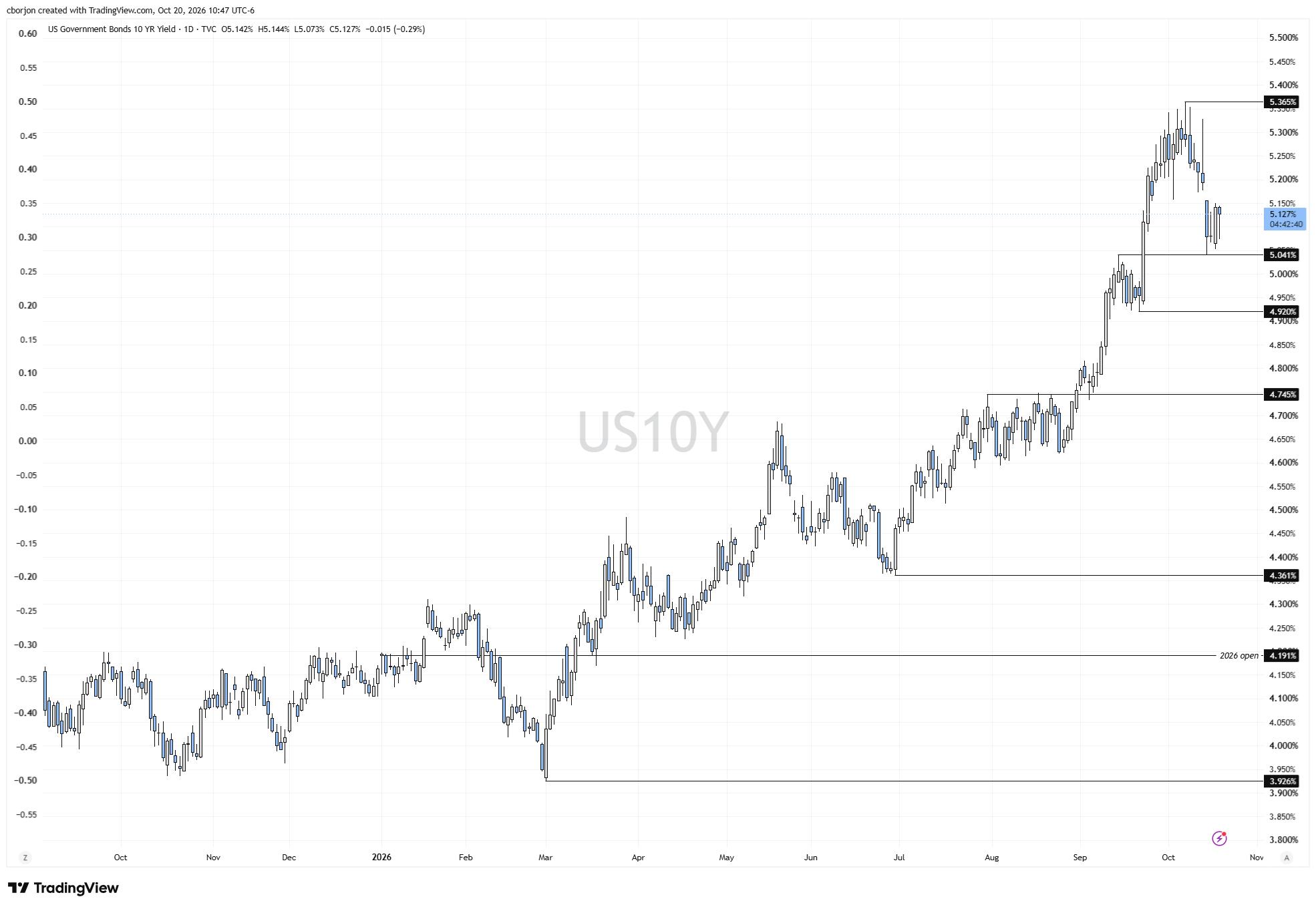
5.123% is the latest US 10-year Treasury yield, down nearly 2 basis points. Geopolitical developments initially drove the benchmark yield lower as energy prices declined. A rebound in US equities also weighed on US bond yields. West Texas Intermediate (WTI), the US crude oil benchmark, trades at $97.58 per barrel, down 0.67%.
At 101.66, the US Dollar Index (DXY) has slipped 0.32%. The index tracks the US dollar against a basket of peer currencies.
Higher mortgage rates were blamed for September’s -7.3% reading in US Pending Home Sales, which fell short of the -0.5% forecast. Next on the US economic calendar are Initial Jobless Claims on October 22 and S&P Global Flash PMIs on October 23.
At 4.789%, the US 2-year Treasury yield is unchanged. This maturity is the most sensitive to interest rate expectations.
An unchanged interest rate decision at the Federal Reserve’s October meeting was priced into money markets. For December’s meeting, however, the probability remains at 89%, according to Prime Terminal.
10-year US Treasury note yield: Daily chart
Interest rates: Key questions
Borrowers pay interest on loans from financial institutions, while savers and depositors receive interest on their funds. These rates reflect base lending rates, which central banks adjust as economic conditions change. Maintaining price stability is normally part of a central bank’s mandate. In most cases, this involves targeting core inflation of around 2%. When inflation undershoots the target, a central bank may lower base lending rates to encourage borrowing and support economic activity. Inflation substantially above 2%, by contrast, normally prompts an increase in base lending rates to bring price growth down.
A country’s currency generally benefits from higher interest rates, as global investors find it more attractive to place their funds there.
Holding Gold becomes more costly in opportunity terms when interest rates rise, compared with owning interest-bearing assets or keeping cash in a bank. Higher rates therefore tend to put pressure on Gold prices. High interest rates also usually strengthen the US Dollar (USD). As Gold is priced in Dollars, a stronger Dollar tends to reduce its price.
US banks lend to one another overnight at the Fed funds rate. Set by the Federal Reserve at its FOMC meetings, this is the headline rate frequently cited in market coverage. The Fed specifies a range, such as 4.75%-5.00%, but the quoted figure is the upper bound, in this example 5.00%. The CME FedWatch tool tracks market expectations for the future Fed funds rate. Those expectations influence trading across many financial markets as participants anticipate the Federal Reserve’s next monetary policy decisions.
POPULAR ARTICLES
1China: CNY finds support in growth momentum – MUFG2Forex Today: Focus shifts to UK inflation3European Central Bank: Rate Path and Core Inflation Pressures in Focus – Commerzbank450 within reach for RSI: AUD/USD Price Forecast as double bottom develops5Inflation risks rise as wage disinflation stalls, BoE’s Greene warns6Canadian Dollar: BoC bets lift CAD against US Dollar – Scotiabank7One-month highs for Canadian Dollar as BoC rate-hike expectations build8December hike expected to mark Federal Reserve cycle peak – BNY9British Pound: Range Highs Against US Dollar in Sight on Bullish Flag Signal – Scotiabank
LIVE QUOTES


Get Started!
Sign up and access the Global Markets in less than 3 minutes

Connect With Us












The information provided on this website is of a general nature only and does not constitute personal financial advice. Before acting on any information on this website, you should consider the suitability of the information in relation to your objectives, financial situation and needs. Investing in CFDs and FX Margin Contracts carries significant risks and is not suitable for all investors. You may lose more than your initial deposit. You do not own, or have, any interest in the underlying asset. We recommend that you seek independent advice and ensure you fully understand the risks involved before trading. It is important that you read and consider the disclosure document before you acquire any product listed on the website. The information and advertisements offered on this website are not intended for use by any person in any country or jurisdiction where such use would be contrary to local laws and regulations. The Products and Services offered on this website are not intended for residents of the United States, Malaysia and Thailand.
TMGM is authorized and regulated in various jurisdictions.
Trademax Australia Limited, trading as TMGM, is regulated by the Australian Securities and Investments Commission (ASIC), AFSL no. 436416 and is located at Level 28, One International Tower, 100 Barangaroo Avenue, 2000 Sydney, NSW Australia.
Email: [email protected]
Trademax Global Limited, trading as TMGM, is authorized and regulated by the Vanuatu Financial Services Commission (VFSC), registration number 40356 and registered at 1276, Kumul Highway, Port Vila, Vanuatu, Republic of Vanuatu.
Email: [email protected]
Trademax Global Markets (SE) Limited, trading as TMGM, is authorized and regulated by the Financial Services Authority (FSA) of Seychelles, with license number SD224. The company is registered at Office No 13, Providence Estate ABIS Centre, Mahe, Seychelles.
Email: [email protected]
Trademax Global Markets (International) Pty Ltd, trading as TMGM, is authorized and regulated by the Financial Services Commission, Mauritius (FSC) with license no. GB22201012, and registered at 33, Edith Cavell Street C/o IQ EQ Fund Services (Mauritius) Ltd Port Louis, 11324 Mauritius.
Email: [email protected]
Copyright © TMGM. All rights reserved