

Trading
Explore a wide range of markets with competitive pricing, deep liquidity, and advanced trading tools.
Learn More 
Platform
Trade seamlessly with TMGM's powerful platform, built for speed, precision, and a superior trading experience.
Learn More Trading Platform
Academy
Learn the fundamentals of trading with beginner-friendly resources, including guides, webinars, and market insights.
Learn More News & Analysis
Get real-time market updates and expert analysis to stay ahead of trading opportunities
Learn More News & Analysis
About
Learn what sets TMGM apart — our global presence, regulatory strength, and commitment to innovation in trading.
Learn More Why Choose TMGM
Sponsorship
Ripple Price Forecast: Sellers maintain their grip as Evernorth Holdings submits SEC filing to buy more XRP
- $1.30 remains out of reach for XRP. Overhead technical resistance continues to constrain price action.
- An SEC filing by Ripple-backed treasury company Evernorth Holdings outlines plans to raise $81 million for further XRP purchases.
- Further technical downside threatens XRP, with the MACD maintaining its sell signal and the RSI approaching oversold levels.
$1.30 remains above Ripple’s (XRP) price on Monday. The correction is intensifying as headwinds build across the cryptocurrency market. The token’s technical outlook suggests the downside could remain the path of least resistance until the supply zone at $1.30 becomes support.

$81 million equity facility targets larger Evernorth Holdings XRP treasury
Up to 5,218,935 Shares of Class A Common Stock would underpin an equity facility agreed between Evernorth Holdings (XRPN) and CF Principal Investments. Evernorth, a leading digital asset treasury company offering institutional access to XRP, announced the common stock agreement on Monday. Full execution of the facility would generate nearly $81 million at XRPN’s prevailing market rate.
Proceeds are earmarked for general corporate purposes, development of the XRP ecosystem and additional XRP treasury holdings. Alongside this facility, Evernorth said it would maintain its treasury strategy through other committed equity offerings and equity-linked facilities.
Matt Frymier, Chief Financial Officer of Evernorth, said: “This represents our first step in putting facilities in place to help grow and manage our treasury in an accretive manner for shareholders,”
Through a regulated, liquid and transparent structure, publicly traded Evernorth offers investors exposure to XRP. The company ranks among the world’s largest XRP treasuries. Supported by the institutional and decentralised finance (DeFi) ecosystem, its strategies aim to grow XRP value per share over time.
38 RSI reading: XRP technical outlook remains bearish
Trading above, XRP retains a bearish short-term bias. Its price remains beneath the 50-day, 100-day and 200-day Exponential Moving Averages (EMAs), which converge at roughly $1.33 to $1.37. Further overhead, the SuperTrend at $1.45 adds to the multiple layers of resistance limiting the market. The Moving Average Convergence Divergence (MACD) indicator is still slightly negative. A Relative Strength Index (RSI) reading of 38 points to weak, though not extreme, downside momentum.
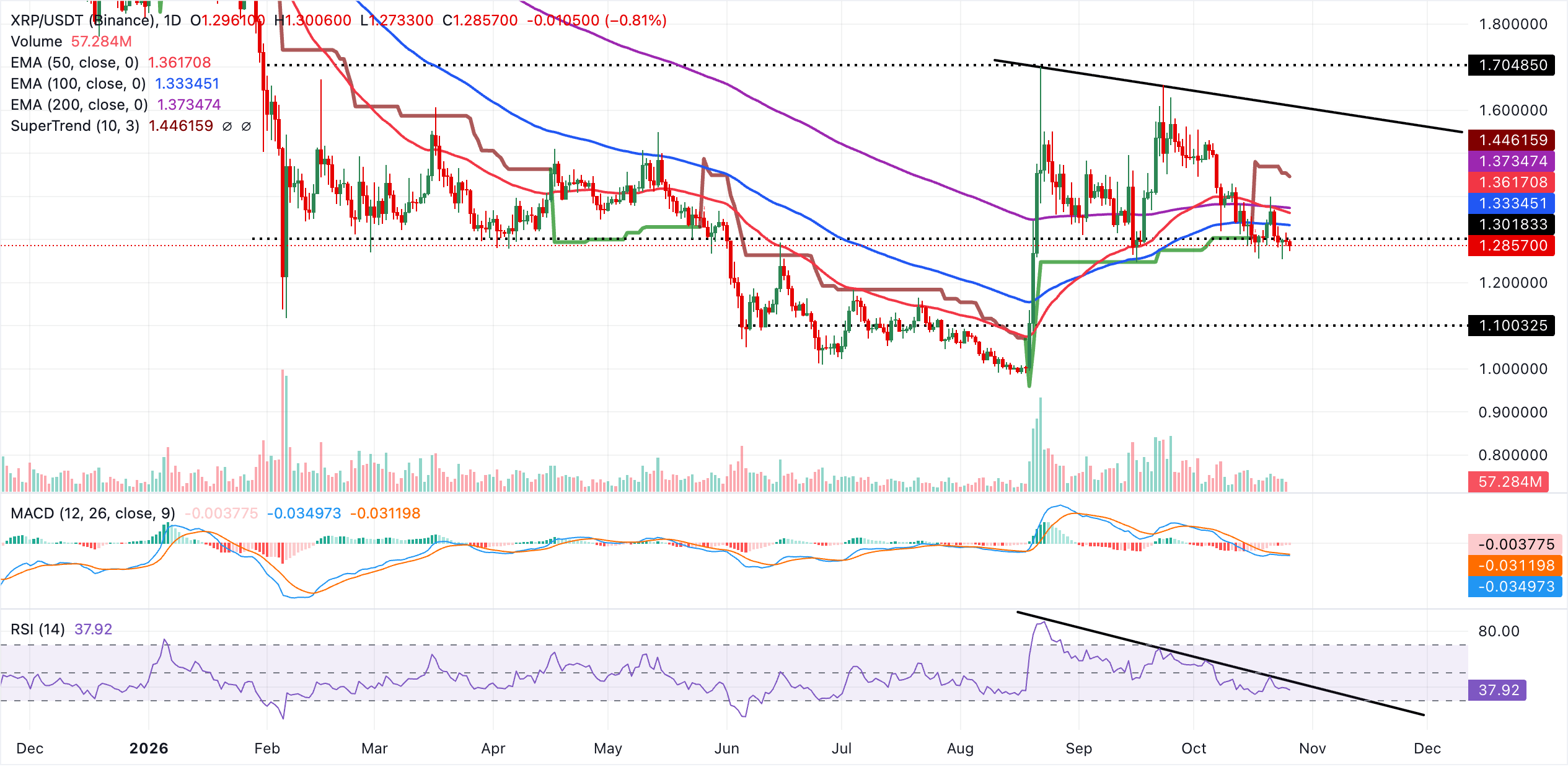
Near $1.33, the 100-day EMA marks the first resistance hurdle. The 50-day EMA at $1.36 and 200-day EMA at $1.37 follow, creating a concentrated supply zone that buyers must recover to relieve the prevailing pressure. Higher obstacles comprise the SuperTrend at $1.45 and the descending resistance trend line originating at $1.72. With no clearly defined support immediately below the market, the pair remains vulnerable to additional losses while trading beneath all major dynamic resistance levels.
(The technical analysis of this story was written with the help of an AI tool. Find out more.)
Ripple: frequently asked questions
Specialising in cross-border remittances, payments company Ripple uses blockchain technology to deliver its services. Financial institutions worldwide can access RippleNet, the payment transfer network developed by Ripple Labs Inc. The XRP token is also used by the company.
On the decentralised XRPLedger blockchain, XRP serves as the native token. Ripple Labs uses it to support XRPLedger transactions, enabling financial institutions to transfer value across borders. By facilitating instant, trustless payments on the XRPLedger chain, XRP helps financial companies reduce the cost of global transactions.
Built on distributed ledger technology and blockchain, XRPLedger uses XRP to power transactions. A built-in inflammatory protocol distinguishes the ledger from other blockchains and helps counter spam and distributed denial-of-service (DDOS) attacks. Maintenance of XRPL is handled by a peer-to-peer network called the global XRP Ledger community.
The interledger standard used by XRP is a blockchain protocol that facilitates payments between different networks. Connecting the ledgers of two or more banks is one example of what XRP’s blockchain can do. This effectively eliminates intermediaries and the need for centralisation within the system. Engineered by Jed McCaleb, Arthur Britto and David Schwartz, the XRPLedger blockchain uses XRP as its native token.
POPULAR ARTICLES
1British Pound Eases: Fed Decision and UK Budget Challenge Sterling Bulls2RBA hike odds rise ahead of CPI as Australian Dollar pulls back from recent peak3Canadian Dollar: Commerzbank sees rate hikes ahead4October hold for Bank of Canada at odds with market pricing – TD Securities5Euro edges lower as traders await monetary policy decisions from Fed and ECB6Below 2%: Commerzbank expects Spain’s growth to slow in 20277Germany: Growth momentum shows resilience as Ifo improves - ING8Euro area: Modest GDP expansion, mixed inflation signals - Societe Generale9United Kingdom: Borrowing rises on investment drive – Deutsche Bank
LIVE QUOTES

ALL ABOUT TECHNICAL
What Is the Dark Cloud Cover Pattern and How Do You Trade It?
What Is the Piercing Line Candlestick Pattern and How Do You Trade It?
What Are Tweezer Top and Bottom Candlestick Patterns?
Inside Bar Candlestick Pattern: What It Is, How to Identify It, and How to Trade It
Hanging Man Candlestick Pattern: How to Identify and Trade It
How to Draw Fibonacci Retracement: Mastering the Golden Ratio in Trading
What is the Relative Strength Index (RSI)
What is Scalping in Trading & How Does It Work
Get Started!
Sign up and access the Global Markets in less than 3 minutes

Connect With Us












The information provided on this website is of a general nature only and does not constitute personal financial advice. Before acting on any information on this website, you should consider the suitability of the information in relation to your objectives, financial situation and needs. Investing in CFDs and FX Margin Contracts carries significant risks and is not suitable for all investors. You may lose more than your initial deposit. You do not own, or have, any interest in the underlying asset. We recommend that you seek independent advice and ensure you fully understand the risks involved before trading. It is important that you read and consider the disclosure document before you acquire any product listed on the website. The information and advertisements offered on this website are not intended for use by any person in any country or jurisdiction where such use would be contrary to local laws and regulations. The Products and Services offered on this website are not intended for residents of the United States, Malaysia and Thailand.
TMGM is authorized and regulated in various jurisdictions.
Trademax Australia Limited, trading as TMGM, is regulated by the Australian Securities and Investments Commission (ASIC), AFSL no. 436416 and is located at Level 28, One International Tower, 100 Barangaroo Avenue, 2000 Sydney, NSW Australia.
Email: [email protected]
Trademax Global Limited, trading as TMGM, is authorized and regulated by the Vanuatu Financial Services Commission (VFSC), registration number 40356 and registered at 1276, Kumul Highway, Port Vila, Vanuatu, Republic of Vanuatu.
Email: [email protected]
Trademax Global Markets (SE) Limited, trading as TMGM, is authorized and regulated by the Financial Services Authority (FSA) of Seychelles, with license number SD224. The company is registered at Office No 13, Providence Estate ABIS Centre, Mahe, Seychelles.
Email: [email protected]
Trademax Global Markets (International) Pty Ltd, trading as TMGM, is authorized and regulated by the Financial Services Commission, Mauritius (FSC) with license no. GB22201012, and registered at 33, Edith Cavell Street C/o IQ EQ Fund Services (Mauritius) Ltd Port Louis, 11324 Mauritius.
Email: [email protected]
Copyright © TMGM. All rights reserved