

Canada CPI expected to show steady inflation in August
- Canadian inflation is expected to come in flat on a monthly basis in August.
- The underlying inflation gauges are seen unchanged from the prior month.
- The Canadian Dollar has been losing momentum vs the US Dollar recently.
Canada’s August Consumer Price Index (CPI) figures will be the focus of attention when published on Monday. Indeed, Statistics Canada data will provide markets with an update on price pressures following the Bank of Canada’s (BoC) September 2 meeting, when officials kept the interest rate steady at 2.25%, broadly in line with analyst consensus.

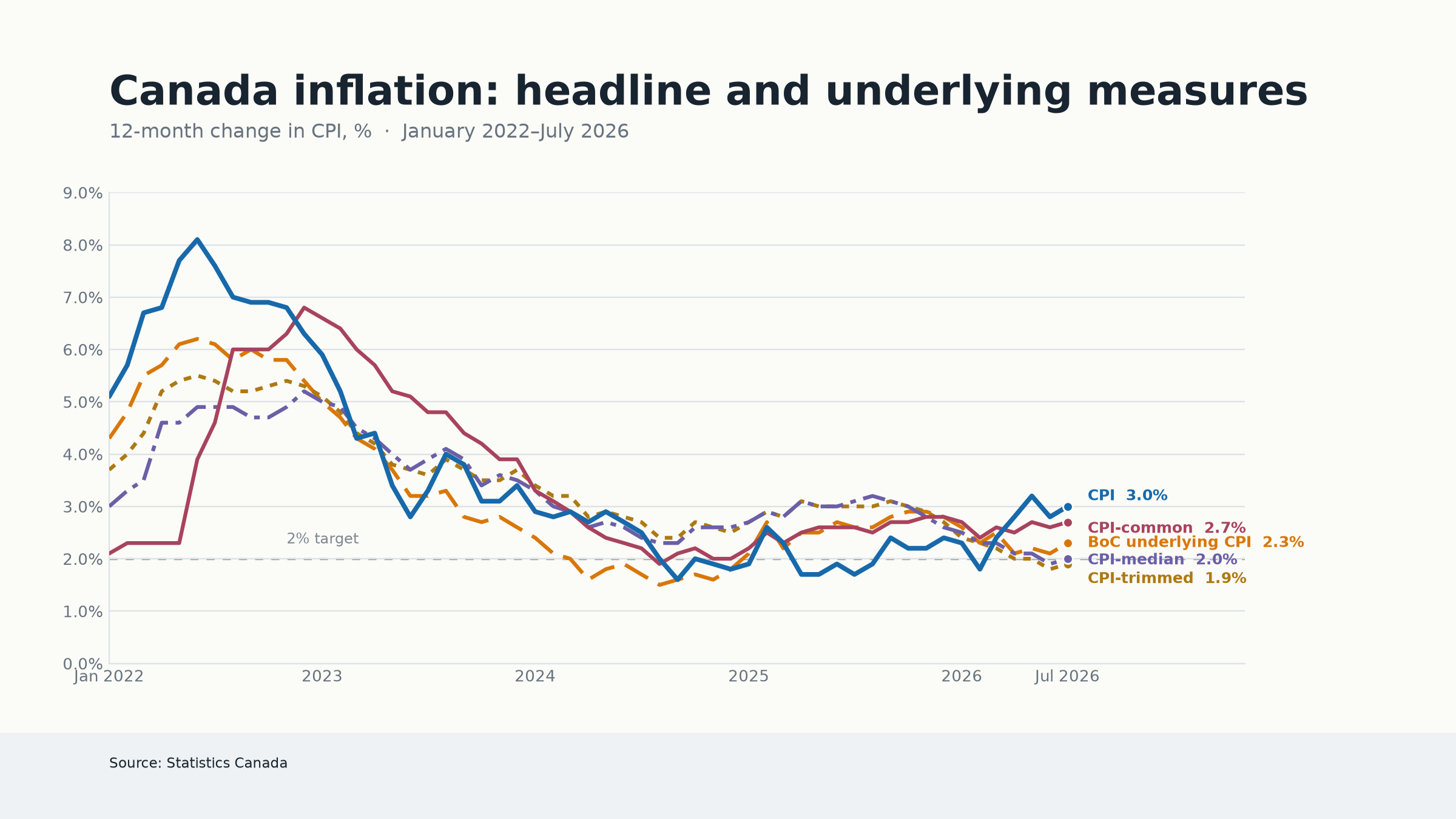
This time, economists expect the headline CPI to remain unchanged at 3% YoY and to rise by 0.3% on a monthly basis, below the 0.5% in July. The BoC’s core measure (which strips food and energy costs) is forecast to rise by 0.1%.
In the current context of heightened geopolitical volatility, crude Oil dynamics are likely to keep inflationary pressures anything but abated, while reignited tensions on the tariffs front are expected to also add to the sentiment.
Still around data, the BoC’s preferred gauges of underlying inflation, CPI-Common, Trimmed Mean, and Median, picked up pace in July to 2.7%, 1.9%, and 2.0%, respectively.
What can we expect from Canada’s inflation rate?
Inflation gathered some traction in July, and market participants would not rule out that trend to have further extended in August.
The BoC delivered a cautiously hawkish hold on September 2, leaving rates unchanged as economic slack and lingering trade uncertainty continue to argue for patience. Still, policymakers appear increasingly uneasy about the inflation outlook. Governor Tiff Macklem’s warning that several rate hikes could be needed suggests renewed tightening is firmly back on the table, particularly if Oil prices remain elevated or inflationary pressures begin to spread beyond energy.
So far, market participants expect nearly 36 basis points of tightening by year-end.
When is the Canada CPI data due, and how could it affect USD/CAD?
Markets will fully focus on Monday at 12:30 GMT, when Statistics Canada publishes August’s inflation prints. If inflation adds to the recent uptick, bets on further rate hikes should likely increase, providing fresh legs for the Canadian Dollar (CAD).
Pablo Piovano, Senior Analyst at FXStreet, notes that USD/CAD has been in a steady recovery so far this week, bouncing off lows in the mid-1.3700s and gaining around a cent since then.
Piovano points out that the pair has recently broken above its critical 200-day SMA in the 1.3830 region, allowing the upside impulse to return.
“If bulls regain some balance, there is a provisional hurdle at the 100-day SMA near 1.3930 prior to the September top at 1.3939 (September 2). North from here, the interim 55-day SMA comes just ahead of the key 1.4000 barrier," Piovano adds.
On the flip side, the resurgence of the bearish trend could prompt the pair to revisit its August floor at 1.3731 (August 21). If that contention gives way, then spot could embark on a potential visit to the May bottom at 1.3549 (May 1).
“Momentum now favours further recovery,” he notes, signalling that the Relative Strength Index (RSI) has bounced past the 48 level, while the Average Directional Index (ADX) around 23 suggests a modestly decent trend.
Economic Indicator
BoC Interest Rate Decision
The Bank of Canada (BoC) announces its interest rate decision at the end of its eight scheduled meetings per year. If the BoC believes inflation will be above target (hawkish), it will raise interest rates in order to bring it down. This is bullish for the CAD since higher interest rates attract greater inflows of foreign capital. Likewise, if the BoC sees inflation falling below target (dovish) it will lower interest rates in order to give the Canadian economy a boost in the hope inflation will rise back up. This is bearish for CAD since it detracts from foreign capital flowing into the country.
Read more.Last release: Wed Sep 02, 2026 13:45
Frequency: Irregular
Actual: 2.25%
Consensus: 2.25%
Previous: 2.25%
Source: Bank of Canada
Economic Indicator
BoC Consumer Price Index Core (YoY)
The BoC Consumer Price Index Core, released by the Bank of Canada (BoC) on a monthly basis, represents changes in prices for Canadian consumers by comparing the cost of a fixed basket of goods and services. It is considered a measure of underlying inflation as it excludes eight of the most-volatile components: fruits, vegetables, gasoline, fuel oil, natural gas, mortgage interest, intercity transportation and tobacco products. The YoY reading compares prices in the reference month to the same month a year earlier. Generally, a high reading is seen as bullish for the Canadian Dollar (CAD), while a low reading is seen as bearish.
Read more.Next release: Mon Sep 14, 2026 12:30
Frequency: Monthly
Consensus: -
Previous: 2.3%
Source: Statistics Canada











