

EUR/USD Price Forecast: Slides to four-week low as hawkish Fed bets accelerate
- EUR/USD slumps to near 1.1565 on fresh acceleration in hawkish Fed expectations.
- Faster growth in the US monthly CPI data for August prompts Fed interest rate hike expectations.
- The ECB didn’t deliver any remarks on outlook of the monetary policy at the policy meeting last week.
The Euro (EUR) is down 0.28% to near 1.1565 against the US Dollar (USD) during the European trading session on Monday. The major currency pair comes under pressure as traders have raised hawkish Federal Reserve (Fed) after the release of the sticky United States (US) Consumer Price Index (CPI) data for August.

The CPI report showed on Friday that the headlines inflation remained sticky at 3.4% Year-on-Year (YoY), as expected. The core CPI – which excludes volatile food and energy items – cooled down to 2.4% from 2.5% in July.
Month-on-month headline CPI grew at a faster pace of 0.4%, as expected, against the previous reading of 0.1%. The core CPI also rose faster by 0.3% than expectations and the prior release of 0.2%.
A faster growth in monthly inflation data has prompted hawkish Federal Reserve (Fed) interest rate expectations further for the September policy meeting. Hawkish Fed bets also increased last week after the release of the hotter-than-expected US Producer Price Index (PPI) growth for August.
On the Euro front, the European Central Bank (ECB) hiked policy rates last week, as expected, but didn’t deliver any meaningful comments regarding the interest rate outlook.
"Discussion was focused on today's decision, did not debate future rate path," ECB President Christine Lagarde said at the press conference. She added, “Can't anticipate what will be the next move."
EUR/USD Technical Analysis
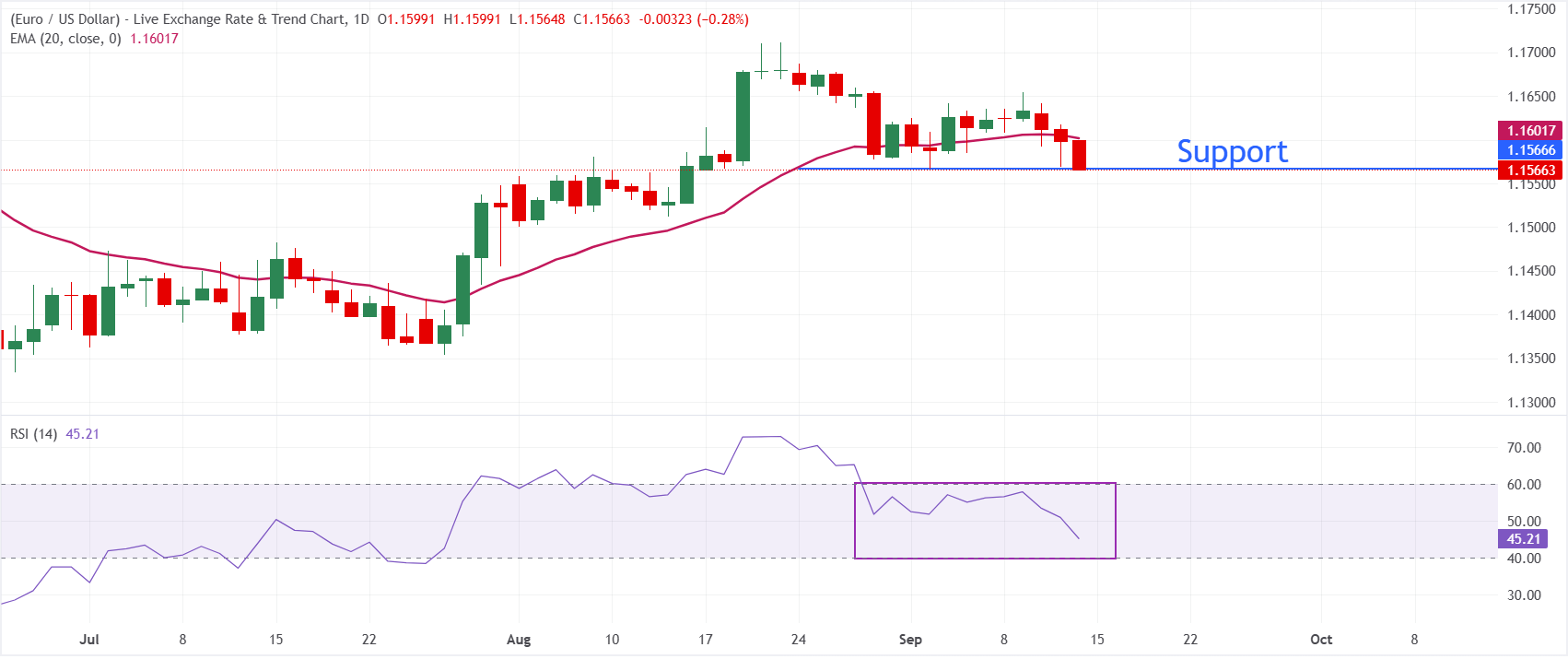
In the daily chart, EUR/USD trades at 1.1565, retaining a mildly bearish near-term bias as it holds beneath the 20-period exponential moving average (EMA) at 1.1602. The pair has slipped back under this short-term trend benchmark, suggesting topside attempts are increasingly capped, while the Relative Strength Index (RSI) at 45 leans toward a loss of bullish momentum rather than outright oversold conditions.
On the topside, initial resistance is defined by the 20-period EMA at 1.1602, and a daily close above this level would be needed to ease the current pressure and reopen the path toward higher highs. Looking down, the pair could be exposed to the psychologocal level of 1.1500 if it fails to hold the immediate support of 1.1560.
(The technical analysis of this story was written with the help of an AI tool. Know more.)
Fed FAQs
Monetary policy in the US is shaped by the Federal Reserve (Fed). The Fed has two mandates: to achieve price stability and foster full employment. Its primary tool to achieve these goals is by adjusting interest rates. When prices are rising too quickly and inflation is above the Fed’s 2% target, it raises interest rates, increasing borrowing costs throughout the economy. This results in a stronger US Dollar (USD) as it makes the US a more attractive place for international investors to park their money. When inflation falls below 2% or the Unemployment Rate is too high, the Fed may lower interest rates to encourage borrowing, which weighs on the Greenback.
The Federal Reserve (Fed) holds eight policy meetings a year, where the Federal Open Market Committee (FOMC) assesses economic conditions and makes monetary policy decisions. The FOMC is attended by twelve Fed officials – the seven members of the Board of Governors, the president of the Federal Reserve Bank of New York, and four of the remaining eleven regional Reserve Bank presidents, who serve one-year terms on a rotating basis.
In extreme situations, the Federal Reserve may resort to a policy named Quantitative Easing (QE). QE is the process by which the Fed substantially increases the flow of credit in a stuck financial system. It is a non-standard policy measure used during crises or when inflation is extremely low. It was the Fed’s weapon of choice during the Great Financial Crisis in 2008. It involves the Fed printing more Dollars and using them to buy high grade bonds from financial institutions. QE usually weakens the US Dollar.
Quantitative tightening (QT) is the reverse process of QE, whereby the Federal Reserve stops buying bonds from financial institutions and does not reinvest the principal from the bonds it holds maturing, to purchase new bonds. It is usually positive for the value of the US Dollar.













