

Trading
Explora una amplia gama de mercados con precios competitivos, liquidez profunda y herramientas de trading avanzadas.
Más información 
Plataforma
Opera sin interrupciones con la potente plataforma de TMGM, diseñada para ofrecer velocidad, precisión y una experiencia de trading superior.
Más información Plataforma de trading
Herramientas de trading
Academia
Aprende los fundamentos del trading con recursos ideales para principiantes, incluidas guías, seminarios web y análisis del mercado.
Más información Academia TMGM
Noticias y análisis
Obtén actualizaciones del mercado en tiempo real y análisis de expertos para adelantarte a las oportunidades de trading
Más información Noticias y análisis
Acerca de
Descubre qué distingue a TMGM: nuestra presencia global, solidez regulatoria y compromiso con la innovación en el trading.
Más información Por qué elegir TMGM
US S&P Global PMI expected to show moderating business activity in October
- US business activity is expected to slow slightly in October, while remaining firmly in expansion territory.
- Manufacturing and services surveys are forecast to ease, following strong readings in September.
- The US Dollar could find support if stronger-than-expected business activity reinforces expectations of further Fed rate hikes.
The United States (US) S&P Global preliminary Purchasing Managers Indices (PMIs) for October will be released on Friday, providing fresh insights into the health of the world's largest economy ahead of next week's Federal Reserve (Fed) monetary policy meeting.

The report includes the Manufacturing PMI, Services PMI and Composite PMI, which measure business activity across the private sector. Readings above 50 indicate expansion, while figures below that threshold signal contraction.
The October surveys come at a time when recent US economic data continue to highlight resilient economic activity, despite persistent inflationary pressures and elevated borrowing costs. Investors will closely monitor the figures for signs of slowing growth and renewed price pressures that could influence the Fed's monetary policy outlook and the US Dollar (USD).
What can we expect from the October S&P Global PMI report?
Market expectations point to a moderate slowdown in US private-sector activity in October, following particularly strong readings in September. The S&P Global Manufacturing PMI is expected to decline slightly to 55.6 from 55.9 in September, while the Services PMI is forecast to ease to 57.9 from 58.8. Meanwhile, the Composite PMI stood at 58.4 in September, highlighting robust growth across the US private sector.
Although both sectors are expected to lose some momentum, the anticipated figures remain comfortably above the 50 threshold, suggesting that the US economy continues to expand at a healthy pace.
The report will be particularly important given the latest signs of persistent inflationary pressures. Recent US economic releases show stronger-than-expected inflation, while Retail Sales and labor market indicators continue to suggest that domestic demand remains resilient.
Against this backdrop, the Fed is widely expected to leave interest rates unchanged at its October 28 meeting, following a 25-basis-point (bps) increase in September. However, investors are fully pricing in another rate hike in December, according to the CME FedWatch tool.
When will the October flash US S&P Global PMIs be released, and how could they affect EUR/USD?
The S&P Global Manufacturing, Services and Composite PMIs for October will be released on Friday at 13:45 GMT. The publication could trigger volatility in the US Dollar and the EUR/USD pair, particularly as investors position themselves ahead of the Fed's October 28 monetary policy decision.
A stronger-than-expected report could reinforce expectations of additional Fed rate hikes in the coming months. Such a scenario would likely support US Treasury yields and the US Dollar, potentially weighing on EUR/USD.
Conversely, a sharper-than-anticipated slowdown in business activity, particularly in the services sector, could raise concerns about the sustainability of US economic growth. Weaker PMI readings could encourage investors to reassess the likelihood of further monetary tightening, putting downward pressure on the Greenback and supporting EUR/USD.
However, the market reaction could remain relatively limited if the figures broadly match expectations, given that both manufacturing and services activity are forecast to remain firmly in expansion territory.
With another Fed rate hike already largely priced in for December, investors will closely assess whether Friday's PMI figures confirm the resilience of the US economy or point to a slowdown. A stronger-than-expected report could reinforce expectations of further monetary tightening, while disappointing readings could cast doubt on the strength of economic growth and weigh on the US Dollar.
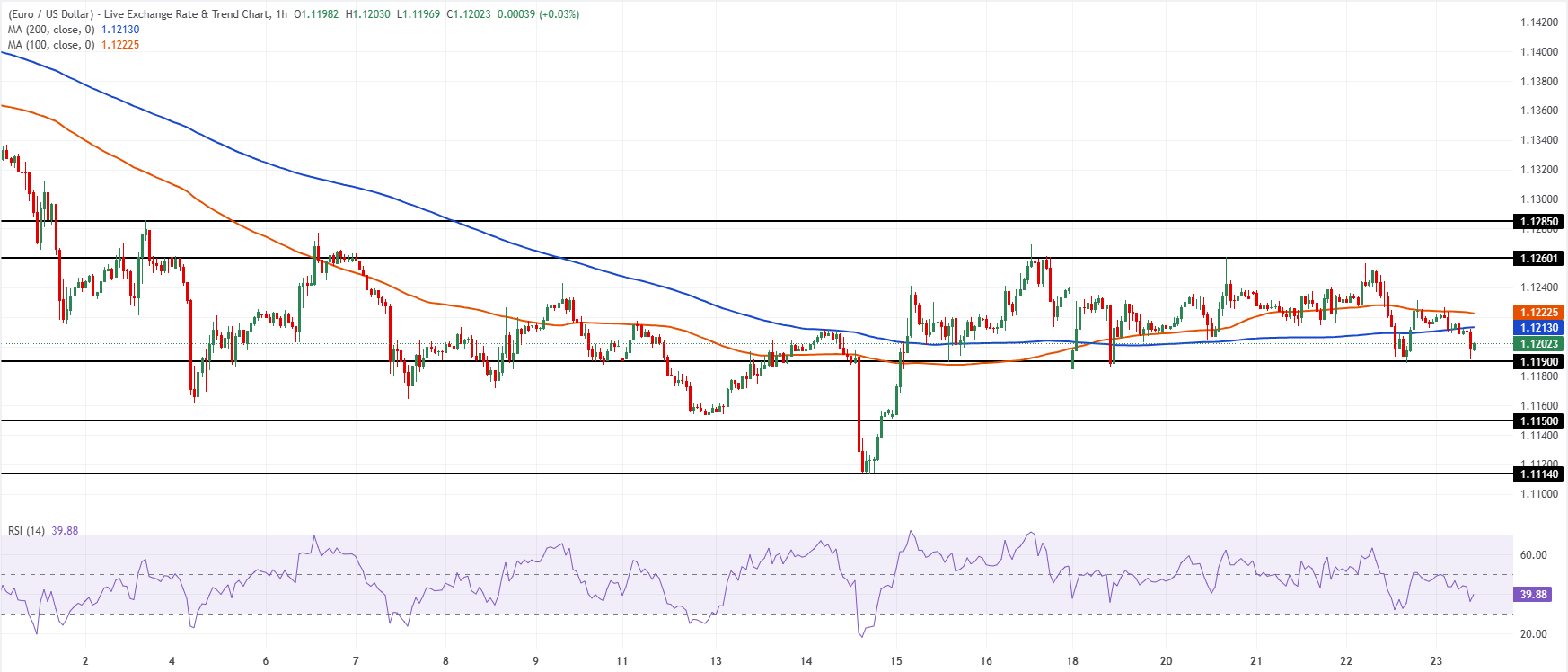
EUR/USD remains modestly bearish on the one-hour chart, holding below the 100-period Simple Moving Average (SMA) at 1.1223 and the 200-period SMA at 1.1213. The pair is drifting just above nearby price support, while the Relative Strength Index (14) around 40 hints at waning bullish momentum rather than outright oversold conditions, suggesting downside risks remain while these averages cap the topside.
On the downside, initial support emerges at the horizontal level near 1.1190, ahead of deeper floors at 1.1150 and 1.1114. On the topside, immediate resistance is seen at the 200-period SMA at 1.1213, followed by the 100-period SMA at 1.1223, with stronger hurdles at 1.1260 and 1.1285 that would need to be reclaimed to ease the current bearish bias.
(The technical analysis of this story was written with the help of an AI tool. Know more.)
Artículos destacados
1Yen japonés: el sólido dato del IPC respalda las subidas de tipos del BoJ, mientras se prevé que el USD se mantenga en su rango - BBH2Dólar canadiense: bajo presión cerca de 1,40 frente al dólar estadounidense – TD Securities3Precio de la plata hoy: la plata cae, según datos de FXStreet4Brent: se reanuda la tendencia alcista con un objetivo de 127 dólares – Societe Generale5El euro marca nuevos mínimos de 17 meses frente a la libra esterlina tras los PMI de la eurozona y el Reino Unido6Divisas de Europa Central y Oriental: la aversión al riesgo y las presiones energéticas limitan el avance de las monedas de la región – ING7Previsión del precio de Pi Network: PI mantiene ganancias moderadas mientras las señales técnicas mixtas limitan el potencial alcista8Yen japonés: se perfila para nuevas ganancias frente al dólar estadounidense - UOB9El PMI compuesto de S&P Global del Reino Unido sube a 53,1 en octubre, frente al 51,8 previsto


¡Comience ahora!
Regístrese y acceda a los mercados globales en menos de 3 minutos

Conéctese con nosotros












La información proporcionada en este sitio web es únicamente de carácter general y no constituye asesoramiento financiero personal. Antes de actuar sobre cualquier información de este sitio web, debe considerar la idoneidad de la información en relación con sus objetivos, situación financiera y necesidades. Invertir en CFD y contratos de margen de FX conlleva riesgos significativos y no es adecuado para todos los inversores. Puede perder más que su depósito inicial. Usted no posee ni tiene ningún interés en el activo subyacente. Le recomendamos que busque asesoramiento independiente y se asegure de comprender plenamente los riesgos involucrados antes de operar. Es importante que lea y considere el documento de divulgación antes de adquirir cualquier producto listado en el sitio web. La información y los anuncios ofrecidos en este sitio web no están destinados al uso por parte de ninguna persona en ningún país o jurisdicción donde dicho uso sea contrario a las leyes y regulaciones locales. Los productos y servicios ofrecidos en este sitio web no están destinados a residentes de Estados Unidos, Malasia y Tailandia.
TMGM está autorizado y regulado en varias jurisdicciones.
Trademax Australia Limited, que opera como TMGM, está regulada por la Comisión Australiana de Valores e Inversiones (ASIC), AFSL n.º 436416, y está ubicada en Level 28, One International Tower, 100 Barangaroo Avenue, 2000 Sydney, NSW Australia.
Correo electrónico: [email protected]
Trademax Global Limited, que opera como TMGM, está autorizada y regulada por la Comisión de Servicios Financieros de Vanuatu (VFSC), número de registro 40356, y está registrada en 1276, Kumul Highway, Port Vila, Vanuatu, República de Vanuatu.
Correo electrónico: [email protected]
Trademax Global Markets (SE) Limited, que opera como TMGM, está autorizada y regulada por la Autoridad de Servicios Financieros (FSA) de Seychelles, con número de licencia SD224. La empresa está registrada en Office No 13, Providence Estate ABIS Centre, Mahe, Seychelles.
Correo electrónico: [email protected]
Trademax Global Markets (International) Pty Ltd, que opera como TMGM, está autorizada y regulada por la Comisión de Servicios Financieros de Mauricio (FSC) con licencia n.º GB22201012, y está registrada en 33, Edith Cavell Street C/o IQ EQ Fund Services (Mauritius) Ltd Port Louis, 11324 Mauricio.
Correo electrónico: [email protected]
Copyright © TMGM. Todos los derechos reservados