
News & AnalysisCareer

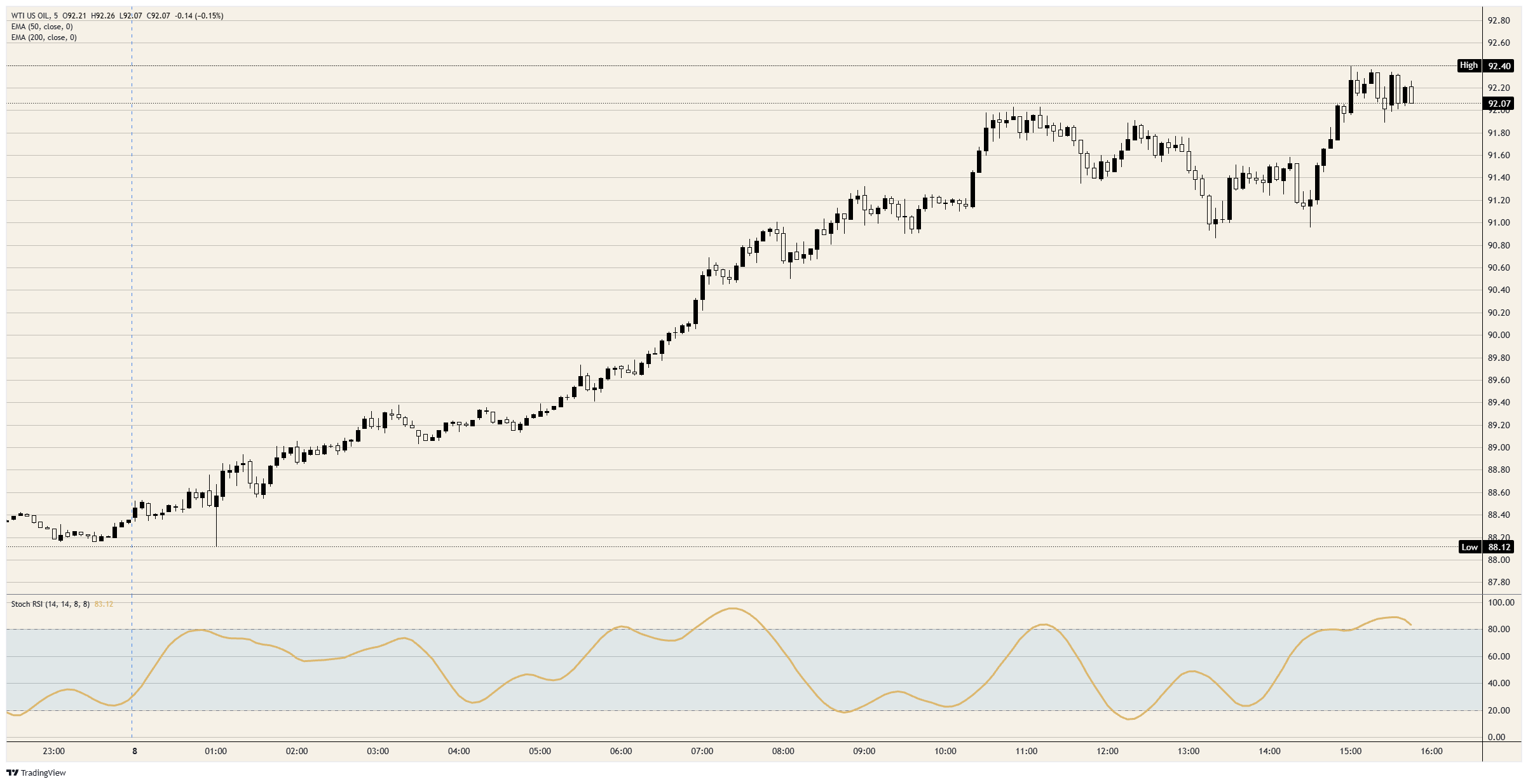
Gulf Crude Oil exports got back to their pre-war level in September by two routes, a tanker shuttle across the Strait of Hormuz and a detour around it, and both have come under attack since September. Crude Oil trades just above $92.00, on track for its biggest one-day rise since September 10.

The tanker tracker Kpler counted 10 tankers struck in the strait between September 28 and October 4, against a previous weekly high of six. Only seven tankers crossed on Tuesday, under half the seven-day average and the fewest since July 23.
On Wednesday a tanker was hit by several projectiles about 51 nautical miles off Qatar's north coast, according to UK Maritime Trade Operations (UKMTO). Iran's Revolutionary Guard navy said on Thursday it is ready to respond decisively to vessels it has not authorised to enter waters it says it controls.
In September 60% of Gulf exports still crossed the strait, most of it shuttled between tankers off Oman and the United Arab Emirates. Hiring a tanker from the Gulf to China cost a record $1.3 million a day on Monday, according to the Baltic Exchange, a cost now built into every barrel that makes the trip. A White House official told Axios on Wednesday that the US controls the Strait of Hormuz, the day after seven tankers made it across.
The other 40% loaded outside the strait, at Fujairah on the Gulf of Oman or at Yanbu on Saudi Arabia's Red Sea coast, against 17% before the war. Yanbu is fed by a pipeline across Saudi Arabia that was attacked on September 10, and loadings there resumed only in late September. France said in late September that it would send troops and air defences to protect the port.
Houthi drones and missiles hit the Riyadh and Abha airports on Tuesday and Wednesday, killing three people, and on Thursday the Houthis fired ballistic missiles at Riyadh again. They have told people to stay away from Saudi energy facilities, which they called targets. Since August, Yanbu's cargoes have turned north to Egypt instead of sailing south through Bab el-Mandeb, which keeps the tankers out of the strait the Houthis are fighting over and leaves the port where it was.
The Pentagon has told US Central Command to finish preparing to resume major combat against Iran, Axios reported on Wednesday, though no date is set and President Trump hasn't decided. US and Israeli officials told the outlet the strikes could come before the November 3 midterms and would likely hit Iranian energy sites. Iran's exports have been near zero since the US reimposed its blockade in July, so bombing those sites removes barrels that already aren't reaching the market.
The storm is Isaias, which formed in the Gulf of Mexico on Wednesday and is forecast to reach the US coast early Saturday. Shell is evacuating and shutting five platforms, including Mars and Olympus, and Chevron has started shutting four facilities.
Offshore Gulf fields pump about 15% of US Crude Oil, and the Gulf Coast refineries that buy much of it hold about half of US refining capacity, so a storm there shuts buyers as well as sellers. It is the only item on Thursday's list that takes barrels out of US supply.
The University of Michigan (UoM) publishes its first October reading of consumer sentiment at 14:00 GMT on Friday, forecast at 47.6 after 48.1 in September. Sentiment hit its record low of 44.8 in May, three months into the war, and a 47.6 would be the second-lowest reading in the survey's 74 years, behind only May of this year.
Regular gasoline averaged $4.36 a gallon on Thursday, according to the American Automobile Association (AAA), close to 40% more than a year earlier. Low inventories and damaged production and export facilities could keep Crude Oil expensive through 2027, Fed Governor Waller said in a speech on Thursday. If that holds, a falling sentiment number is where weaker demand for gasoline, and so for Crude Oil, would show up first.
Resistance: Thursday's rally stopped just short of $92.50, the area where the October 1 and October 2 rallies also ended. Above it are the September 29 high near $93.50 and the September 28 spike to $95.00.
Support: Both of Thursday's pullbacks stopped near $91.00. Below that, the 50-day Exponential Moving Average (EMA) just under $89.00 is where Thursday's climb started, after three straight closes around it.
Bias: Lean long while $91.00 holds, with $93.50 the first objective and $95.00 the second. The daily Stochastic Relative Strength Index (Stoch RSI) is near 12 and has just turned up from the bottom of its range. A daily close below $89.50, back among the Monday-to-Wednesday closes, ends the trade.
WTI Oil is a type of Crude Oil sold on international markets. The WTI stands for West Texas Intermediate, one of three major types including Brent and Dubai Crude. WTI is also referred to as “light” and “sweet” because of its relatively low gravity and sulfur content respectively. It is considered a high quality Oil that is easily refined. It is sourced in the United States and distributed via the Cushing hub, which is considered “The Pipeline Crossroads of the World”. It is a benchmark for the Oil market and WTI price is frequently quoted in the media.
Like all assets, supply and demand are the key drivers of WTI Oil price. As such, global growth can be a driver of increased demand and vice versa for weak global growth. Political instability, wars, and sanctions can disrupt supply and impact prices. The decisions of OPEC, a group of major Oil-producing countries, is another key driver of price. The value of the US Dollar influences the price of WTI Crude Oil, since Oil is predominantly traded in US Dollars, thus a weaker US Dollar can make Oil more affordable and vice versa.
The weekly Oil inventory reports published by the American Petroleum Institute (API) and the Energy Information Agency (EIA) impact the price of WTI Oil. Changes in inventories reflect fluctuating supply and demand. If the data shows a drop in inventories it can indicate increased demand, pushing up Oil price. Higher inventories can reflect increased supply, pushing down prices. API’s report is published every Tuesday and EIA’s the day after. Their results are usually similar, falling within 1% of each other 75% of the time. The EIA data is considered more reliable, since it is a government agency.
OPEC (Organization of the Petroleum Exporting Countries) is a group of 12 Oil-producing nations who collectively decide production quotas for member countries at twice-yearly meetings. Their decisions often impact WTI Oil prices. When OPEC decides to lower quotas, it can tighten supply, pushing up Oil prices. When OPEC increases production, it has the opposite effect. OPEC+ refers to an expanded group that includes ten extra non-OPEC members, the most notable of which is Russia.










The information provided on this website is of a general nature only and does not constitute personal financial advice. Before acting on any information on this website, you should consider the suitability of the information in relation to your objectives, financial situation and needs. Investing in CFDs and FX Margin Contracts carries significant risks and is not suitable for all investors. You may lose more than your initial deposit. You do not own, or have, any interest in the underlying asset. We recommend that you seek independent advice and ensure you fully understand the risks involved before trading. It is important that you read and consider the disclosure document before you acquire any product listed on the website. The information and advertisements offered on this website are not intended for use by any person in any country or jurisdiction where such use would be contrary to local laws and regulations. The Products and Services offered on this website are not intended for residents of the United States, Malaysia and Thailand.
TMGM is authorized and regulated in various jurisdictions.
Trademax Australia Limited, trading as TMGM, is regulated by the Australian Securities and Investments Commission (ASIC), AFSL no. 436416 and is located at Level 28, One International Tower, 100 Barangaroo Avenue, 2000 Sydney, NSW Australia.
Email: [email protected]
Trademax Global Limited, trading as TMGM, is authorized and regulated by the Vanuatu Financial Services Commission (VFSC), registration number 40356 and registered at 1276, Kumul Highway, Port Vila, Vanuatu, Republic of Vanuatu.
Email: [email protected]
Trademax Global Markets (SE) Limited, trading as TMGM, is authorized and regulated by the Financial Services Authority (FSA) of Seychelles, with license number SD224. The company is registered at Office No 13, Providence Estate ABIS Centre, Mahe, Seychelles.
Email: [email protected]
Trademax Global Markets (International) Pty Ltd, trading as TMGM, is authorized and regulated by the Financial Services Commission, Mauritius (FSC) with license no. GB22201012, and registered at 33, Edith Cavell Street C/o IQ EQ Fund Services (Mauritius) Ltd Port Louis, 11324 Mauritius.
Email: [email protected]
Copyright © TMGM. All rights reserved


