
News & AnalysisCareer

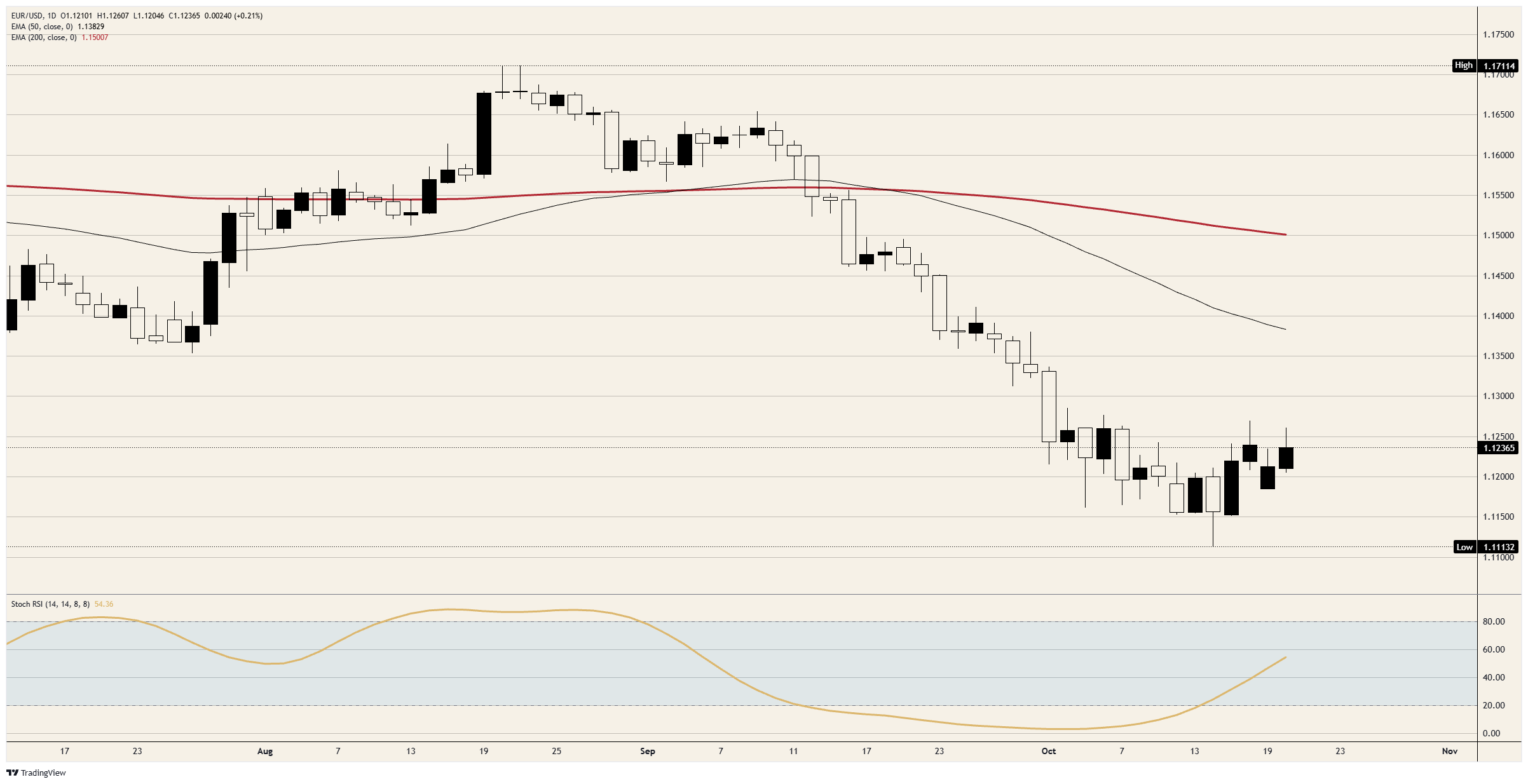
A substantial shortfall in the ZEW economic sentiment survey against forecasts left EUR/USD finishing Tuesday just below 1.1250, broadly matching Friday’s close. The pair advanced from around 1.1200 to a little above 1.1250, marking the fifth daily high above that level this month.

October’s ZEW reading dropped from 25.8 to 18.5, missing the forecast of 24.2. The softer euro area growth outlook weakens the case for further European Central Bank (ECB) rate increases. Against a Fed that is still raising rates, higher ECB rates remain a source of support for the euro.
For 29 October, expectations point to an unchanged ECB deposit rate of 2.50%. Danske Bank anticipates a further increase in December, taking the rate to a peak of 2.75%. Even then, it would remain almost a percentage point below September’s inflation rate of 3.7%.
Wednesday’s ECB speakers include chief economist Lane, Bundesbank President Nagel and Executive Board member Cipollone, ahead of President Lagarde’s address at 16:30 GMT. On Thursday, Bank of Italy Governor Panetta is scheduled to speak at 12:15 GMT. Friday brings Hamburg Commercial Bank’s October Purchasing Managers Index (PMI) readings at 08:00 GMT, with forecasts of 52.8 for both manufacturing and services.
US jobless claims, due on Thursday at 12:30 GMT, are expected to reach 200K, compared with the previous 199K. On Friday, S&P Global releases its US PMIs at 13:45 GMT. That is less than six hours after the euro area figures, putting PMI releases from both sides of EUR/USD on the same day.
Since 2 October, EUR/USD has held within a band running from a little above 1.1100 to just below 1.1300, reaching its low on 14 October. Above this range sit the 50-day Exponential Moving Average (EMA), just below 1.1400, and the 200-day EMA, around 1.1500. The pair has remained beneath both averages since mid-September.
Used by the 20 European Union countries that make up the eurozone, the euro is the world’s second most actively traded currency after the US dollar. Its share of all foreign exchange transactions stood at 31% in 2022, with average daily turnover exceeding $2.2 trillion. An estimated 30% of all transactions involve EUR/USD, making it the most actively traded currency pair worldwide. Next come EUR/JPY (4%), EUR/GBP (3%) and EUR/AUD (2%).
Based in Frankfurt, Germany, the European Central Bank (ECB) serves as the eurozone’s reserve bank, determining interest rates and overseeing monetary policy. Maintaining price stability is its central mandate, whether through curbing inflation or encouraging growth. To achieve this, the ECB chiefly adjusts interest rates upwards or downwards. The euro generally benefits from relatively high rates, or expectations of higher rates; the reverse also applies. Monetary policy is decided by the ECB Governing Council at eight meetings each year. The decision-makers comprise the heads of the eurozone’s national banks and six permanent members, among them ECB President Christine Lagarde.
Measured using the Harmonized Index of Consumer Prices (HICP), eurozone inflation is a key economic indicator for the euro. An increase in inflation beyond expectations, particularly above the ECB’s 2% target, requires the central bank to lift interest rates to bring price pressures back under control. When the region’s interest rates are relatively high compared with those elsewhere, the euro typically benefits: global investors find it a more attractive destination for their money.
By providing a measure of economic health, data releases can affect the euro’s performance. GDP, manufacturing and services PMIs, employment figures and consumer sentiment surveys are among the indicators that can steer the single currency. Economic strength supports the euro by drawing in more foreign investment. It may also prompt the ECB to raise interest rates, directly strengthening the currency. Weak economic readings, by contrast, are likely to weigh on the euro. Particular importance attaches to figures from Germany, France, Italy and Spain. As the euro area’s four largest economies, they represent 75% of the eurozone economy.
The trade balance is another important release for the euro, showing the difference over a given period between a country’s export earnings and its spending on imports. Strong overseas demand for a country’s exports creates additional demand for its currency as foreign buyers seek to purchase those goods, lifting its value. A positive net trade balance therefore strengthens a currency, while a negative balance has the opposite effect.










The information provided on this website is of a general nature only and does not constitute personal financial advice. Before acting on any information on this website, you should consider the suitability of the information in relation to your objectives, financial situation and needs. Investing in CFDs and FX Margin Contracts carries significant risks and is not suitable for all investors. You may lose more than your initial deposit. You do not own, or have, any interest in the underlying asset. We recommend that you seek independent advice and ensure you fully understand the risks involved before trading. It is important that you read and consider the disclosure document before you acquire any product listed on the website. The information and advertisements offered on this website are not intended for use by any person in any country or jurisdiction where such use would be contrary to local laws and regulations. The Products and Services offered on this website are not intended for residents of the United States, Malaysia and Thailand.
TMGM is authorized and regulated in various jurisdictions.
Trademax Australia Limited, trading as TMGM, is regulated by the Australian Securities and Investments Commission (ASIC), AFSL no. 436416 and is located at Level 28, One International Tower, 100 Barangaroo Avenue, 2000 Sydney, NSW Australia.
Email: [email protected]
Trademax Global Limited, trading as TMGM, is authorized and regulated by the Vanuatu Financial Services Commission (VFSC), registration number 40356 and registered at 1276, Kumul Highway, Port Vila, Vanuatu, Republic of Vanuatu.
Email: [email protected]
Trademax Global Markets (SE) Limited, trading as TMGM, is authorized and regulated by the Financial Services Authority (FSA) of Seychelles, with license number SD224. The company is registered at Office No 13, Providence Estate ABIS Centre, Mahe, Seychelles.
Email: [email protected]
Trademax Global Markets (International) Pty Ltd, trading as TMGM, is authorized and regulated by the Financial Services Commission, Mauritius (FSC) with license no. GB22201012, and registered at 33, Edith Cavell Street C/o IQ EQ Fund Services (Mauritius) Ltd Port Louis, 11324 Mauritius.
Email: [email protected]
Copyright © TMGM. All rights reserved

