
News & AnalysisCareer

The $4,000 level remains in focus for Gold (XAU/USD) on Tuesday, with prices fluctuating nearby following modest gains at the beginning of the week. Having recently weakened, the US Dollar (USD) is extending its recovery as traders adjust positions before Wednesday’s Federal Reserve (Fed) monetary policy announcement, leaving the metal struggling for traction. XAU/USD stands at around $4,012 at the time of writing, above the three-month low of $3,975 recorded last week.
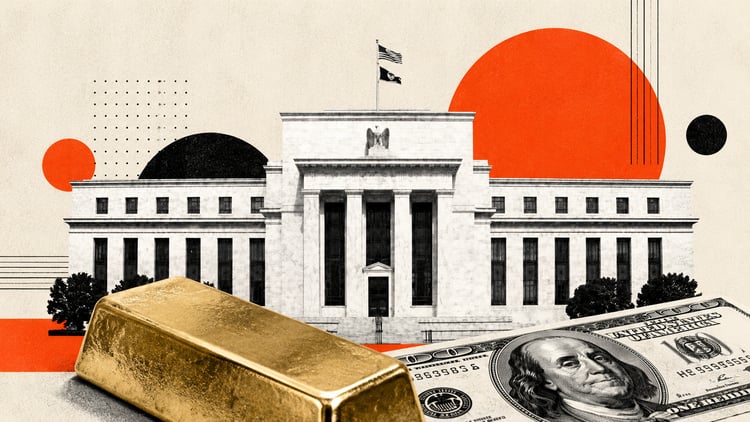
Having reached 101.45 last week, its weakest reading since 1 October, the US Dollar Index (DXY) has climbed above 102.00 to a two-week high. The index measures the Greenback against a basket of six major currencies. Dollar strength raises the cost of Gold for buyers paying in other currencies.
According to ING strategists, the Dollar has “found good support early this week,” with steadier AI-related sentiment enabling markets to “reconnect with the broader supportive backdrop of a hawkish Federal Reserve and high energy prices.” They also suggest that “pre-FOMC positioning may also be kicking in,” as the forward-looking FX market interprets Chair Kevin Warsh’s “reiteration of inflation commitments as reinforcing the structural floor for the Dollar.” Consistent with their earlier preview, ING’s strategists say they “sympathise with this view and expect a broadly supported Dollar this week.”
Following September’s 25 basis points (bps) increase to 3.75%-4.00%, the US central bank is expected to leave rates on hold. That rise was its first since 2023 and came as higher energy costs associated with the war in the Middle East intensified inflationary pressures.
With markets widely anticipating a pause, attention will turn to the policy statement and Chair Kevin Warsh’s press conference for indications of the next step. In September’s revised dot plot, the median rate forecast stood at 4.1% for both end-2026 and end-2027. This pointed to another quarter-point increase this year, followed by no net change next year. In this context, the CME FedWatch Tool shows traders assigning around an 80% probability to a further rate rise in December.
Should the Fed deliver a hawkish message, Gold could face a sustained break below $4,000. By contrast, an emphasis on allowing time to evaluate incoming data could provide some respite. A more substantial recovery may nevertheless prove difficult, with inflation still exceeding the Fed’s 2% target and high energy costs threatening to prolong price pressures. Although Gold is commonly regarded as an inflation hedge, rising interest rates increase the opportunity cost of owning the non-yielding metal.
At around $101.50 per barrel, West Texas Intermediate (WTI) Crude Oil reflects traders’ assessment of diplomatic initiatives alongside supply risks. Talks took place in Tehran on Monday between Iranian officials and Saudi Arabia, Turkey and Pakistan, with all four countries agreeing to pursue further discussions. Nonetheless, threats to shipping security in the Strait of Hormuz, together with Houthi attacks on Saudi Arabia, continue to fuel concerns over supply.
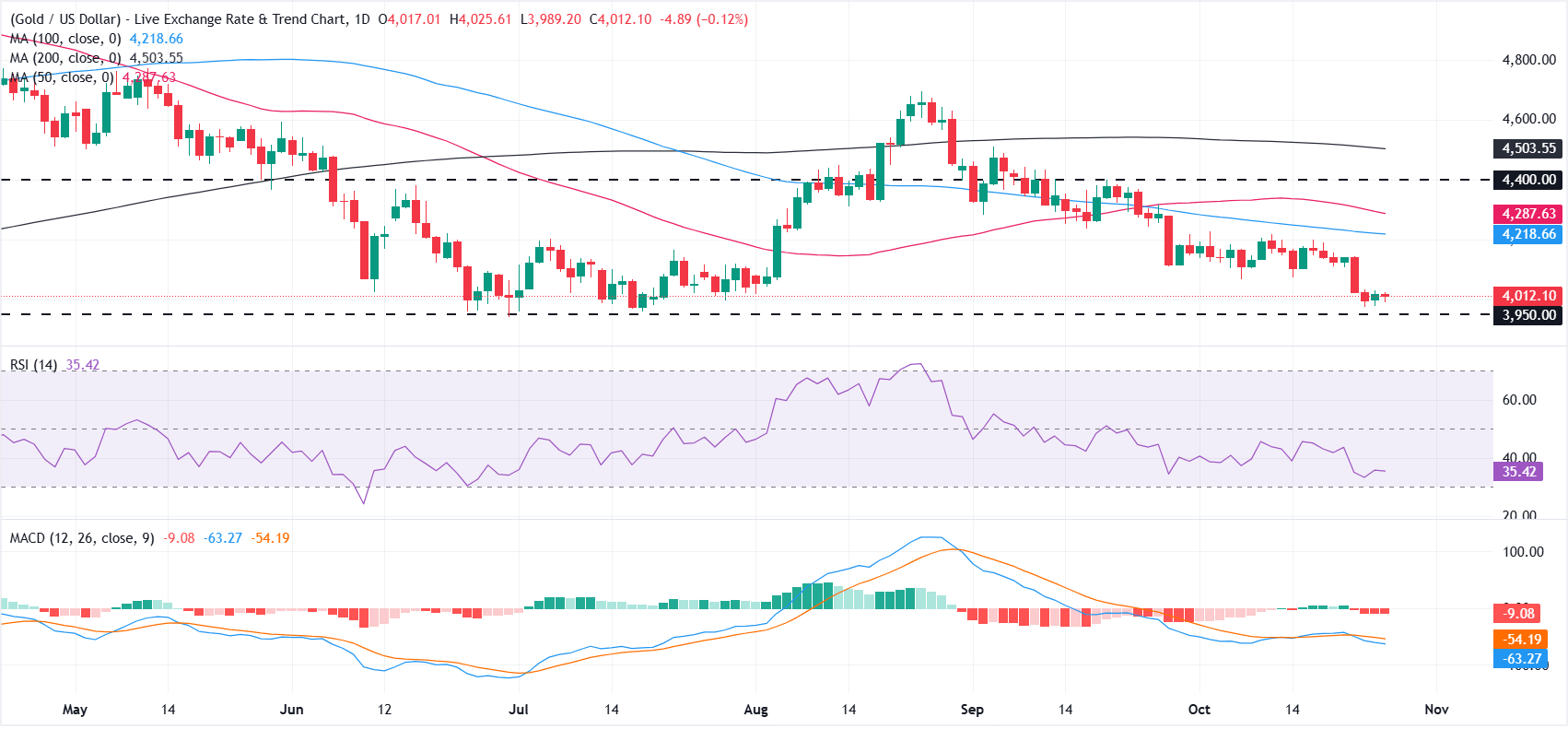
Trading beneath its 50-day, 100-day and 200-day Simple Moving Averages (SMAs), XAU/USD retains a bearish short-term bias on the daily chart, leaving sellers in control. Buying momentum remains weak, as indicated by a Relative Strength Index (RSI) reading of 35. Meanwhile, the Moving Average Convergence Divergence (MACD) stays below zero, signalling continued downward pressure.
Any advance would first encounter resistance around $4,219 at the 100-day SMA, with the 50-day SMA at $4,288 the next barrier. A more pronounced recovery could put horizontal resistance at $4,400 in view before the 200-day SMA near $4,504.
Immediate support lies in the $4,000-$3,950 area; a break below it would clear the way for a deeper retracement. Recovery efforts, meanwhile, are likely to face difficulty while prices remain below the cluster of daily moving averages.
(The technical analysis of this story was written with the help of an AI tool. Know more.)
Responsibility for US monetary policy rests with the Federal Reserve (Fed), whose dual mandate is to maintain price stability and promote full employment. Interest-rate adjustments are its main means of pursuing these objectives. If prices increase too rapidly and inflation exceeds its 2% target, the Fed raises interest rates, pushing up borrowing costs across the economy. The US Dollar (USD) strengthens as a result, because higher rates make the US a more appealing destination for international investors’ funds. Conversely, inflation below 2% or an excessively high Unemployment Rate may prompt the Fed to cut interest rates to stimulate borrowing, putting pressure on the Greenback.
At the Federal Reserve’s (Fed) eight annual policy meetings, the Federal Open Market Committee (FOMC) reviews the state of the economy and determines monetary policy. Twelve Fed officials take part in the FOMC: all seven members of the Board of Governors, the president of the Federal Reserve Bank of New York and four of the other eleven regional Reserve Bank presidents. These four serve rotating one-year terms.
When conditions become extreme, the Federal Reserve may turn to Quantitative Easing (QE), a policy that substantially expands the supply of credit through a financial system that has become blocked. As an unconventional policy tool, QE is deployed during crises or periods of exceptionally low inflation. The Fed favoured this approach during the Great Financial Crisis in 2008. Under QE, it prints additional Dollars to purchase high-grade bonds from financial institutions, typically weakening the US Dollar.
Reversing QE, Quantitative tightening (QT) involves the Federal Reserve ceasing bond purchases from financial institutions. It also refrains from reinvesting the principal repaid on maturing bonds in its portfolio into new bonds. This process is generally supportive of the US Dollar’s value.










The information provided on this website is of a general nature only and does not constitute personal financial advice. Before acting on any information on this website, you should consider the suitability of the information in relation to your objectives, financial situation and needs. Investing in CFDs and FX Margin Contracts carries significant risks and is not suitable for all investors. You may lose more than your initial deposit. You do not own, or have, any interest in the underlying asset. We recommend that you seek independent advice and ensure you fully understand the risks involved before trading. It is important that you read and consider the disclosure document before you acquire any product listed on the website. The information and advertisements offered on this website are not intended for use by any person in any country or jurisdiction where such use would be contrary to local laws and regulations. The Products and Services offered on this website are not intended for residents of the United States, Malaysia and Thailand.
TMGM is authorized and regulated in various jurisdictions.
Trademax Australia Limited, trading as TMGM, is regulated by the Australian Securities and Investments Commission (ASIC), AFSL no. 436416 and is located at Level 28, One International Tower, 100 Barangaroo Avenue, 2000 Sydney, NSW Australia.
Email: [email protected]
Trademax Global Limited, trading as TMGM, is authorized and regulated by the Vanuatu Financial Services Commission (VFSC), registration number 40356 and registered at 1276, Kumul Highway, Port Vila, Vanuatu, Republic of Vanuatu.
Email: [email protected]
Trademax Global Markets (SE) Limited, trading as TMGM, is authorized and regulated by the Financial Services Authority (FSA) of Seychelles, with license number SD224. The company is registered at Office No 13, Providence Estate ABIS Centre, Mahe, Seychelles.
Email: [email protected]
Trademax Global Markets (International) Pty Ltd, trading as TMGM, is authorized and regulated by the Financial Services Commission, Mauritius (FSC) with license no. GB22201012, and registered at 33, Edith Cavell Street C/o IQ EQ Fund Services (Mauritius) Ltd Port Louis, 11324 Mauritius.
Email: [email protected]
Copyright © TMGM. All rights reserved

