

Trading
Explore a wide range of markets with competitive pricing, deep liquidity, and advanced trading tools.
Learn More 
Platform
Trade seamlessly with TMGM's powerful platform, built for speed, precision, and a superior trading experience.
Learn More Trading Platform
Academy
Learn the fundamentals of trading with beginner-friendly resources, including guides, webinars, and market insights.
Learn More News & Analysis
Get real-time market updates and expert analysis to stay ahead of trading opportunities
Learn More News & Analysis
About
Learn what sets TMGM apart — our global presence, regulatory strength, and commitment to innovation in trading.
Learn More Why Choose TMGM
Sponsorship
DOGE Price Forecast: Can Dogecoin overcome resistance as Dogecoin Labs launches?
- MyDoge, DogeOS and Such App have come together under CEO Jordan Jefferson at Dogecoin Labs, launched in partnership with the Dogecoin Foundation.
- Broader use of DOGE in payments, commerce, DeFi, gaming, AI and consumer applications is central to Dogecoin Labs’ plans.
- A tightly clustered set of EMAs presents resistance for DOGE.
Expanding the use of memecoin (DOGE) in payments, decentralised finance (DeFi) and consumer applications is the aim of Dogecoin (DOGE) Labs, which launched on Wednesday in partnership with the Dogecoin Foundation. The initiative brings several product teams and technologies together.
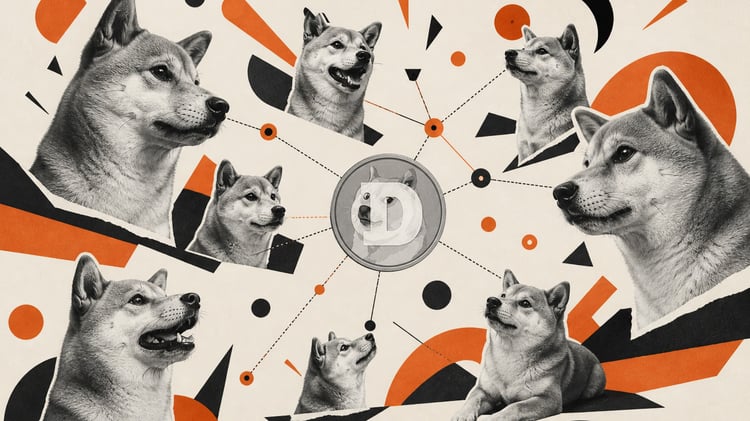
How Will Dogecoin Labs Bring Existing DOGE Ecosystem Products Together?
Following the launch, MyDoge, DogeOS and Such App will operate within a single business headed by Jordan Jefferson, the founder of MyDoge and DogeOS. Through the initiative, Dogecoin's community is intended to gain access to a wider range of applications, services and commercial opportunities.
To develop an economy around DOGE, Dogecoin Labs said it would bring together consumer distribution, application infrastructure and development expertise. Intellectual property and development teams will be transferred to the organisation from the Dogecoin Foundation and House of Doge.
Jefferson said: “No other digital asset has Dogecoin's combination of liquidity, community and cultural reach, and its potential has barely been tapped,”
Bringing Dogecoin's developers together is another objective, he added, with applications built using DogeOS and distributed via MyDoge helping them reach users.
Wallets, payments, commerce, trading, DeFi, gaming, artificial intelligence, social applications and developer infrastructure are also among the areas in which Dogecoin Labs plans to develop products. Bringing these products to market will be the company's focus; the Dogecoin Foundation will continue to support open-source development, advocacy and community stewardship.
According to the announcement, the self-custodial Dogecoin wallet MyDoge has attracted more than 500,000 users without paid acquisition. Applications under development on DogeOS are linked to the wallet's consumer platform through its recently released V3 version.
With its public testnet launch on 30 September, DogeOS made an EVM-compatible environment available for developers to build and test applications for Dogecoin users. Payments, trading, DeFi, gaming and digital assets are among the development areas supported by the testnet.
Commercial payments form part of the new organisation's offering through Such App. In its beta version, businesses can accept DOGE for goods and services using invoices and in-person QR-code payments.
Dogecoin technical outlook: Can DOGE clear EMA and descending trendline resistance?
Despite extending its gains with a fourth successive green candle on the daily chart, DOGE faces a cluster of resistance just above its price. The 20-day, 50-day and 100-day Exponential Moving Averages (EMAs) make up that barrier.
Further constraints on the dog-themed memecoin come from a descending trendline running from 22 September and resistance at $0.088. Clearing that resistance will put the $0.091 hurdle to the test.
Should DOGE decline, the horizontal levels of $0.080 and $0.077 could provide support.
Bearish dominance appears to be weakening, as indicated by the 14-day Relative Strength Index (RSI) at 44 and the Stochastic Oscillator (Stoch) at 50.
POPULAR ARTICLES
1GBP/JPY Price Forecast: Can bulls withstand the Doji challenge below 212.00?2How will the Euro respond to PMIs first and France’s credit rating over the weekend?3Why is the Australian Dollar shrugging off Iran war jitters as RBA hike bets double?4British Pound heads towards retail sales release with November rate hike already factored in5Below the 3.8% forecast: New Zealand’s Q3 CPI inflation slows to 3.7% YoY6Indonesian Rupiah: Bias towards depreciation amid MSCI risk – MUFG7South Korean Won: Are risks of losses towards 1400 against US Dollar mounting? – TD Securities8DOGE Price Forecast: Can Dogecoin overcome resistance as Dogecoin Labs launches?9New Zealand Dollar heads into inflation report with winning streak intact
LIVE QUOTES


ALL ABOUT TECHNICAL
What Is a Judas Swing? ICT Trading Strategy Explained With Examples
The Real Interest Rate: Are Your Savings Actually Earning Anything?
Butterfly Pattern Trading: How to Identify and Trade the Butterfly Harmonic Pattern
What Is a Rising Wedge Pattern and How Do You Trade It?
What Is a Descending Triangle Pattern and How Do You Trade It?
Accumulation, Manipulation and Distribution (AMD): ICT Power of 3 Trading Guide
How to Read the CPI Report Before You Trade It: A Trader's Guide to Headline and Core
Slippage, Spread and Gaps: Why Your Fill Differs From the Price You Saw
Backtesting in Trading: What It Is and How to Backtest a Strategy
Get Started!
Sign up and access the Global Markets in less than 3 minutes

Connect With Us












The information provided on this website is of a general nature only and does not constitute personal financial advice. Before acting on any information on this website, you should consider the suitability of the information in relation to your objectives, financial situation and needs. Investing in CFDs and FX Margin Contracts carries significant risks and is not suitable for all investors. You may lose more than your initial deposit. You do not own, or have, any interest in the underlying asset. We recommend that you seek independent advice and ensure you fully understand the risks involved before trading. It is important that you read and consider the disclosure document before you acquire any product listed on the website. The information and advertisements offered on this website are not intended for use by any person in any country or jurisdiction where such use would be contrary to local laws and regulations. The Products and Services offered on this website are not intended for residents of the United States, Malaysia and Thailand.
TMGM is authorized and regulated in various jurisdictions.
Trademax Australia Limited, trading as TMGM, is regulated by the Australian Securities and Investments Commission (ASIC), AFSL no. 436416 and is located at Level 28, One International Tower, 100 Barangaroo Avenue, 2000 Sydney, NSW Australia.
Email: [email protected]
Trademax Global Limited, trading as TMGM, is authorized and regulated by the Vanuatu Financial Services Commission (VFSC), registration number 40356 and registered at 1276, Kumul Highway, Port Vila, Vanuatu, Republic of Vanuatu.
Email: [email protected]
Trademax Global Markets (SE) Limited, trading as TMGM, is authorized and regulated by the Financial Services Authority (FSA) of Seychelles, with license number SD224. The company is registered at Office No 13, Providence Estate ABIS Centre, Mahe, Seychelles.
Email: [email protected]
Trademax Global Markets (International) Pty Ltd, trading as TMGM, is authorized and regulated by the Financial Services Commission, Mauritius (FSC) with license no. GB22201012, and registered at 33, Edith Cavell Street C/o IQ EQ Fund Services (Mauritius) Ltd Port Louis, 11324 Mauritius.
Email: [email protected]
Copyright © TMGM. All rights reserved