

Trading
Explore a wide range of markets with competitive pricing, deep liquidity, and advanced trading tools.
Learn More 
Platform
Trade seamlessly with TMGM's powerful platform, built for speed, precision, and a superior trading experience.
Learn More Trading Platform
Academy
Learn the fundamentals of trading with beginner-friendly resources, including guides, webinars, and market insights.
Learn More News & Analysis
Get real-time market updates and expert analysis to stay ahead of trading opportunities
Learn More News & Analysis
About
Learn what sets TMGM apart — our global presence, regulatory strength, and commitment to innovation in trading.
Learn More Why Choose TMGM
Sponsorship
XRP holds support at $1.30 as Ripple teams up with Arf to bring RLUSD settlement liquidity to XRPL
- A near-term rebound is in focus for XRP as buyers held the $1.30 support level after Thursday’s steep fall.
- Through a partnership, Ripple and Arf will introduce RLUSD-powered settlement liquidity on the XRP Ledger.
- The 50-day, 100-day and 200-day EMAs continue to restrict XRP’s upside, constraining the scope for a recovery.
A short-term rebound towards $1.40 remains in focus for XRP bulls on Friday, with Ripple (XRP) holding close to newly confirmed support at $1.30. However, structural resistance continues to limit the remittance token’s upside, leaving any recovery dependent on buyers’ ability to maintain momentum. Should the daily close fall below $1.30, it could confirm the bearish outlook and increase the likelihood of a prolonged decline towards the psychological demand area at $1.12.

How will Ripple and Arf deliver RLUSD-powered settlement liquidity?
Licensed cross-border merchants on the XRP Ledger (XRPL) are set to gain access to stablecoin settlement liquidity under a strategic partnership announced by Ripple and Arf on Thursday. In its press release, Arf said PayFi could address the liquidity challenges faced by cross-border payment companies. This financial infrastructure is built around treasury, foreign exchange, custody, investment products and real-time settlements. Using fiat as well as stablecoins, PayFi covers settlement liquidity, working capital financing and treasury management.
By combining Arf’s regulated infrastructure with the XRPL blockchain, the partnership provides cross-border payment companies with short-term working capital that is both deployed and repaid on-chain.
In the press release, Ali Erhat Nalbant, Co-founder and CEO at Arf, said: “Through this partnership with Ripple, we’re bringing stablecoin working capital to the XRP Ledger to help payment companies bridge that gap and support more payment volume,”
As cross-border transactions clear, repayment of Arf’s short-term settlement liquidity generally takes place within one to five days. This allows capital to be efficiently redeployed into continuing real-world payment flows.
Technical analysis: Can XRP maintain key support?
Trading at $1.32 below the key Exponential Moving Averages, XRP retains a bearish near-term bias. Overhead resistance comes from the 100-day EMA at $1.34, the 50-day EMA at $1.37 and the 200-day EMA at $1.38. Together, these levels indicate that recent rebounds remain constrained within a wider corrective phase.
Buying interest appears muted, with the Relative Strength Index (RSI) hovering near 42, while the SuperTrend indicator at $1.47 strengthens the dominant resistance band above the current price. Momentum also remains weak: the Moving Average Convergence Divergence (MACD) indicator is marginally negative, with readings below zero.
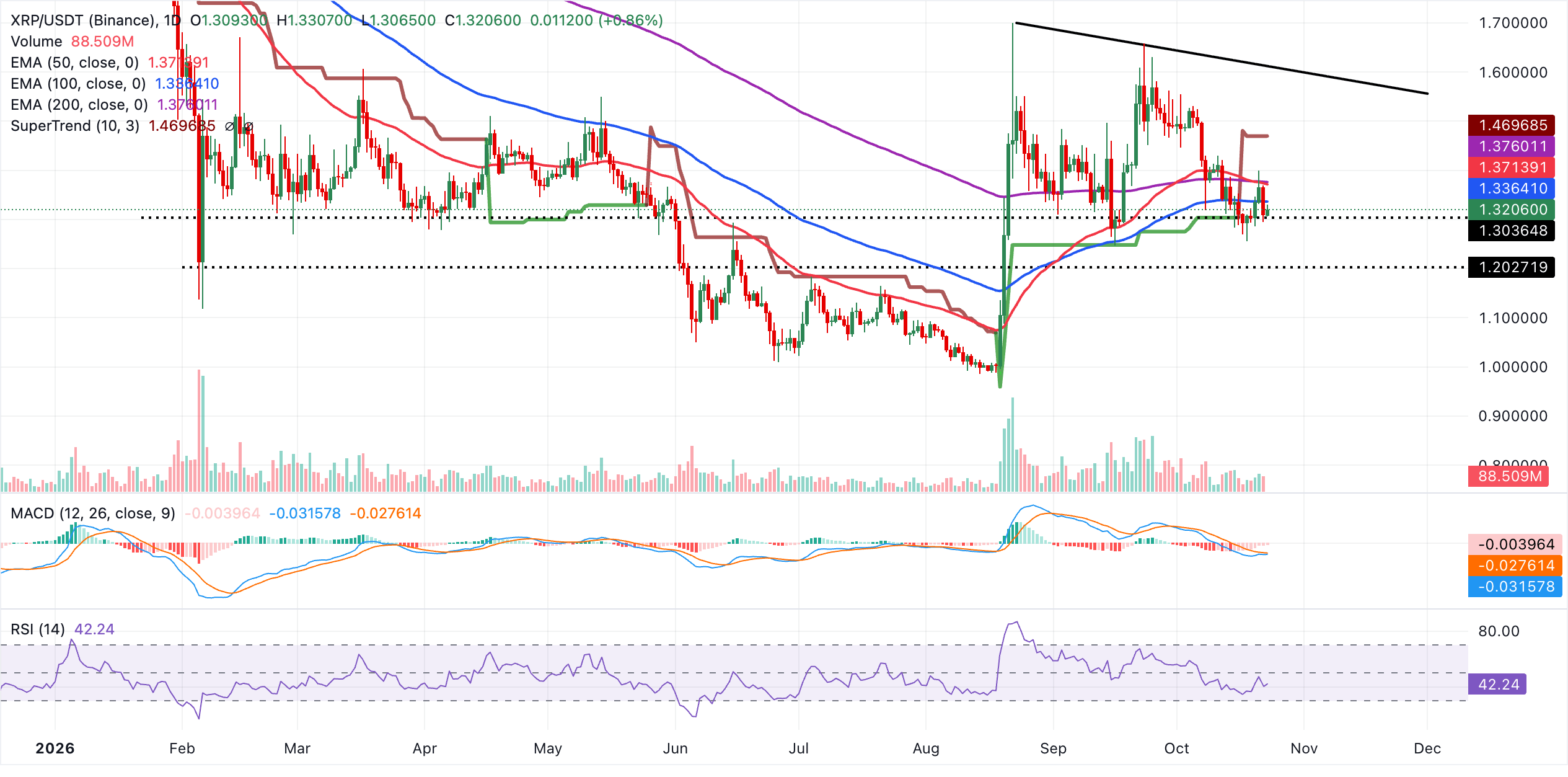
The first upside hurdle is the 100-day EMA around $1.34. Beyond it, resistance is clustered at the 50-day EMA of $1.37 and the 200-day EMA of $1.38, where sellers could try to regain control during a rebound. Further up, the SuperTrend line stands at $1.47, ahead of a more distant structural hurdle marked by the descending resistance trend line. Notable reference points on that line are its break price near $1.61 and its origin zone around $1.70.
With no clearly defined moving-average or trend-line support on the daily chart, the recent low around $1.30 serves as a soft floor. A decisive move below $1.32 would therefore leave XRP vulnerable to an extended decline before a stronger demand zone comes into view.
(The technical analysis of this story was written with the help of an AI tool. Know more.)
Ripple: Frequently asked questions
Specialising in cross-border remittances, Ripple is a payments company that uses blockchain technology to facilitate transfers. Ripple Labs Inc. created RippleNet, a payment transfer network available to financial institutions across the world. The company also uses the XRP token.
As the native token of the decentralised XRPLedger blockchain, XRP is used by Ripple Labs to facilitate transactions on the network. It enables financial institutions to transfer value across borders. By supporting trustless, instant payments on the XRPLedger chain, XRP helps financial firms reduce the cost of worldwide transactions.
Built on distributed ledger technology and blockchain, XRPLedger uses XRP to power transactions. A built-in inflammatory protocol distinguishes the ledger from other blockchains and helps counter spam and distributed denial-of-service (DDOS) attacks. Maintenance of XRPL is handled by a peer-to-peer network called the global XRP Ledger community.
The interledger standard used by XRP is a blockchain protocol that facilitates payments between different networks. XRP’s blockchain can, for example, link the ledgers of two or more banks, effectively eliminating intermediaries and the need for centralisation within the system. Engineered by Jed McCaleb, Arthur Britto and David Schwartz, the XRPLedger blockchain uses XRP as its native token.
POPULAR ARTICLES
1Indian Rupee: Downside Risk Against US Dollar Calls for Caution – OCBC2Will US S&P Global PMI point to the expected slowdown in October business activity?3Mexican Peso: Banxico’s lag behind Fed keeps currency under pressure – ING4US Dollar: Holding Firm Ahead of FOMC Amid Election Risks – TD Securities5Silver Price Forecast: Is $50 in sight as bearish pressure intensifies?6Euro: Will Fed and ECB convergence support gradual gains? – Commerzbank7XRP holds support at $1.30 as Ripple teams up with Arf to bring RLUSD settlement liquidity to XRPL8Gold: A cautious view of near-term prospects – OCBC9Why did safe-haven demand weaken the US Dollar against the Japanese Yen despite its yield advantage?
LIVE QUOTES


ALL ABOUT TECHNICAL
What Does Smart Money Concept (SMC) Mean, and How Can You Trade It?
What Is an Order Block in Trading and How Can You Trade It?
Average True Range (ATR) Indicator: What Is the Formula, and How Do You Read and Use It?
What Is a Judas Swing? ICT Trading Strategy Explained With Examples
The Real Interest Rate: Are Your Savings Actually Earning Anything?
Butterfly Pattern Trading: How to Identify and Trade the Butterfly Harmonic Pattern
What Is a Rising Wedge Pattern and How Do You Trade It?
What Is a Descending Triangle Pattern and How Do You Trade It?
Accumulation, Manipulation and Distribution (AMD): ICT Power of 3 Trading Guide
Get Started!
Sign up and access the Global Markets in less than 3 minutes

Connect With Us












The information provided on this website is of a general nature only and does not constitute personal financial advice. Before acting on any information on this website, you should consider the suitability of the information in relation to your objectives, financial situation and needs. Investing in CFDs and FX Margin Contracts carries significant risks and is not suitable for all investors. You may lose more than your initial deposit. You do not own, or have, any interest in the underlying asset. We recommend that you seek independent advice and ensure you fully understand the risks involved before trading. It is important that you read and consider the disclosure document before you acquire any product listed on the website. The information and advertisements offered on this website are not intended for use by any person in any country or jurisdiction where such use would be contrary to local laws and regulations. The Products and Services offered on this website are not intended for residents of the United States, Malaysia and Thailand.
TMGM is authorized and regulated in various jurisdictions.
Trademax Australia Limited, trading as TMGM, is regulated by the Australian Securities and Investments Commission (ASIC), AFSL no. 436416 and is located at Level 28, One International Tower, 100 Barangaroo Avenue, 2000 Sydney, NSW Australia.
Email: [email protected]
Trademax Global Limited, trading as TMGM, is authorized and regulated by the Vanuatu Financial Services Commission (VFSC), registration number 40356 and registered at 1276, Kumul Highway, Port Vila, Vanuatu, Republic of Vanuatu.
Email: [email protected]
Trademax Global Markets (SE) Limited, trading as TMGM, is authorized and regulated by the Financial Services Authority (FSA) of Seychelles, with license number SD224. The company is registered at Office No 13, Providence Estate ABIS Centre, Mahe, Seychelles.
Email: [email protected]
Trademax Global Markets (International) Pty Ltd, trading as TMGM, is authorized and regulated by the Financial Services Commission, Mauritius (FSC) with license no. GB22201012, and registered at 33, Edith Cavell Street C/o IQ EQ Fund Services (Mauritius) Ltd Port Louis, 11324 Mauritius.
Email: [email protected]
Copyright © TMGM. All rights reserved