

التداول
اكتشف مجموعة متنوعة من الأسواق العالمية مع تسعير تنافسي، سيولة عالية، وأدوات تداول متقدمة تدعم قراراتك الاستثمارية.
اكتشف المزيد 
منصات التداول
تداول بسلاسة مع منصة TMGM القوية، المصممة للسرعة والدقة وتجربة تداول فائقة.
اكتشف المزيد منصات التداول
الأكاديمية
تعلّم أساسيات التداول من خلال محتوى تعليمي مُبسط ومصمم للمبتدئين، يشمل أدلة تعليمية،ندوات مباشرة عبر الإنترنت، وتحليلات لأهم تحركات السوق.
اكتشف المزيد أكاديمية TMGM
الأخبار والتحليلات
تابع أحدث تطورات الأسواق لحظة بلحظة، مع تحليلات احترافية تساعدك على اتخاذ قرارات مدروسة والاستفادة من فرص التداول.
اكتشف المزيد الأخبار والتحليلات
معلومات عنا
تعرّف على ما يميز TMGM، من حضور عالمي قوي وإشراف تنظيمي موثوق، إلى التزامنا المستمر بالابتكار وتطوير بيئة تداول متقدمة.
اكتشف المزيد لماذا TMGM؟
Indian Rupee trades cautiously at start of the week
- The Indian Rupee trades with caution against the US Dollar at the start of the Fed’s policy week.
- Investors expect the Fed to leave interest rates unchanged in the 3.75%-4.00% range.
- Elevated oil prices continue to keep the Indian currency under pressure.
The Indian Rupee (INR) holds on to Friday’s losses against the US Dollar (USD) at the start of the week. The USD/INR pair ticks up to near 95.00 as the Indian currency faces pressure due to elevated oil prices.

On Monday, the MCX Crude Oil contract expiring on November 19 opens gap down almost 2% to near Rs. 9,612, but is close to its recent highs of Rs. 9,828 posted on Friday.
Currencies from economies, such as India, which rely heavily on oil imports to meet its energy demands, tend to underperform in a high oil-price environment.
What is keeping oil prices elevated?
According to TD Securities, crude prices remain biased higher in the near term, with analysts warning that “we expect crude oil will remain skewed to the upside in the near term as escalation risk ahead of Israeli elections and US midterm elections remains elevated.” They note that “recent Houthi strikes have seen risk premium pricing in the market increase, while persistent tanker attacks by Iran appear to have been successful in reducing some Hormuz flows,” reinforcing the geopolitical premium embedded in current pricing.
US Dollar trades lower at start of Fed week
The US Dollar trades lower at the start of the week amid caution ahead of the Federal Reserve’s (Fed) monetary policy announcement on Wednesday, and preliminary Q3 Gross Domestic Product (GDP) and Personal Consumption Expenditures (PCE) Price Index data for September on Thursday.
Analysts at Royal Bank of Canada expect the Fed to keep policy steady at this week’s meeting, with the “Fed expected to hold the fed funds target range unchanged on Wednesday after hiking for the first time since 2023 in September.” While the September move marked a resumption of tightening, RBC notes that “FOMC members continue to signal that more hikes will follow, but comments after the last decision suggest a gradual approach.” In terms of the projected path, the bank reiterates that “we expect two 25-basis-point rate hikes ahead before the end of Q1 2027.”
Other than the Fed’s monetary policy and key economic data releases, investors will pay close attention to Q3 earnings of hyperscalers, including Amazon, Alphabet and Microsoft.
The impact of guidance from hyperscalers regarding their spending plans on Artificial Intelligence (AI) infrastructure would be significant on the US Dollar and US Treasury Yields. In past quarters, hyperscalers issued a substantial amount of debt to fund their AI spending plans, which had resulted in a significant jump in US bond yields.
The guidance on AI spending plans would also have a significant impact on the Indian Rupee, given India is known as anti-AI trade in global markets.
USD/INR Technical Analysis
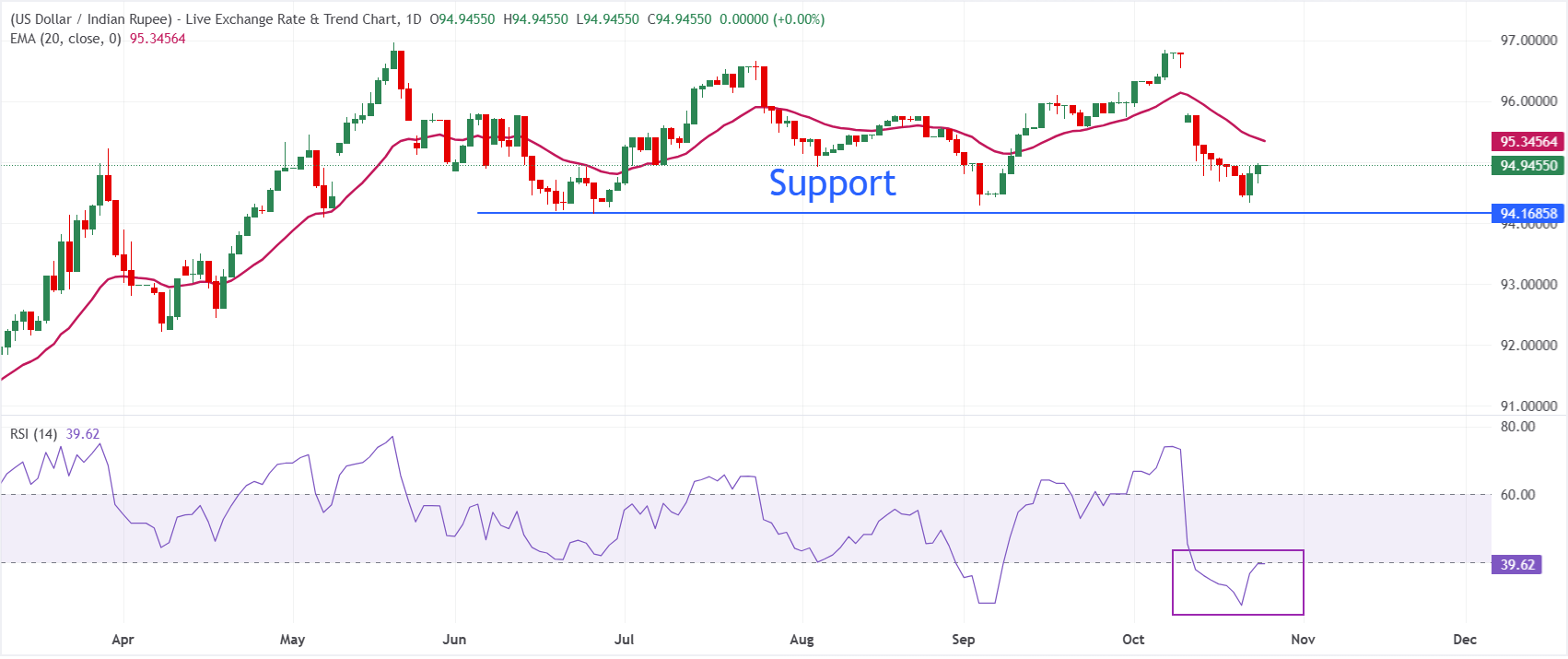
In the daily chart, USD/INR trades at 94.9455, maintaining a bearish near-term bias as spot holds beneath the 20-day exponential moving average (EMA) at 95.3456. The pair has retreated sharply from the recent 96.80 area, and the EMA now acts as an immediate cap on any recovery attempts, while the Relative Strength Index (RSI) around 39 suggests weak but stabilizing downside momentum after probing oversold territory earlier in the month.
On the topside, initial resistance is located at the 20-day EMA at 95.3456, and a daily close above this barrier would help alleviate current selling pressure and open the way to higher levels. On the downside, momentum support is indicated by the RSI at 39.62; a sustained drop in the oscillator toward the 30 zone would reinforce the bearish tone and expose the pair to further losses below the 95 handle.
(The technical analysis of this story was written with the help of an AI tool. Know more.)
Indian Rupee FAQs
The Indian Rupee (INR) is one of the most sensitive currencies to external factors. The price of Crude Oil (the country is highly dependent on imported Oil), the value of the US Dollar – most trade is conducted in USD – and the level of foreign investment, are all influential. Direct intervention by the Reserve Bank of India (RBI) in FX markets to keep the exchange rate stable, as well as the level of interest rates set by the RBI, are further major influencing factors on the Rupee.
The Reserve Bank of India (RBI) actively intervenes in forex markets to maintain a stable exchange rate, to help facilitate trade. In addition, the RBI tries to maintain the inflation rate at its 4% target by adjusting interest rates. Higher interest rates usually strengthen the Rupee. This is due to the role of the ‘carry trade’ in which investors borrow in countries with lower interest rates so as to place their money in countries’ offering relatively higher interest rates and profit from the difference.
Macroeconomic factors that influence the value of the Rupee include inflation, interest rates, the economic growth rate (GDP), the balance of trade, and inflows from foreign investment. A higher growth rate can lead to more overseas investment, pushing up demand for the Rupee. A less negative balance of trade will eventually lead to a stronger Rupee. Higher interest rates, especially real rates (interest rates less inflation) are also positive for the Rupee. A risk-on environment can lead to greater inflows of Foreign Direct and Indirect Investment (FDI and FII), which also benefit the Rupee.
Higher inflation, particularly, if it is comparatively higher than India’s peers, is generally negative for the currency as it reflects devaluation through oversupply. Inflation also increases the cost of exports, leading to more Rupees being sold to purchase foreign imports, which is Rupee-negative. At the same time, higher inflation usually leads to the Reserve Bank of India (RBI) raising interest rates and this can be positive for the Rupee, due to increased demand from international investors. The opposite effect is true of lower inflation.
المقالات الشائعة
1الدولار النيوزيلندي يرتفع مقتربًا من 0.5700 مع تزايد الرهانات على رفع بنك الاحتياطي النيوزيلندي أسعار الفائدة2الين الياباني يستقر قرب أعلى مستوى في شهر مقابل الدولار الأمريكي الضعيف مع ترقّب المتداولين اجتماعي الاحتياطي الفيدرالي وبنك اليابان3توقعات أسعار الفضة: XAG/USD يتراجع دون 54.00 دولارًا مع انحسار الطلب على الملاذات الآمنة4اليورو يرتفع قليلًا فوق مستوى 1.1200 رغم المخاوف بشأن الديون الفرنسية5الجنيه الإسترليني يرتفع قليلاً مقابل الدولار الأمريكي الضعيف مع استمرار تركيز الأنظار على اجتماع اللجنة الفيدرالية للسوق المفتوحة هذا الأسبوع6الدولار الكندي يرتفع رغم انخفاض أسعار النفط7بنك الشعب الصيني يحدد السعر المرجعي لزوج USD/CNY عند 6.7162 مقابل 6.7180 سابقًا8خام غرب تكساس الوسيط يتراجع إلى قرب 101.00 مع استبعاد ترامب شن ضربات وشيكة على إيران9الدولار الأسترالي يتراجع رغم تحذيرات بنك الاحتياطي الأسترالي من رفع أسعار الفائدة
أسعار مباشرة

كل شيء عن OIL
تداول النفط الخام: فرصة أم مخاطرة؟
علاقة النفط والذهب بأزواج العملات: دليل التداول الأمثل
قرارات أسعار الفائدة وكيف تتداول عليها بنجاح
الذهب والنفط: اللغة الأم لأسواق الشرق الأوسط
التداول المدفوع بالأحداث في النفط
بناء نظام تداول خاص بك:
الخريطة نحو الربحية المنهجية
الدعم والمقاومة : الدليل العملي الشامل
أنواع التحليل في الفوركس: الفني والأساسي والوجداني
كيف تختار وسيط فوركس موثوق؟ 7 معايير أساسية
ابدأ الآن!
سجّل وابدأ التداول في الأسواق العالمية خلال أقل من 3 دقائق

تواصل معنا









جهات الاتصال
الهاتف +61 2 8036 8388
الفاكس +61 2 8036 8388
البريد الإلكتروني [email protected]
الموقع الإلكتروني https://www.tmgm-asia.com/en



المعلومات المقدمة على هذا الموقع الإلكتروني ذات طبيعة عامة فقط ولا تشكل نصيحة مالية شخصية. قبل اتخاذ أي إجراء بناءً على أي معلومات واردة في هذا الموقع الإلكتروني، ينبغي عليك النظر في مدى ملاءمة هذه المعلومات لأهدافك ووضعك المالي واحتياجاتك. ينطوي الاستثمار في عقود الفروقات وعقود الهامش على الفوركس على مخاطر كبيرة، وهو غير مناسب لجميع المستثمرين. قد تخسر أكثر من إيداعك الأولي. أنت لا تملك الأصل الأساسي، ولا لديك أي مصلحة فيه. نوصي بأن تطلب مشورة مستقلة وأن تتأكد من أنك تفهم تمامًا المخاطر التي تنطوي عليها قبل التداول. من المهم أن تقرأ وثيقة الإفصاح وتدرسها قبل الحصول على أي منتج مدرج على الموقع الإلكتروني. إن المعلومات والإعلانات المعروضة على هذا الموقع الإلكتروني غير مخصصة للاستخدام من قبل أي شخص في أي بلد أو ولاية قضائية يكون فيها هذا الاستخدام مخالفًا للقوانين واللوائح المحلية. المنتجات والخدمات المعروضة على هذا الموقع الإلكتروني غير مخصصة للمقيمين في الولايات المتحدة وماليزيا وتايلاند.
TMGM مرخصة ومنظمة في ولايات قضائية مختلفة.
شركة Trademax Australia Limited، التي تتداول باسم TMGM، منظمة من قبل لجنة الأوراق المالية والاستثمارات الأسترالية (ASIC)، رقم AFSL 436416 وتقع في المستوى 28، برج دولي واحد، 100 شارع بارانجارو، 2000 سيدني، نيو ساوث ويلز أستراليا.
البريد الإلكتروني: [email protected]
شركة Trademax Global Limited، التي تتداول باسم TMGM، مرخصة ومنظمة من قبل لجنة الخدمات المالية في فانواتو (VFSC)، رقم التسجيل 40356 ومسجلة في 1276، طريق كومول السريع، بورت فيلا، فانواتو، جمهورية فانواتو.
البريد الإلكتروني: [email protected]
شركة Trademax Global Markets (SE) Limited، المعروفة باسم TMGM، مرخصة ومنظمة من قبل هيئة الخدمات المالية (FSA) في سيشيل، برقم الترخيص SD224. الشركة مسجلة في المكتب رقم 13، مركز ABIS العقاري، ماهي، سيشيل.
البريد الإلكتروني: [email protected]
شركة Trademax Global Markets (International) Pty Ltd، التي تتداول باسم TMGM، مرخصة ومنظمة من قبل لجنة الخدمات المالية، موريشيوس (FSC) برقم الترخيص GB22201012، ومسجلة في 33، شارع إديث كافيل c/o IQ EQ Fund Services (Mauritius) Ltd بورت لويس، 11324 موريشيوس.
البريد الإلكتروني: [email protected]
حقوق الطبع والنشر © TMGM. جميع الحقوق محفوظة