

Australian Dollar finds a floor as Oil retreat loosens USD’s grip
- AUD/USD rebounds from 50- and 100-day SMA confluence.
- Lower Oil prices ease Dollar support after Fed hike.
- Bullock speech may reshape RBA expectations after Fed tightening.
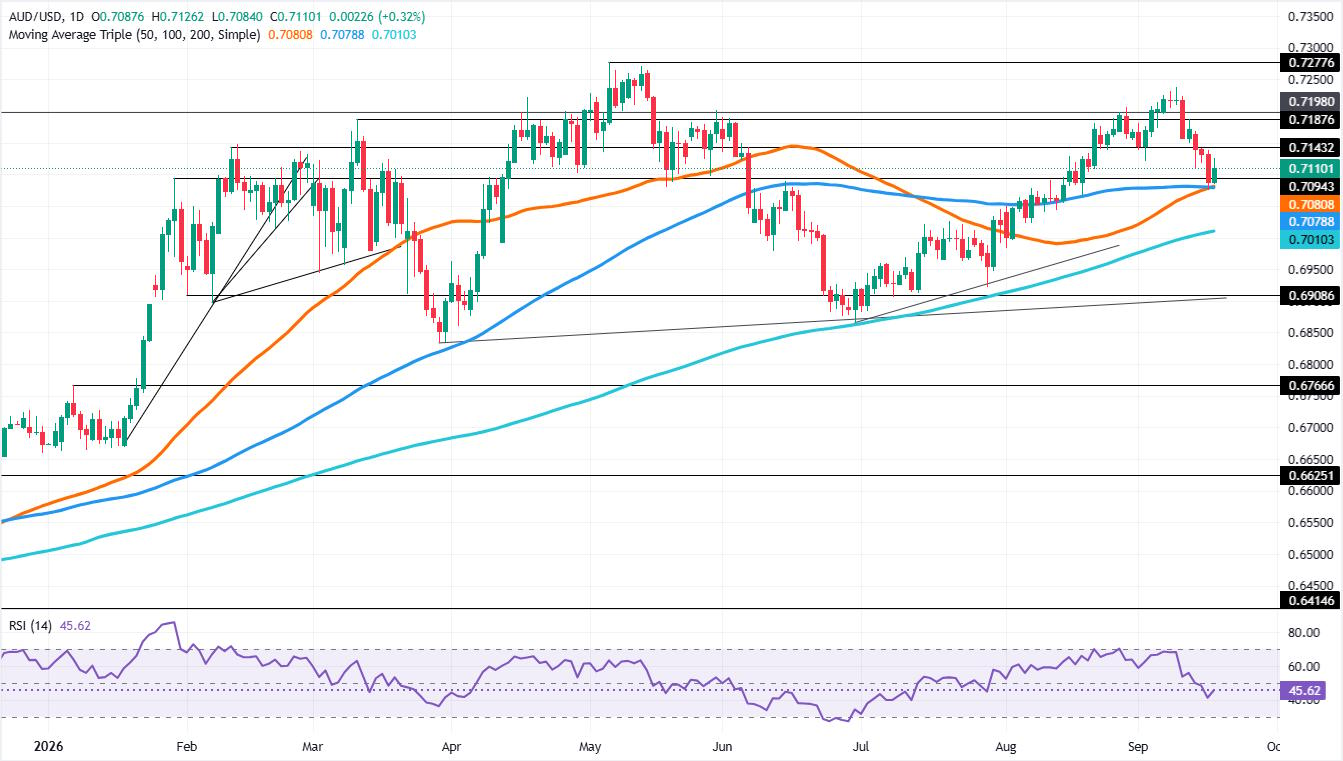
The Australian Dollar recovered some ground versus the US Dollar on Thursday, following the Federal Reserve’s monetary policy decision on Wednesday, which witnessed a 0.25% rate hike and paved the way for further tightening. The AUD/USD trades at 0.7110 after bouncing off the confluence of the 50- and 100-day SMAs.
AUD/USD rebounds from key SMAs as easing Oil tensions pressure Dollar
During the day, market mood turned optimistic on a potential de-escalation of the Middle East conflict. Consequently, Oil prices drifted lower, weakening the Greenback due to its close correlation as Saudi Arabia reported its crude production would return to half capacity within days.
The US Dollar Index (DXY), which tracks the performance of the US currency against six other currencies, is down 0.10%, at 100.23, a day after the Fed raised rates for the first time in three years.
Fed Chair Warsh stated, “The fact is that inflation remains too high and persistent." The Fed's dot plot, which shows officials' interest rate outlooks, indicates the Fed funds rate is around 4.10%, implying another rate hike may occur soon. This aligns with inflation forecasts, as the Personal Consumption Expenditures (PCE) index is projected to stay at 3.7% this year and gradually approach the Fed’s 2% target by 2028.
Money markets had priced in a 53% chance of another rate hike at the October meeting, according to Prime Terminal.
The US economic report indicated that for the week ending September 12, jobless claims decreased notably from 206K to 196K, beating the forecast of 208K. Eyes shift for Friday’s speech of Fed Governor Bowman and the release of Industrial Production data for August.
In Australia, the economic docket was absent, yet the Reserve Bank of Australia (RBA) Governor Michele Bullock is expected to cross the wires at 00:00 GMT.
AUD/USD Price Forecast: Technical outlook
Australian Dollar FAQs
One of the most significant factors for the Australian Dollar (AUD) is the level of interest rates set by the Reserve Bank of Australia (RBA). Because Australia is a resource-rich country another key driver is the price of its biggest export, Iron Ore. The health of the Chinese economy, its largest trading partner, is a factor, as well as inflation in Australia, its growth rate and Trade Balance. Market sentiment – whether investors are taking on more risky assets (risk-on) or seeking safe-havens (risk-off) – is also a factor, with risk-on positive for AUD.
The Reserve Bank of Australia (RBA) influences the Australian Dollar (AUD) by setting the level of interest rates that Australian banks can lend to each other. This influences the level of interest rates in the economy as a whole. The main goal of the RBA is to maintain a stable inflation rate of 2-3% by adjusting interest rates up or down. Relatively high interest rates compared to other major central banks support the AUD, and the opposite for relatively low. The RBA can also use quantitative easing and tightening to influence credit conditions, with the former AUD-negative and the latter AUD-positive.
China is Australia’s largest trading partner so the health of the Chinese economy is a major influence on the value of the Australian Dollar (AUD). When the Chinese economy is doing well it purchases more raw materials, goods and services from Australia, lifting demand for the AUD, and pushing up its value. The opposite is the case when the Chinese economy is not growing as fast as expected. Positive or negative surprises in Chinese growth data, therefore, often have a direct impact on the Australian Dollar and its pairs.
Iron Ore is Australia’s largest export, accounting for $118 billion a year according to data from 2021, with China as its primary destination. The price of Iron Ore, therefore, can be a driver of the Australian Dollar. Generally, if the price of Iron Ore rises, AUD also goes up, as aggregate demand for the currency increases. The opposite is the case if the price of Iron Ore falls. Higher Iron Ore prices also tend to result in a greater likelihood of a positive Trade Balance for Australia, which is also positive of the AUD.
The Trade Balance, which is the difference between what a country earns from its exports versus what it pays for its imports, is another factor that can influence the value of the Australian Dollar. If Australia produces highly sought after exports, then its currency will gain in value purely from the surplus demand created from foreign buyers seeking to purchase its exports versus what it spends to purchase imports. Therefore, a positive net Trade Balance strengthens the AUD, with the opposite effect if the Trade Balance is negative.











