
News & AnalysisCareer

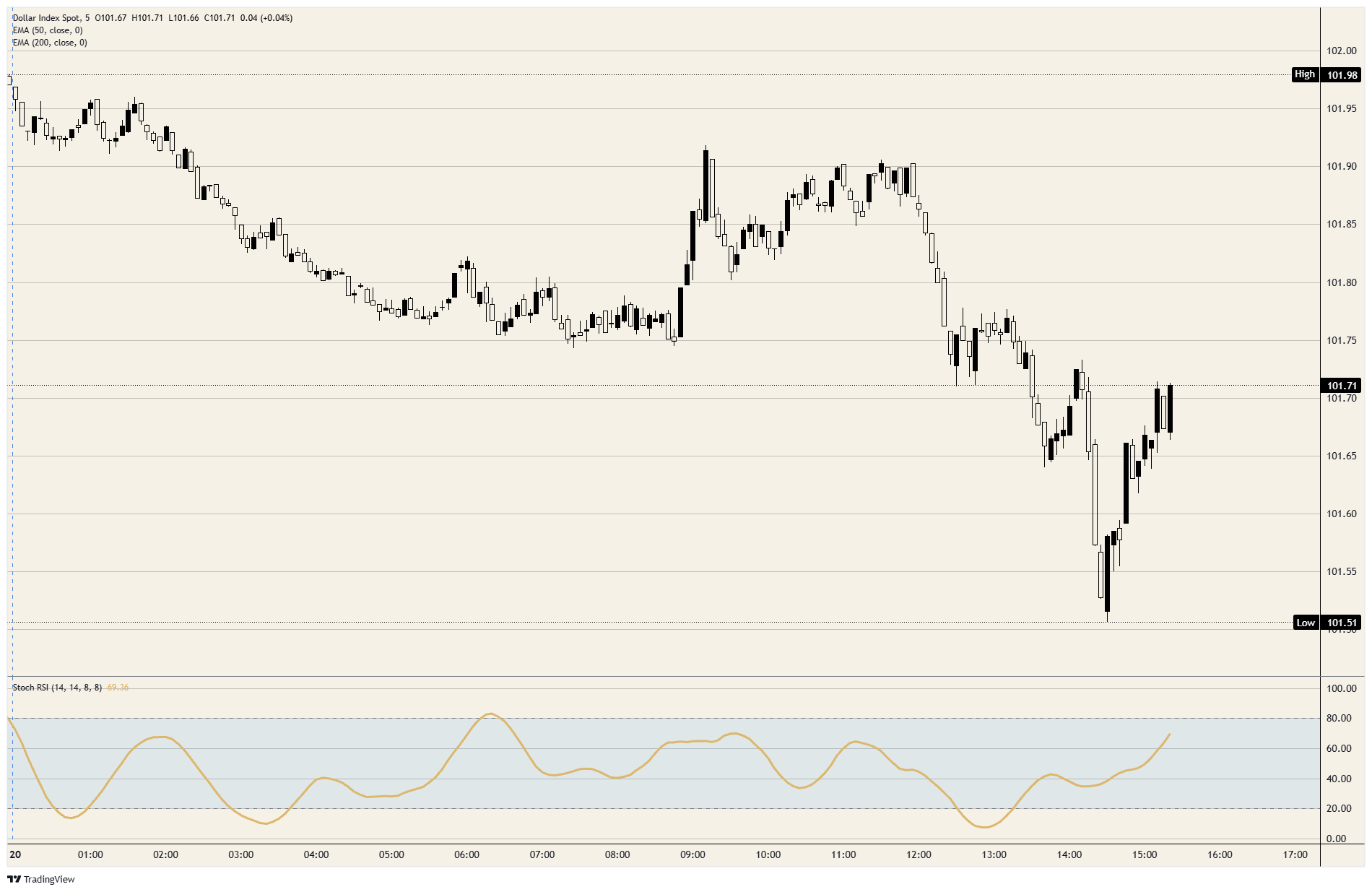
From near 101.75, the Dollar Index slipped to around 101.65 after initial reports that Washington and Tehran had both provisionally approved a compromise put forward by Qatar and Pakistan. When Israel’s Channel 12 reported the terms, the index extended its decline to just above 101.50, its lowest since 1 October. A diplomat involved in the talks subsequently rejected reports that an agreement was close, prompting a recovery towards 101.70.

As the reports sent Crude Oil lower, cheaper energy helped lift the Euro, which accounts for more than half the index’s weight. Treasury Secretary Bessent attributed higher US rates to the energy shock. An agreement that brings that shock to an end could therefore lead to lower US rates and a softer Dollar.
September housing starts declined to 1.221 million, short of the 1.3 million forecast. Pending home sales, meanwhile, fell 7.3% to a record low, compared with expectations for a 0.5% decline. Although housing weakness strengthens the argument against further Fed rate rises, the index advanced on the chart bars corresponding to both releases.
Ahead of the Federal Open Market Committee (FOMC) meeting on 27-28 October, Fed officials have entered their quiet period, leaving no Fed commentary before the 28 October decision. Of 100 economists surveyed, 94 anticipate rates remaining at 3.75%-4.00% in October, while all 100 forecast a rise in December.
Thursday’s initial jobless claims are due at 12:30 GMT, followed on Friday at 13:45 GMT by S&P Global’s preliminary October Purchasing Managers Index (PMI) readings. Both releases inform the case for bringing a rate rise forward from December to 28 October, an outcome expected by 6 of the 100 economists.
By the session trough, roughly a third of the index’s advance from the 9 September low near 98.60 to the 14 October peak just below 103.00 had been retraced. That session low also sits below Friday’s dip near 101.60. At just under 101.00, the 50-day Exponential Moving Average (EMA) lies about three-quarters of a point further down.
Alongside its role as the official currency of the United States of America, the US Dollar (USD) circulates with local banknotes as the ‘de facto’ currency in a significant number of other countries. No currency is traded more widely: according to 2022 data, it accounts for over 88% of global foreign exchange turnover, equivalent to average daily transactions of $6.6 trillion. After the Second World War, the USD displaced the British Pound as the world’s reserve currency. Gold provided backing for the US Dollar for most of its history, until the Gold Standard ended with the Bretton Woods Agreement in 1971.
Monetary policy set by the Federal Reserve (Fed) is the single biggest influence on the US Dollar’s value. Price stability, meaning control of inflation, and full employment form the Fed’s dual mandate. Changes to interest rates are its main means of pursuing those objectives. If prices increase too rapidly and inflation exceeds the Fed’s 2% target, the central bank will raise rates, supporting the USD. Conversely, inflation below 2% or an excessively high unemployment rate may prompt the Fed to cut rates, putting pressure on the Greenback.
When conditions become extreme, the Federal Reserve can print additional Dollars and introduce quantitative easing (QE), substantially expanding the supply of credit within a stalled financial system. This unconventional policy is used when credit dries up because banks, fearing counterparty default, refuse to lend to one another. It serves as a last resort when interest rate cuts alone are unlikely to deliver the required outcome. During the Great Financial Crisis in 2008, QE was the Fed’s preferred response to the credit crunch. Under this approach, the Fed prints more Dollars to purchase US government bonds, mainly from financial institutions. The usual effect is a weaker US Dollar.
By contrast, quantitative tightening (QT) reverses that process: the Federal Reserve halts bond purchases from financial institutions and refrains from reinvesting the principal repaid as its existing bond holdings mature. This is generally supportive of the US Dollar.










The information provided on this website is of a general nature only and does not constitute personal financial advice. Before acting on any information on this website, you should consider the suitability of the information in relation to your objectives, financial situation and needs. Investing in CFDs and FX Margin Contracts carries significant risks and is not suitable for all investors. You may lose more than your initial deposit. You do not own, or have, any interest in the underlying asset. We recommend that you seek independent advice and ensure you fully understand the risks involved before trading. It is important that you read and consider the disclosure document before you acquire any product listed on the website. The information and advertisements offered on this website are not intended for use by any person in any country or jurisdiction where such use would be contrary to local laws and regulations. The Products and Services offered on this website are not intended for residents of the United States, Malaysia and Thailand.
TMGM is authorized and regulated in various jurisdictions.
Trademax Australia Limited, trading as TMGM, is regulated by the Australian Securities and Investments Commission (ASIC), AFSL no. 436416 and is located at Level 28, One International Tower, 100 Barangaroo Avenue, 2000 Sydney, NSW Australia.
Email: [email protected]
Trademax Global Limited, trading as TMGM, is authorized and regulated by the Vanuatu Financial Services Commission (VFSC), registration number 40356 and registered at 1276, Kumul Highway, Port Vila, Vanuatu, Republic of Vanuatu.
Email: [email protected]
Trademax Global Markets (SE) Limited, trading as TMGM, is authorized and regulated by the Financial Services Authority (FSA) of Seychelles, with license number SD224. The company is registered at Office No 13, Providence Estate ABIS Centre, Mahe, Seychelles.
Email: [email protected]
Trademax Global Markets (International) Pty Ltd, trading as TMGM, is authorized and regulated by the Financial Services Commission, Mauritius (FSC) with license no. GB22201012, and registered at 33, Edith Cavell Street C/o IQ EQ Fund Services (Mauritius) Ltd Port Louis, 11324 Mauritius.
Email: [email protected]
Copyright © TMGM. All rights reserved

