
News & AnalysisCareer

Following weaker-than-expected New Zealand Q3 inflation figures, the New Zealand Dollar (NZD) is losing ground against its major currency counterparts on Thursday. During the European session, it is down 0.25% against the US Dollar (USD), trading near 0.5679.

Today's percentage movements in the New Zealand Dollar (NZD) against the major currencies listed are set out below. Its weakest performance was against the Japanese Yen.
| USD | EUR | GBP | JPY | CAD | AUD | NZD | CHF | |
|---|---|---|---|---|---|---|---|---|
| USD | 0.14% | 0.10% | -0.82% | -0.11% | 0.27% | 0.42% | -0.39% | |
| EUR | -0.14% | -0.05% | -0.95% | -0.29% | 0.12% | 0.27% | -0.57% | |
| GBP | -0.10% | 0.05% | -0.92% | -0.25% | 0.16% | 0.31% | -0.50% | |
| JPY | 0.82% | 0.95% | 0.92% | 0.69% | 1.08% | 1.20% | 0.41% | |
| CAD | 0.11% | 0.29% | 0.25% | -0.69% | 0.39% | 0.55% | -0.28% | |
| AUD | -0.27% | -0.12% | -0.16% | -1.08% | -0.39% | 0.13% | -0.67% | |
| NZD | -0.42% | -0.27% | -0.31% | -1.20% | -0.55% | -0.13% | -0.78% | |
| CHF | 0.39% | 0.57% | 0.50% | -0.41% | 0.28% | 0.67% | 0.78% |
Percentage movements between the major currencies are displayed in the heat map. Select the base currency from the left-hand column and the quote currency from the top row. For instance, choosing the New Zealand Dollar on the left and following its row across to the US Dollar gives the percentage change for NZD (base)/USD (quote) in the corresponding cell.
New Zealand (NZ) Q3 Consumer Price Index (CPI) figures came in below expectations, putting pressure on the Kiwi dollar.
Describing NZ Q3 CPI as having “undershot expectations,” strategists at Brown Brothers Harriman (BBH) point to a headline CPI increase of “0.7% q/q vs. 1.5% in Q2, below the 0.8% rise forecast by consensus and RBNZ.”
BBH nevertheless maintains that “above target inflation and still elevated oil prices argue for additional RBNZ rate hikes.” On market pricing, the strategists note that “the swaps curve price in 85% odds of a 25bps RBNZ rate hike to 3.00% on October 28 and more than 100bps of tightening over the next twelve months to 3.75% - near the upper end of the RBNZ’s estimated neutral range of 2.20%-4.10%.”
A recovering US Dollar is also keeping the Kiwi pair under pressure. After returning to a three-week low near 101.45, the US Dollar Index (DXY) has rebounded towards 101.66. The index tracks the Greenback against six major currencies.
Attention now turns to October's flash US S&P Global PMI release, due on Friday, which will be the next focus for investors.
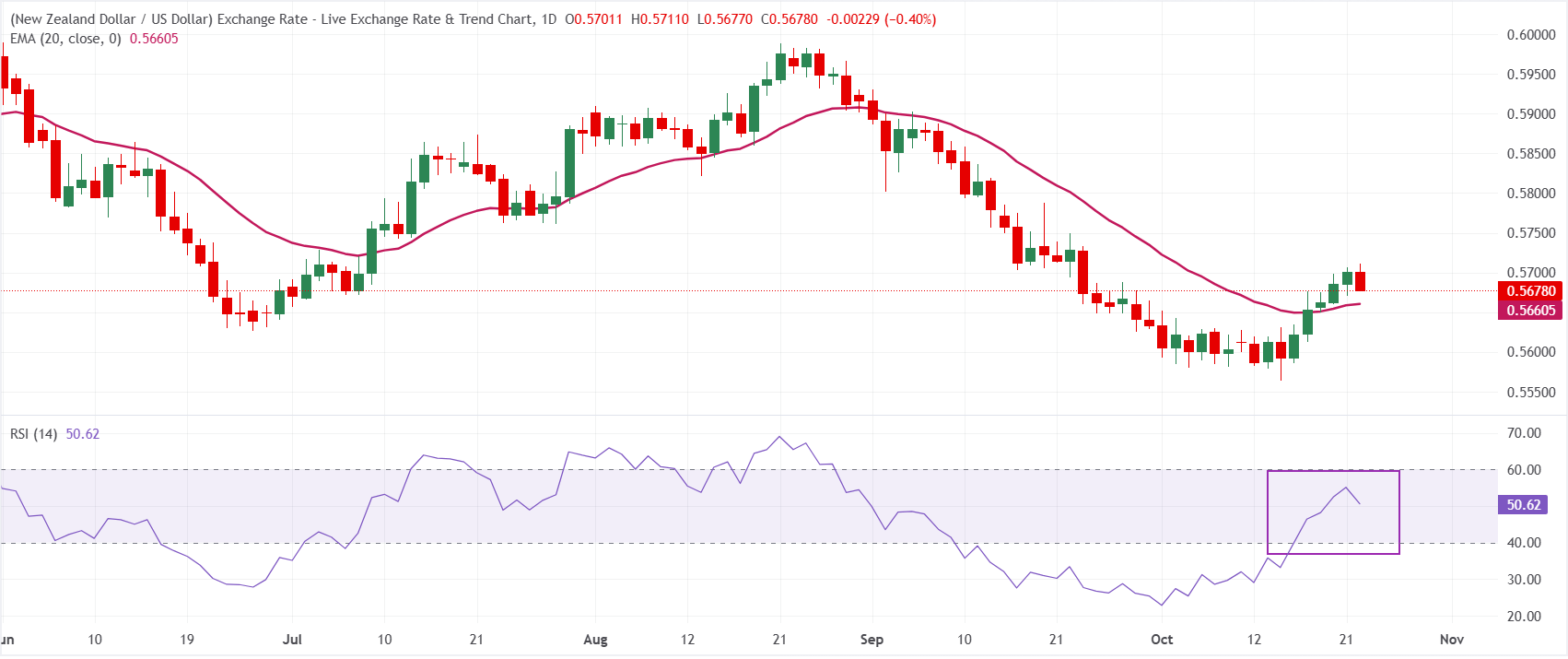
Having regained the 20-day exponential moving average (EMA) at 0.5661, NZD/USD stands at 0.5678 at the time of writing. Holding above this short-term trend indicator gives the near-term outlook a mildly bullish tilt. On the daily chart, the Relative Strength Index (RSI) has moved back into neutral-to-positive territory near 51. This points to easing downward pressure and suggests scope for the recovery to continue, provided the pair retains support above the EMA.
The 20-day EMA at 0.5661 provides the first support level on the downside. A break below it would weaken the emerging positive outlook and bring the recent lows back into view. While NZD/USD remains above this moving average, buyers are likely to step in on dips. The focus is therefore on whether the pair can establish a base for a more lasting rebound over the coming sessions.
(The technical analysis of this story was written with the help of an AI tool. Know more.)
Published quarterly by Statistics New Zealand, the Consumer Price Index (CPI) tracks movements in the prices of goods and services purchased by New Zealand households. It is a key gauge of inflation and shifts in purchasing patterns. The QoQ figure compares prices in the reporting quarter with those in the preceding quarter. A high reading is regarded as positive for the New Zealand Dollar (NZD), whereas a low reading is regarded as negative.
Find out more.Latest release: Wed 21 Oct 2026 21:45
Release frequency: Quarterly
Reported figure: 0.7%
Consensus forecast: 0.8%
Previous reading: 1.5%
Data source: Stats NZ
Quarterly Consumer Price Index (CPI) figures from Statistics New Zealand carry considerable weight because the Reserve Bank of New Zealand (RBNZ) has an inflation target with a midpoint of around 2%. Consumer price trends typically help shape the RBNZ’s interest rate decisions, with substantial implications for the NZD’s value. Faster inflation could prompt the RBNZ to tighten rates more quickly, while slower inflation could have the opposite effect. Readings above forecasts are bullish for the NZD.










The information provided on this website is of a general nature only and does not constitute personal financial advice. Before acting on any information on this website, you should consider the suitability of the information in relation to your objectives, financial situation and needs. Investing in CFDs and FX Margin Contracts carries significant risks and is not suitable for all investors. You may lose more than your initial deposit. You do not own, or have, any interest in the underlying asset. We recommend that you seek independent advice and ensure you fully understand the risks involved before trading. It is important that you read and consider the disclosure document before you acquire any product listed on the website. The information and advertisements offered on this website are not intended for use by any person in any country or jurisdiction where such use would be contrary to local laws and regulations. The Products and Services offered on this website are not intended for residents of the United States, Malaysia and Thailand.
TMGM is authorized and regulated in various jurisdictions.
Trademax Australia Limited, trading as TMGM, is regulated by the Australian Securities and Investments Commission (ASIC), AFSL no. 436416 and is located at Level 28, One International Tower, 100 Barangaroo Avenue, 2000 Sydney, NSW Australia.
Email: [email protected]
Trademax Global Limited, trading as TMGM, is authorized and regulated by the Vanuatu Financial Services Commission (VFSC), registration number 40356 and registered at 1276, Kumul Highway, Port Vila, Vanuatu, Republic of Vanuatu.
Email: [email protected]
Trademax Global Markets (SE) Limited, trading as TMGM, is authorized and regulated by the Financial Services Authority (FSA) of Seychelles, with license number SD224. The company is registered at Office No 13, Providence Estate ABIS Centre, Mahe, Seychelles.
Email: [email protected]
Trademax Global Markets (International) Pty Ltd, trading as TMGM, is authorized and regulated by the Financial Services Commission, Mauritius (FSC) with license no. GB22201012, and registered at 33, Edith Cavell Street C/o IQ EQ Fund Services (Mauritius) Ltd Port Louis, 11324 Mauritius.
Email: [email protected]
Copyright © TMGM. All rights reserved

