
News & AnalysisCareer

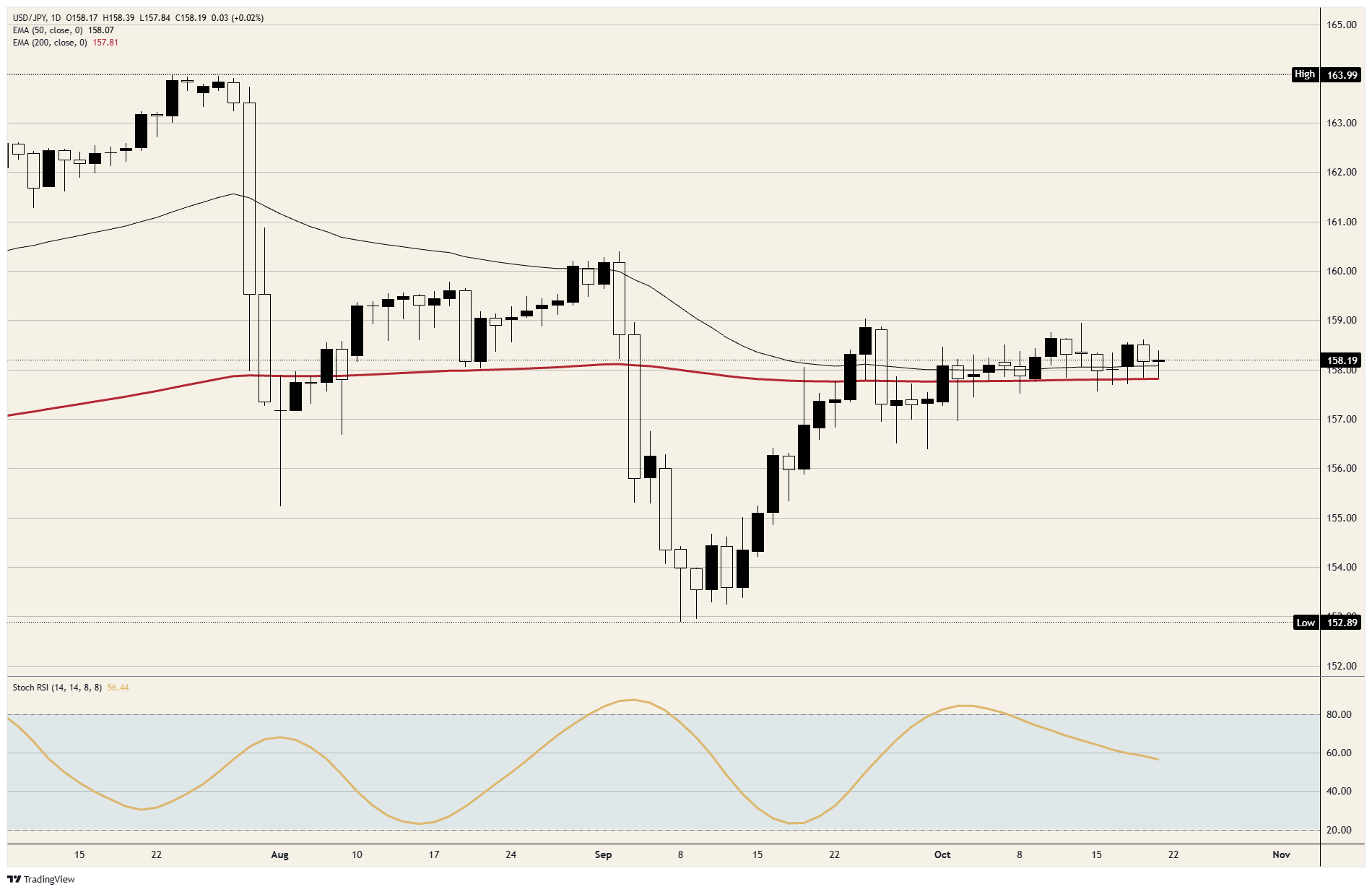
Core inflation in Japan remained below the Bank of Japan's (BoJ) 2% target throughout the seven months to August, even as the bank raised rates twice this year, reaching 1.25% in September. Trading near 158.00, USD/JPY has spent 12 sessions within a 157.50-159.00 band. The range remained intact on Wednesday after BoJ Deputy Governor Himino said underlying inflation was approaching 2% and price risks were tilted to the upside.

With upside inflation risks still elevated, Deputy Governor Himino cautioned that a late policy adjustment could allow those risks to materialise. Financial conditions remained accommodative in his assessment, reflecting low real interest rates and rapid growth in bank lending. An initial modest rise in the Yen following his comments subsequently unwound, leaving it within Wednesday's trading range.
A hold at 1.25% on October 30 is expected by Kyodo, while swaps imply about a 75%-80% chance of an increase on December 18. September's Japanese trade deficit stood at ¥536.6 billion, roughly three times the ¥181 billion forecast. Exports increased 16.7% year on year, short of the 20.1% forecast. Whatever Deputy Governor Himino's inflation assessment, a deficit of that scale means Yen must be sold to fund imports.
Between April 28 and May 27, Japan's Ministry of Finance purchased ¥11.74 trillion of Yen. It then acted alongside the US Treasury in late July after USD/JPY exceeded 160.00. Following a stronger-than-expected US inflation reading, Finance Minister Katayama repeated his warnings on October 15; the pair has not moved above 159.00 since.
These opposing forces leave USD/JPY confined to its range. Downside is limited by a US 10-year Treasury yield near 5.1%, compared with a Japanese 10-year yield that hit about 3.1% on October 7 before returning to around 2.9% by October 16. Meanwhile, the prospect of renewed Yen purchases restricts the upside. Although Finance Minister Katayama has not specified an intervention threshold, traders have focused on the level breached by USD/JPY ahead of the previous intervention.
Due at 23:30 GMT on Thursday, Japan's September national Consumer Price Index (CPI) is expected to show core inflation excluding fresh food rising to 2.1% from 1.7%. August's headline rate was 1.9%, as was the measure stripping out food and energy. Government energy subsidies helped push electricity prices down 2.4% year on year in August, partly explaining why core inflation remained below 2% through both BoJ rate increases.
Two policymakers opposed the BoJ's September increase on the grounds that inflation remained below 2%, leaving the vote at 7-2. Should the reading reach 2.1%, that objection would no longer hold a month after it was raised and a week before the next policy decision.
Nevertheless, a robust release would reinforce the prospect of a December increase rather than shift it forward to October 30. The benefit to the Yen may therefore be smaller than the headline figure implies. Friday's University of Michigan survey, due at 14:00 GMT, is expected to put US household inflation expectations at 4.7% for the next year and 3.5% over five years. US yields remain the factor holding USD/JPY nearer 160.00 than 155.00.
Resistance: Monday's and Tuesday's advances stalled at 158.50. Since October 6, no session has broken above 159.00, and the October 14 peak fell just short of that mark. Beyond it, 160.00 marks the threshold USD/JPY crossed ahead of July's intervention.
Support: The 200-day Exponential Moving Average (EMA), slightly below 158.00, arrested Wednesday's decline. Every session since October 6 has respected 157.50, while the October 2 trough lies a little below 157.00.
Bias: The long bias remains valid provided closing prices hold above 157.50, with targets at 158.50 followed by 159.00. Rather than gathering strength for a breakout, momentum within the range is weakening: the daily Stochastic Relative Strength Index (Stoch RSI) has dropped to around 56 from over 80 in early October. A daily close beneath 157.50 invalidates the long position.
Among the world's most actively traded currencies, the Japanese Yen (JPY) broadly reflects the performance of Japan's economy. More specific influences include Bank of Japan policy, the gap between Japanese and US bond yields, and traders' appetite for risk, alongside other factors.
Currency control forms part of the Bank of Japan's mandate, making its actions an important influence on the Yen. On occasion, the BoJ has intervened directly in foreign exchange markets, usually to weaken the currency. Political concerns among its principal trading partners, however, discourage frequent intervention. From 2013 to 2024, the BoJ's ultra-loose monetary policy weakened the Yen against its major currency peers as policy increasingly diverged from that of other leading central banks. The subsequent gradual withdrawal of that ultra-loose stance has more recently provided the Yen with some support.
By maintaining ultra-loose monetary policy over the past decade, the BoJ increasingly diverged from other central banks, most notably the US Federal Reserve. That divergence helped widen the gap between US and Japanese 10-year bond yields, supporting the US Dollar against the Japanese Yen. The gap is now narrowing as the BoJ follows its 2024 decision to withdraw ultra-loose policy gradually, while other major central banks cut interest rates.
Often regarded as a safe-haven investment, the Japanese Yen tends to attract funds during periods of market stress because investors perceive it as reliable and stable. As a result, turbulent conditions are likely to lift the Yen against currencies considered riskier investments.










The information provided on this website is of a general nature only and does not constitute personal financial advice. Before acting on any information on this website, you should consider the suitability of the information in relation to your objectives, financial situation and needs. Investing in CFDs and FX Margin Contracts carries significant risks and is not suitable for all investors. You may lose more than your initial deposit. You do not own, or have, any interest in the underlying asset. We recommend that you seek independent advice and ensure you fully understand the risks involved before trading. It is important that you read and consider the disclosure document before you acquire any product listed on the website. The information and advertisements offered on this website are not intended for use by any person in any country or jurisdiction where such use would be contrary to local laws and regulations. The Products and Services offered on this website are not intended for residents of the United States, Malaysia and Thailand.
TMGM is authorized and regulated in various jurisdictions.
Trademax Australia Limited, trading as TMGM, is regulated by the Australian Securities and Investments Commission (ASIC), AFSL no. 436416 and is located at Level 28, One International Tower, 100 Barangaroo Avenue, 2000 Sydney, NSW Australia.
Email: [email protected]
Trademax Global Limited, trading as TMGM, is authorized and regulated by the Vanuatu Financial Services Commission (VFSC), registration number 40356 and registered at 1276, Kumul Highway, Port Vila, Vanuatu, Republic of Vanuatu.
Email: [email protected]
Trademax Global Markets (SE) Limited, trading as TMGM, is authorized and regulated by the Financial Services Authority (FSA) of Seychelles, with license number SD224. The company is registered at Office No 13, Providence Estate ABIS Centre, Mahe, Seychelles.
Email: [email protected]
Trademax Global Markets (International) Pty Ltd, trading as TMGM, is authorized and regulated by the Financial Services Commission, Mauritius (FSC) with license no. GB22201012, and registered at 33, Edith Cavell Street C/o IQ EQ Fund Services (Mauritius) Ltd Port Louis, 11324 Mauritius.
Email: [email protected]
Copyright © TMGM. All rights reserved


