

Trading
Explore a wide range of markets with competitive pricing, deep liquidity, and advanced trading tools.
Learn More 
Platform
Trade seamlessly with TMGM's powerful platform, built for speed, precision, and a superior trading experience.
Learn More Trading Platform
Academy
Learn the fundamentals of trading with beginner-friendly resources, including guides, webinars, and market insights.
Learn More News & Analysis
Get real-time market updates and expert analysis to stay ahead of trading opportunities
Learn More News & Analysis
About
Learn what sets TMGM apart — our global presence, regulatory strength, and commitment to innovation in trading.
Learn More Why Choose TMGM
Sponsorship
British Pound slips: Can Sterling bulls withstand Fed decision and UK budget tests?
- Stronger demand for the Dollar weighs on GBP/USD, down 0.22% at 1.3342.
- Markets assign an 83% probability to a December Fed hike; October odds hold at 9%.
- Markets fully price in a November BoE hike ahead of the UK Autumn Budget.
Sterling is under pressure against the US Dollar, with GBP/USD trading at 1.3342 after a decline of around 0.22%. Traders are awaiting the Federal Reserve’s monetary policy decision on Tuesday and Wednesday, while also preparing for the UK’s Autumn Budget.
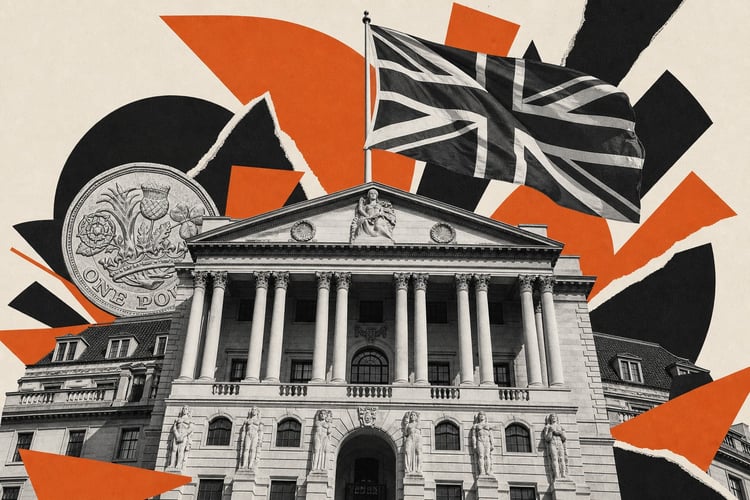
Can BoE hike expectations support the Pound as Dollar strength and UK fiscal uncertainty weigh?
The stronger Dollar is weighing on GBP/USD, with the US Dollar Index (DXY) gaining 0.24% to 101.99. The index measures the currency’s performance against six peers. Geopolitical developments remain a key influence on trading, alongside enthusiasm over AI, as Anthropic’s IPO filing lifted the Nasdaq.
With few US economic releases last week, the Middle East conflict and technology shares set the direction for markets. Expectations of a Federal Reserve rate increase at the two-day meeting concluding this Wednesday have faded, leaving the probability at 9%. According to Prime Terminal, the likelihood of a December hike has also declined, from around 90% last week to 83% at the time of writing.
Energy prices, meanwhile, are easing as senior diplomats from the region travelled to Iran in an effort to calm mounting tensions. Speculation over a potential US-Israel strike on Tehran receded after US President Donald Trump said on Sunday that he would not attack Iran.
A technology-led market sell-off put the US dollar under pressure last week. Earnings from major cloud computing providers Alphabet GOOGL.O, Microsoft MSFT.O and Amazon AMZN.O will provide another test of the fragile AI-driven rally and investors’ broader appetite for risk.
Attention in the UK centres on Chancellor of the Exchequer John Healey’s forthcoming budget. Stabilising the UK bond market is his priority, amid concerns about the large spending measures that the new Prime Minister Andy Burnham discussed when he took office.
The prospect of a Bank of England rate increase on November 5, meanwhile, depends on strong economic releases demonstrating the economy’s resilience.
A 25-basis-point increase had been fully priced into money markets, with an implied probability of 100%. Such a move would reduce the US-UK interest rate differential to zero, suggesting GBP/USD could rebound in the coming weeks if Fed Chair Kevin Warsh does not adopt a hawkish tone.
The forthcoming US data calendar includes Durable Goods Orders, housing and employment figures, as well as Conference Board Consumer Confidence.
GBP/USD Price Forecast: Can the pair overcome technical resistance?
GBP/USD is trading at 1.3344 on the daily chart, where the near-term outlook remains bearish. The pair sits beneath the 50-, 100- and 200-day simple moving averages (SMAs), which converge around 1.3400, and below key upward trend-line breaks at 1.3640 and 1.3820. Although the Relative Strength Index (14) has climbed towards the neutral 52 region, signalling better momentum, this suggests only that selling pressure is easing. With these overhead barriers still containing the price, a clear trend reversal has yet to emerge.
The first resistance on the upside lies near 1.3397 at the downward-sloping trend-line break, followed by the cluster of SMAs around 1.3400. Only a daily close above this zone would soften the bearish outlook and clear a path towards 1.3640 and 1.3820. Immediate support, meanwhile, comes from the former resistance trend line, now acting as a floor around 1.3260. A sustained break below that level would likely renew selling pressure, bringing lower levels within the broader range into view.
(The technical analysis of this story was written with the help of an AI tool. Know more.)
Common questions about the Pound Sterling
Dating back to 886 AD, the Pound Sterling (GBP) is the world’s oldest currency and serves as the United Kingdom’s official currency. Figures for 2022 show that it ranks fourth globally in foreign exchange (FX) trading, representing 12% of all transactions and an average daily value of $630 billion. Among its main currency pairs, GBP/USD, known as ‘Cable’, represents 11% of FX trading. GBP/JPY, referred to by traders as the ‘Dragon’, accounts for 3%, while EUR/GBP represents 2%. The Bank of England (BoE) issues the Pound Sterling.
Monetary policy set by the Bank of England is the main influence on the Pound Sterling’s value. Policy decisions depend on progress towards the BoE’s central objective of “price stability”, meaning inflation held steadily around 2%. Adjusting interest rates is its principal means of pursuing that goal. To curb excessive inflation, the BoE seeks to raise borrowing costs through higher interest rates, making credit more expensive for households and businesses. GBP generally benefits because higher rates increase the appeal of UK investments to international investors. Conversely, very low inflation signals a slowdown in economic growth. The BoE will then consider cutting interest rates to make borrowing cheaper, encouraging businesses to take on credit and invest in projects that support growth.
Sterling can respond to economic releases because they provide a measure of the economy’s health. GDP, Manufacturing and Services PMIs, and employment figures are among the indicators that can shape GBP’s direction. Economic strength supports Sterling by drawing in foreign investment and potentially prompting the BoE to raise interest rates, which would directly strengthen GBP. Weak economic figures, by contrast, are likely to weigh on the Pound Sterling.
The Trade Balance is another key release for Sterling, showing the gap between a country’s export earnings and its expenditure on imports during a specified period. Strong overseas demand for a country’s exports generates additional demand for its currency as foreign buyers seek to purchase those goods. A positive net Trade Balance therefore supports the currency, whereas a negative balance has the opposite effect.
POPULAR ARTICLES
1Brazilian Real: What post-election risks accompany Lula’s return? – Commerzbank2Canadian Dollar slips from six-week high as Fed, BoC rate decisions draw closer3United States: Resilient growth runs alongside sticky inflation - TD Securities4British Pound slips: Can Sterling bulls withstand Fed decision and UK budget tests?5Why is the Australian Dollar pulling back from its recent peak as RBA hike odds rise ahead of CPI?6Canadian Dollar: Are rate hikes on the horizon? – Commerzbank7Bank of Canada to Hold in October Despite Market Pricing, Says TD Securities8Euro weakens as traders look ahead to monetary policy decisions from Fed and ECB9Spain: Will growth slip below 2% in 2027 as Commerzbank expects?
LIVE QUOTES


ALL ABOUT FOREX
What Is a Stop Loss, How Does It Work and How Do You Set One?
Margin Call Meaning: What It Is, What Triggers It, and How to Avoid One
What Is an Islamic Account in Forex?
Best Indicators for Forex Trading and How to Use Them
The Top 10 Most Traded Currency Pairs in the World
What are the Major Forex Pairs? 7 Major Currency Pairs in the World
5 Best Forex Trading Apps In India In 2026
Top 15 Weakest Currencies in the World
Best Time to Trade Forex
Get Started!
Sign up and access the Global Markets in less than 3 minutes

Connect With Us












The information provided on this website is of a general nature only and does not constitute personal financial advice. Before acting on any information on this website, you should consider the suitability of the information in relation to your objectives, financial situation and needs. Investing in CFDs and FX Margin Contracts carries significant risks and is not suitable for all investors. You may lose more than your initial deposit. You do not own, or have, any interest in the underlying asset. We recommend that you seek independent advice and ensure you fully understand the risks involved before trading. It is important that you read and consider the disclosure document before you acquire any product listed on the website. The information and advertisements offered on this website are not intended for use by any person in any country or jurisdiction where such use would be contrary to local laws and regulations. The Products and Services offered on this website are not intended for residents of the United States, Malaysia and Thailand.
TMGM is authorized and regulated in various jurisdictions.
Trademax Australia Limited, trading as TMGM, is regulated by the Australian Securities and Investments Commission (ASIC), AFSL no. 436416 and is located at Level 28, One International Tower, 100 Barangaroo Avenue, 2000 Sydney, NSW Australia.
Email: [email protected]
Trademax Global Limited, trading as TMGM, is authorized and regulated by the Vanuatu Financial Services Commission (VFSC), registration number 40356 and registered at 1276, Kumul Highway, Port Vila, Vanuatu, Republic of Vanuatu.
Email: [email protected]
Trademax Global Markets (SE) Limited, trading as TMGM, is authorized and regulated by the Financial Services Authority (FSA) of Seychelles, with license number SD224. The company is registered at Office No 13, Providence Estate ABIS Centre, Mahe, Seychelles.
Email: [email protected]
Trademax Global Markets (International) Pty Ltd, trading as TMGM, is authorized and regulated by the Financial Services Commission, Mauritius (FSC) with license no. GB22201012, and registered at 33, Edith Cavell Street C/o IQ EQ Fund Services (Mauritius) Ltd Port Louis, 11324 Mauritius.
Email: [email protected]
Copyright © TMGM. All rights reserved