

Trading
Explore a wide range of markets with competitive pricing, deep liquidity, and advanced trading tools.
Learn More 
Platform
Trade seamlessly with TMGM's powerful platform, built for speed, precision, and a superior trading experience.
Learn More Trading Platform
Academy
Learn the fundamentals of trading with beginner-friendly resources, including guides, webinars, and market insights.
Learn More News & Analysis
Get real-time market updates and expert analysis to stay ahead of trading opportunities
Learn More News & Analysis
About
Learn what sets TMGM apart — our global presence, regulatory strength, and commitment to innovation in trading.
Learn More Why Choose TMGM
Sponsorship
The Yen round-trips after Japanese pay beats its forecast
- USD/JPY round-trips from just above 158.50, its highest since September 25, on Japan's pay data.
- Japanese real wages rose 1.5% YoY in August, an eighth straight gain.
- Futures give an October BoJ hike about 17% and a December move about 71%.
Japanese pay grew faster than forecast in August and the Yen weakened anyway. USD/JPY trades near 158.00, back where it was before the release took it to its highest since September 25.
Nominal pay rose 3.8% YoY against a 3.7% forecast, but that was down from July, and real wage growth slowed for a second month to 1.5%. The same release revised July down to 4.3% from 4.7%, a cut four times the size of the beat.

Pay running ahead of prices is the case the Bank of Japan (BoJ) makes for further hikes, and a slowing trend did nothing to bring the next one forward. That leaves USD/JPY following the Dollar side of the pair for most of October.
Tokyo calls the Yen undervalued and promises a tax cut
Prime Minister Takaichi told parliament on Tuesday she will cut the consumption tax on food without issuing new bonds. The 10-year Japanese government bond yield held near 3.11% on Wednesday, close to its highest in three decades. Yields that rise on budget worries rather than rate expectations can weaken a currency instead of lifting it.
Finance Minister Katayama and US Treasury Secretary Bessent called the Yen's undervaluation a concern in late September. Wednesday's Federal Open Market Committee (FOMC) minutes recorded the New York Fed's currency intervention for the Treasury, the yen purchase made alongside Japan on July 31 with USD/JPY just under 164.00. Undervalued is the word two finance ministries use for a currency they have already spent money on once.
A BoJ quarter-point is a tenth of the gap it would narrow
The BoJ's rate is 1.25% after the September 18 hike, against the Fed's 3.75%-4.00%, and futures give the BoJ about 71% odds of another move by December. The Fed on October 28 and the BoJ on October 30 carry the same odds of a hike, near 17%.
Friday's University of Michigan (UoM) survey at 14:00 GMT includes US households' one-year inflation expectations, 4.6% last month. A higher reading would add to Fed hike bets and lift USD/JPY with them.
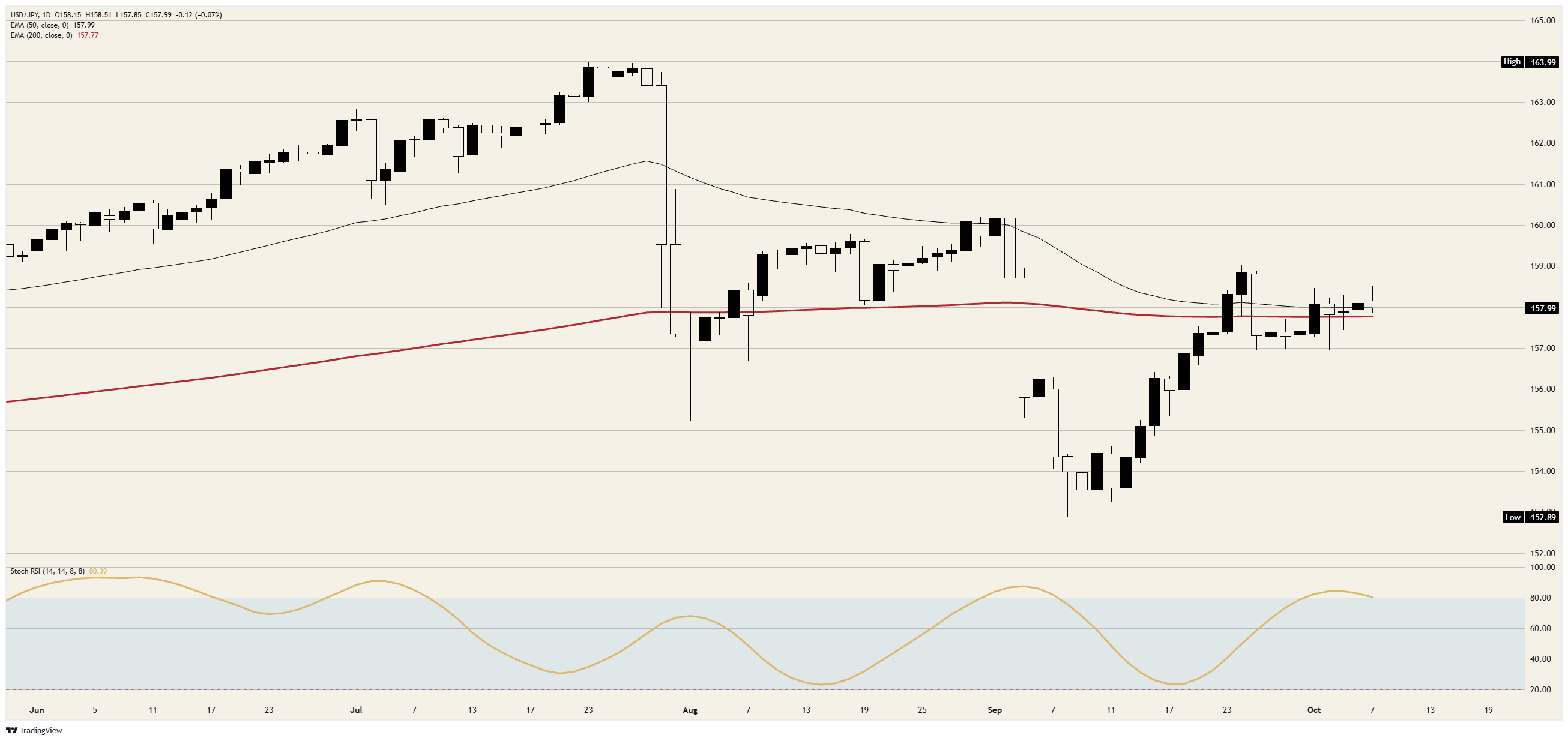
Yen levels around the moving averages
Resistance: Wednesday's high, just above 158.50, was the highest since September 25 and faded within the session. 159.00 stopped the September rebound on September 24.
Support: The 200-day Exponential Moving Average (EMA), just under 158.00, has been below every daily close since October 1. Monday's low, just under 157.50, is the line the long rests on.
Bias: The lean stays long while 157.50 holds on a closing basis, with 158.50, touched by a pip on Wednesday, still the first objective and 159.00 the second. The Stochastic Relative Strength Index (Stoch RSI) on the daily chart has turned down from about 85 to near 80, so a dip toward 157.50 would fit the call. A daily close below 157.00 takes the long off.
USD/JPY daily chart
Japanese Yen FAQs
The Japanese Yen (JPY) is one of the world’s most traded currencies. Its value is broadly determined by the performance of the Japanese economy, but more specifically by the Bank of Japan’s policy, the differential between Japanese and US bond yields, or risk sentiment among traders, among other factors.
One of the Bank of Japan’s mandates is currency control, so its moves are key for the Yen. The BoJ has directly intervened in currency markets sometimes, generally to lower the value of the Yen, although it refrains from doing it often due to political concerns of its main trading partners. The BoJ ultra-loose monetary policy between 2013 and 2024 caused the Yen to depreciate against its main currency peers due to an increasing policy divergence between the Bank of Japan and other main central banks. More recently, the gradually unwinding of this ultra-loose policy has given some support to the Yen.
Over the last decade, the BoJ’s stance of sticking to ultra-loose monetary policy has led to a widening policy divergence with other central banks, particularly with the US Federal Reserve. This supported a widening of the differential between the 10-year US and Japanese bonds, which favored the US Dollar against the Japanese Yen. The BoJ decision in 2024 to gradually abandon the ultra-loose policy, coupled with interest-rate cuts in other major central banks, is narrowing this differential.
The Japanese Yen is often seen as a safe-haven investment. This means that in times of market stress, investors are more likely to put their money in the Japanese currency due to its supposed reliability and stability. Turbulent times are likely to strengthen the Yen’s value against other currencies seen as more risky to invest in.
POPULAR ARTICLES
1Pentagon orders readiness for potential Iran strikes as Trump weighs timing2Gold falls to two‑month low near $4,100 on stronger US Dollar3The Yen round-trips after Japanese pay beats its forecast4Australian Dollar slips as Fed hike bets meet Middle East Oil risk5The Euro gives back its bounce as French bonds sell off again6Mexican Peso holds firm as FOMC Minutes signal further rate hikes7The Pound slides back to the bottom of its range as the bond selloff resumes8Ethereum Price Forecast: ETH drops below $2,600 as Tom Lee says BitMine will end buying spree9Chinese Yuan: Tight ranges persist against US Dollar – UOB
LIVE QUOTES


ALL ABOUT FOREX
What Is an Islamic Account in Forex?
Best Indicators for Forex Trading and How to Use Them
The Top 10 Most Traded Currency Pairs in the World
What are the Major Forex Pairs? 7 Major Currency Pairs in the World
5 Best Forex Trading Apps In India In 2026
Top 15 Weakest Currencies in the World
Best Time to Trade Forex
Forex Trading Regulations in India
How to Start Forex Trading in India: A Guide for Beginners
Get Started!
Sign up and access the Global Markets in less than 3 minutes

Connect With Us












The information provided on this website is of a general nature only and does not constitute personal financial advice. Before acting on any information on this website, you should consider the suitability of the information in relation to your objectives, financial situation and needs. Investing in CFDs and FX Margin Contracts carries significant risks and is not suitable for all investors. You may lose more than your initial deposit. You do not own, or have, any interest in the underlying asset. We recommend that you seek independent advice and ensure you fully understand the risks involved before trading. It is important that you read and consider the disclosure document before you acquire any product listed on the website. The information and advertisements offered on this website are not intended for use by any person in any country or jurisdiction where such use would be contrary to local laws and regulations. The Products and Services offered on this website are not intended for residents of the United States, Malaysia and Thailand.
TMGM is authorized and regulated in various jurisdictions.
Trademax Australia Limited, trading as TMGM, is regulated by the Australian Securities and Investments Commission (ASIC), AFSL no. 436416 and is located at Level 28, One International Tower, 100 Barangaroo Avenue, 2000 Sydney, NSW Australia.
Email: [email protected]
Trademax Global Limited, trading as TMGM, is authorized and regulated by the Vanuatu Financial Services Commission (VFSC), registration number 40356 and registered at 1276, Kumul Highway, Port Vila, Vanuatu, Republic of Vanuatu.
Email: [email protected]
Trademax Global Markets (SE) Limited, trading as TMGM, is authorized and regulated by the Financial Services Authority (FSA) of Seychelles, with license number SD224. The company is registered at Office No 13, Providence Estate ABIS Centre, Mahe, Seychelles.
Email: [email protected]
Trademax Global Markets (International) Pty Ltd, trading as TMGM, is authorized and regulated by the Financial Services Commission, Mauritius (FSC) with license no. GB22201012, and registered at 33, Edith Cavell Street C/o IQ EQ Fund Services (Mauritius) Ltd Port Louis, 11324 Mauritius.
Email: [email protected]
Copyright © TMGM. All rights reserved