

Trading
Explore a wide range of markets with competitive pricing, deep liquidity, and advanced trading tools.
Learn More 
Platform
Trade seamlessly with TMGM's powerful platform, built for speed, precision, and a superior trading experience.
Learn More Trading Platform
Academy
Learn the fundamentals of trading with beginner-friendly resources, including guides, webinars, and market insights.
Learn More News & Analysis
Get real-time market updates and expert analysis to stay ahead of trading opportunities
Learn More News & Analysis
About
Learn what sets TMGM apart — our global presence, regulatory strength, and commitment to innovation in trading.
Learn More Why Choose TMGM
Sponsorship
Why are centralised exchanges gaining RWA market share at Hyperliquid’s expense?
- Competitive pressure pushed Hyperliquid’s share of RWA perpetual futures trading down to 26% from 80% in July, with centralised exchanges securing 64% of trading volume.
- As competition intensified, Binance expanded its RWA market share to 30% from 3% in two weeks, while OKX’s share rose to 14%.
- Support at the 100-day EMA, slightly above $75.6, helped HYPE rebound.
Competitive pressure from centralised exchanges (CEXs) is eroding Hyperliquid’s (HYPE) share of real-world asset (RWA) perpetual futures trading, against a backdrop of strain across the broader financial market.

Centralised exchanges now command a combined 64% of the market, while Hyperliquid’s trade.xyz has seen its share shrink to 26%. In July, trade.xyz represented roughly 80% of RWA perpetual trading volume, according to Artemis figures shared by Ark Invest Digital Asset Head of Research Lorenzo Valente. Over this period, weekly trading volume has doubled to tripled, rising from around $20 billion to between $40 billion and $60 billion.
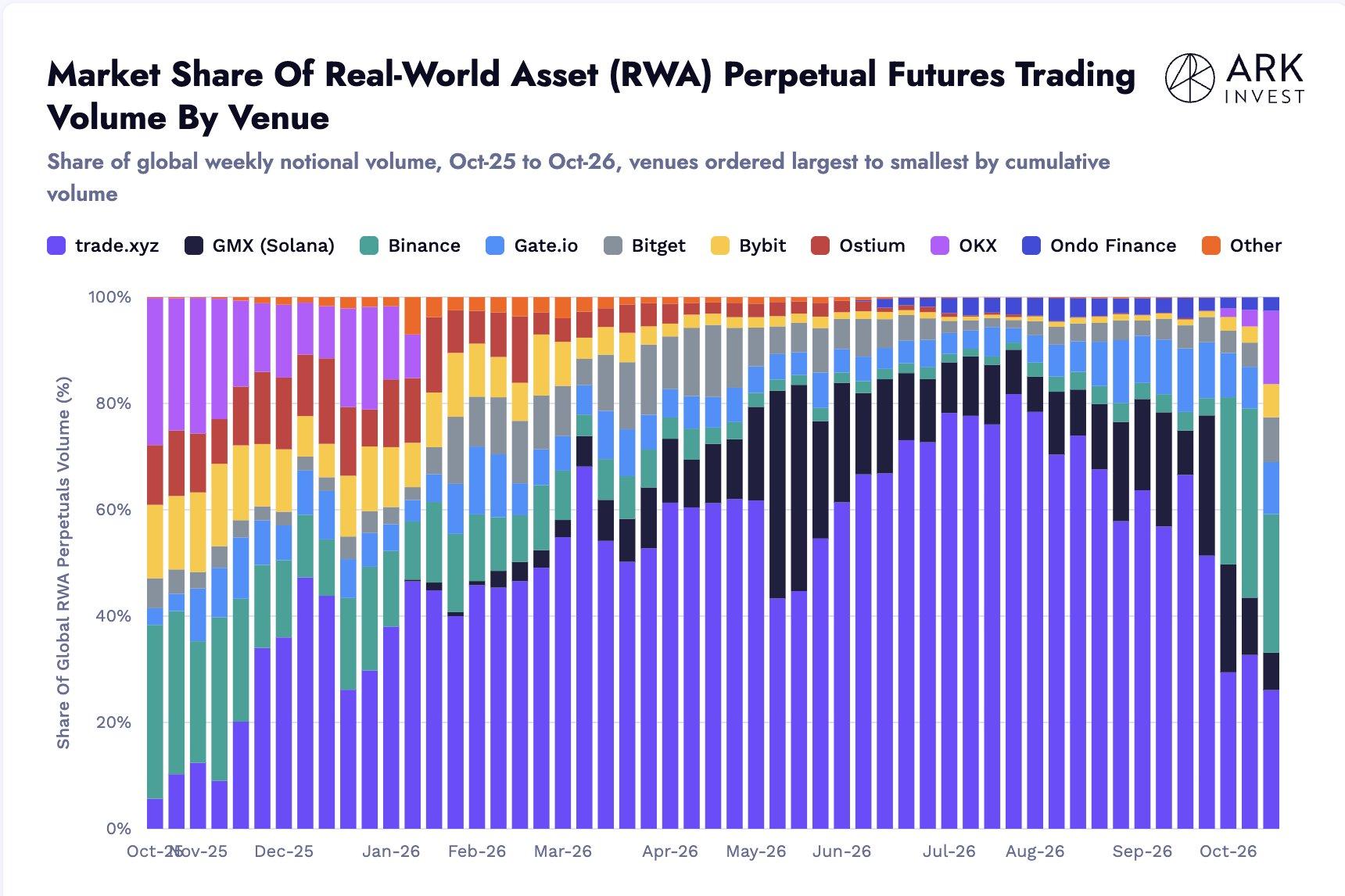
Rather than merely drawing existing volume away from other venues, centralised exchanges appear to be securing most of the incremental trading activity, the figures suggest.
Are CEXs gaining ground in RWA perpetuals at Hyperliquid’s expense?
Within two weeks, Binance reportedly lifted its share to 30% from 3%, with OKX reaching 14% during the same period. Gate and Bitget are strengthening their presence as well.
Behind this expansion is centralised exchanges’ ability to combine exposure to traditional assets with their established crypto trading products.
An early advantage for Hyperliquid was its round-the-clock access to assets whose traditional markets operate only during restricted hours.
At the start of the year, geopolitical tensions increased the appeal of oil perpetual futures as traders looked to react to events beyond conventional market hours. With continuous oil trading available on only a few venues, Hyperliquid drew activity from traders outside its core crypto-native audience.
That initial edge is now narrowing, however, as centralised exchanges introduce comparable access to traditional assets.
In March, Binance introduced TradFi perpetual contracts offering exposure to commodities such as gold and silver, selected stocks including Tesla and Intel, and exchange-traded funds (ETFs). Settled in USDT, these contracts support round-the-clock trading.
July saw OKX introduce more than 40 tokenised US stocks and ETFs, enabling 24/7 trading against USDT in supported regions. Through its unified markets, users can access assets such as Apple, Nvidia and Tesla using their existing exchange accounts.
Traditional financial institutions are also advancing into tokenised securities as this competitive landscape changes. In January, the NYSE outlined plans for a platform enabling 24/7 trading and blockchain-based settlement of tokenised securities, subject to regulatory approval.
Subsequently, plans for an on-chain tokenised securities venue were announced by OKX and NYSE parent Intercontinental Exchange (ICE) through their joint venture, OKXICE.
In September, the US Securities and Exchange Commission (SEC) also introduced its Innovation Exemption. This provides conditional, temporary regulatory relief for qualifying venues that trade certain tokenised US-listed stocks.
Hyperliquid nevertheless remains a major venue for perpetual futures despite its declining RWA market share, with total perpetual futures volume of $208.07 billion over 30 days.
Hyperliquid technical outlook: Can HYPE maintain the 100-day EMA and $75.6 support?
Near-term sentiment towards HYPE remains bearish on the daily chart, with the token trading at $77.8 at the time of writing, a decline of 3.8% over the past 24 hours. Although it rebounded from the 100-day EMA near $76, the price remains below the 20-day and 50-day Exponential Moving Averages (EMAs), which are grouped just above $82.00.
Weak momentum readings indicate that downward pressure continues despite the modest recovery from recent lows: the 14-day Relative Strength Index (RSI) stands at 41, while the Stochastic Oscillator (Stoch) is near 17.
The 100-day EMA offers immediate downside support slightly above the $75.69 horizontal level. Below that, the next support levels are $67.64, followed by $61.16.
For a recovery, the first resistance lies at $82.10, where the short-term EMAs converge, followed by a stronger hurdle at $85.04. Sustained trading above that zone would clear a path towards the major resistance marked at $97.84.
(The technical analysis of this story was written with the help of an AI tool. Know more.)
POPULAR ARTICLES
1Why are centralised exchanges gaining RWA market share at Hyperliquid’s expense?2Cardano Price Forecast: Why is whale selling intensifying ADA’s correction?3Fed hike bets keep gold at risk despite rebound from three-month low4EUR/JPY Price Forecast: Rebound from fresh 12-month lows puts pair near 176.005New Zealand Dollar approaches 0.5700 as RBNZ rate hike prospects lend support6Are weak tech earnings weighing on the United States Dollar Index?7Silver Price Forecast: XAG/USD Extends Fall Below $54.00 as YTD Lows Deepen8US Dollar weakness amid tech earnings and Middle East risk aversion lifts Canadian Dollar9Can the British Pound sustain gains above 1.3400 as hot CPI data strengthens BoE rate hike bets?
LIVE QUOTES


ALL ABOUT TECHNICAL
What Is an Order Block in Trading and How Can You Trade It?
Average True Range (ATR) Indicator: What Is the Formula, and How Do You Read and Use It?
What Is a Judas Swing? ICT Trading Strategy Explained With Examples
The Real Interest Rate: Are Your Savings Actually Earning Anything?
Butterfly Pattern Trading: How to Identify and Trade the Butterfly Harmonic Pattern
What Is a Rising Wedge Pattern and How Do You Trade It?
What Is a Descending Triangle Pattern and How Do You Trade It?
Accumulation, Manipulation and Distribution (AMD): ICT Power of 3 Trading Guide
How to Read the CPI Report Before You Trade It: A Trader's Guide to Headline and Core
Get Started!
Sign up and access the Global Markets in less than 3 minutes

Connect With Us












The information provided on this website is of a general nature only and does not constitute personal financial advice. Before acting on any information on this website, you should consider the suitability of the information in relation to your objectives, financial situation and needs. Investing in CFDs and FX Margin Contracts carries significant risks and is not suitable for all investors. You may lose more than your initial deposit. You do not own, or have, any interest in the underlying asset. We recommend that you seek independent advice and ensure you fully understand the risks involved before trading. It is important that you read and consider the disclosure document before you acquire any product listed on the website. The information and advertisements offered on this website are not intended for use by any person in any country or jurisdiction where such use would be contrary to local laws and regulations. The Products and Services offered on this website are not intended for residents of the United States, Malaysia and Thailand.
TMGM is authorized and regulated in various jurisdictions.
Trademax Australia Limited, trading as TMGM, is regulated by the Australian Securities and Investments Commission (ASIC), AFSL no. 436416 and is located at Level 28, One International Tower, 100 Barangaroo Avenue, 2000 Sydney, NSW Australia.
Email: [email protected]
Trademax Global Limited, trading as TMGM, is authorized and regulated by the Vanuatu Financial Services Commission (VFSC), registration number 40356 and registered at 1276, Kumul Highway, Port Vila, Vanuatu, Republic of Vanuatu.
Email: [email protected]
Trademax Global Markets (SE) Limited, trading as TMGM, is authorized and regulated by the Financial Services Authority (FSA) of Seychelles, with license number SD224. The company is registered at Office No 13, Providence Estate ABIS Centre, Mahe, Seychelles.
Email: [email protected]
Trademax Global Markets (International) Pty Ltd, trading as TMGM, is authorized and regulated by the Financial Services Commission, Mauritius (FSC) with license no. GB22201012, and registered at 33, Edith Cavell Street C/o IQ EQ Fund Services (Mauritius) Ltd Port Louis, 11324 Mauritius.
Email: [email protected]
Copyright © TMGM. All rights reserved