

Trading
Explore a wide range of markets with competitive pricing, deep liquidity, and advanced trading tools.
Learn More 
Platform
Trade seamlessly with TMGM's powerful platform, built for speed, precision, and a superior trading experience.
Learn More Trading Platform
Academy
Learn the fundamentals of trading with beginner-friendly resources, including guides, webinars, and market insights.
Learn More News & Analysis
Get real-time market updates and expert analysis to stay ahead of trading opportunities
Learn More News & Analysis
About
Learn what sets TMGM apart — our global presence, regulatory strength, and commitment to innovation in trading.
Learn More Why Choose TMGM
Sponsorship
Busy week for Ripple’s RLUSD: What changes for stablecoin holders?
Ripple’s RLUSD is gaining ground across institutional finance, with a major bank launching custody services, a new wallet integration making it easier for developers to build payments and agentic experiences on the network, and a brokerage platform planning to use the stablecoin for settlement. Together, the three developments mark another step forward connecting blockchain-based assets with traditional financial infrastructure.
For many years, cryptocurrencies and traditional finance were treated like two different worlds. Banks handled US dollars, bonds and traditional assets, while crypto exchanges handled digital tokens and coins.
However, that divide is narrowing. This week, three back-to-back events and developments helped bridge the gap, with new custody options, better wallet tools and a brokerage deal.
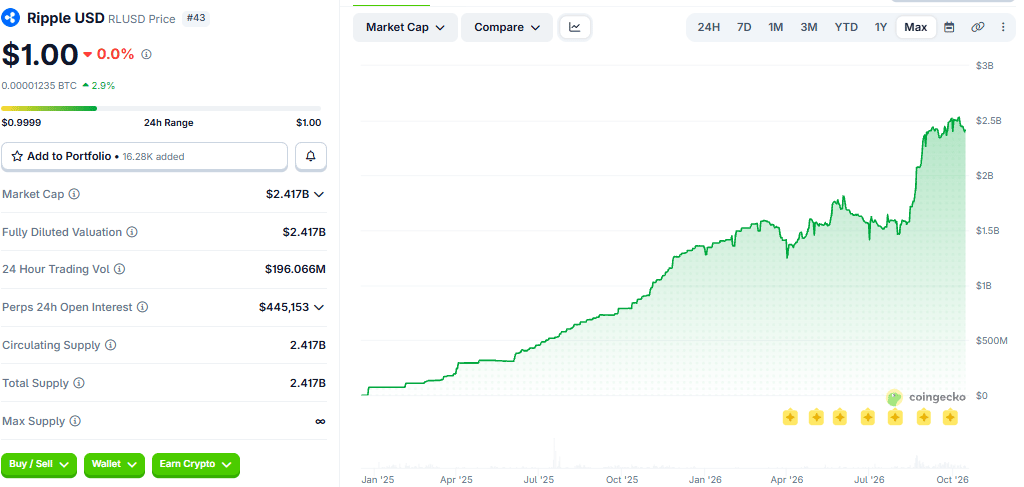
According to CoinGecko, Ripple USD’s (RLUSD) market capitalization stood around $2.41 billion on Thursday, up from $1.46 billion in early August. That represents an increase of approximately 65%. This growth highlights rising demand for the dollar-pegged stablecoin. Moreover, the latest institutional partnerships could open more room for adoption and expansion across payments, trading and financial settlement.
A major bank just made holding Ripple’s stablecoin a lot easier
The week began with one of the world’s largest international banks, Standard Chartered, announcing that it now supports institutional custody of RLUSD issued on the XRP Ledger (XRPL) through its Dubai International Financial Centre (DIFC) branch on Monday. This development shows how blockchain-based assets can integrate into the traditional financial system, including through established banking institutions.
This announcement means eligible institutional clients can now access RLUSD custody through a major regulated bank, instead of relying only on crypto exchanges or specialized custodians. For a new stablecoin, which was launched back in December 2024, that’s a big credibility boost.
Beyond custody, the bank is collaborating with Ripple and LMAX Group on a planned collateral integration. Under this arrangement, Standard Chartered intends to extend its collateral mirroring model to LMAX Group. This will be done by mirroring the value of eligible collateral to LMAX Group without requiring the underlying RLUSD to be transferred directly to the trading venue.
This arrangement is expected to give institutional clients greater flexibility in how they hold and deploy digital assets for trading, helping reduce transfer-related operational risk, optimize counterparty exposure and improve capital efficiency.
So far, the collateral part isn’t live yet as it still needs final documentation, successful testing and the necessary approvals. However, the custody service is up and running.
Privy partnership brings RLUSD-enabled programmable wallets
After the custody launch on Monday, Ripple announced a partnership with Privy, a wallet infrastructure company owned by Stripe, on Tuesday to bring programmable wallets to the XRP Ledger, enabling developers to build fintech applications and AI-agent payment solutions.
This lets builders easily add XRP Ledger wallets to their apps, and the wallets can handle XRP, RLUSD, and other assets on the network. This is not simply a wallet integration. It combines embedded stablecoin payments for consumer-facing applications with server-side wallets that let software agents hold and transact funds.
Moreover, this development could open new use cases for RLUSD in consumer payments, digital services and AI-driven commerce. However, it does not establish new RLUSD adoption volumes, institutional customers or actual payment activity.
DriveWealth adopts RLUSD for settlement and payments
Later on Wednesday, DriveWealth, a global Brokerage-as-a-Service platform, announced a partnership with Ripple to integrate RLUSD on the XRP Ledger into its planned stablecoin settlement infrastructure, cross-border payments, and digital asset custody.
The collaboration brings Ripple’s suite of blockchain solutions into DriveWealth’s brokerage infrastructure, creating a more unified experience across traditional and digital assets.
DriveWealth clients are expected to be able to fund and manage their collateral accounts using stablecoins that convert to cash in near real time instead of waiting on a bank wire. The companies plan to start with settlement in Europe and plan to expand to the US.
Moreover, both companies are also exploring opportunities across equity financing through Ripple Prime’s Delta One business, which expands its institutional capabilities across US equities and equity derivatives.
These moves show Ripple is focused on making the stablecoin useful for real settlement, holding assets safely, and moving money faster.
Does RLUSD growth push XRP higher?
Not directly. RLUSD and XRP serve different purposes within Ripple’s ecosystem. RLUSD is a US dollar-backed stablecoin designed to maintain a value close to $1, while XRP is a floating-price cryptocurrency that serves as the native asset of the XRP Ledger.
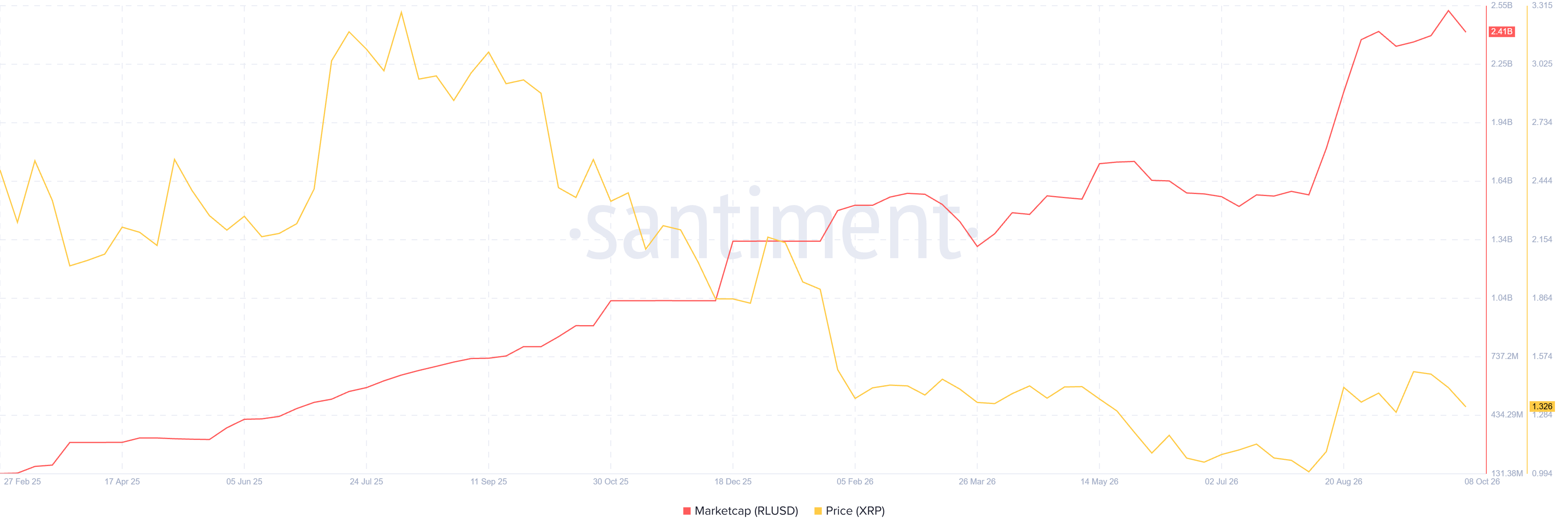
The Santiment chart below shows this clear distinction. RLUSD’s market capitalization (red line) has climbed sharply since the end of July. Over the same period, XRP’s price (yellow line) has fallen. This divergence suggests that growing demand for RLUSD does not translate into buying pressure or activity for XRP.
However, RLUSD’s expansion could still benefit XRP indirectly. As more banks, financial institutions and trading firms adopt RLUSD on the XRP Ledger, the network activity and institutional engagement could increase. This may support deeper liquidity, additional applications and broader adoption of the XRPL ecosystem, potentially providing support for XRP.
Key takeaways for RLUSD holders
This week showed practical developments and use cases for RLUSD, not just big promises. A major bank is introducing custody services, developers are gaining easier access to programmable wallets, and a brokerage platform is integrating RLUSD into its settlement infrastructure.
If these partnerships move into real usage and transaction volumes, RLUSD could become a widely used option for institutions looking for faster, easier ways to move and manage digital dollars.
These developments may not have an immediate impact, but they could help build stronger adoption and utility for RLUSD over the long term.
Ripple FAQs
Ripple is a payments company that specializes in cross-border remittance. The company does this by leveraging blockchain technology. RippleNet is a network used for payments transfer created by Ripple Labs Inc. and is open to financial institutions worldwide. The company also leverages the XRP token.
XRP is the native token of the decentralized blockchain XRPLedger. The token is used by Ripple Labs to facilitate transactions on the XRPLedger, helping financial institutions transfer value in a borderless manner. XRP therefore facilitates trustless and instant payments on the XRPLedger chain, helping financial firms save on the cost of transacting worldwide.
XRPLedger is based on a distributed ledger technology and the blockchain using XRP to power transactions. The ledger is different from other blockchains as it has a built-in inflammatory protocol that helps fight spam and distributed denial-of-service (DDOS) attacks. The XRPL is maintained by a peer-to-peer network known as the global XRP Ledger community.
XRP uses the interledger standard. This is a blockchain protocol that aids payments across different networks. For instance, XRP’s blockchain can connect the ledgers of two or more banks. This effectively removes intermediaries and the need for centralization in the system. XRP acts as the native token of the XRPLedger blockchain engineered by Jed McCaleb, Arthur Britto and David Schwartz.
Top Articles
1Forex Today: US Dollar extends slide as Fed Chair Warsh refrains from hinting at rate path2USD/CAD Price Forecast; Bears gain momentum below 142003GBP/USD Price Forecast: Fits fresh monthly high as bulls retain control above 1.32654Bitcoin steadies at $82,000: The five forces crushing the Uptober rally5Euro: Consolidation potential against US Dollar on CPI – ING6Euro surges against Canadian Dollar despite political uncertainty in France70.6900: A key level to watch for AUD/USD amid Head and Shoulders formation8Gold: Recovery hinges on real yields – OCBC9Dow Jones futures lead market gains following comments from US financial leaders
LIVE QUOTES

ALL ABOUT CRYPTO
Crypto Trading vs Stock Trading
Difference between Crypto Tokens and Crypto Coins
How to Trade Dogecoin (DOGE)
What is Dogecoin: How It Works, Value, Uses
CEX vs DEX: 9 Key Differences for Crypto Traders
How to Trade Ethereum (ETH)
How to Trade Litecoin (LTC)
What is Litecoin: How It Works, Price, Uses
Bitcoin vs Ethereum: 9 Key Differences
Get Started!
Sign up and access the Global Markets in less than 3 minutes

Connect With Us












The information provided on this website is of a general nature only and does not constitute personal financial advice. Before acting on any information on this website, you should consider the suitability of the information in relation to your objectives, financial situation and needs. Investing in CFDs and FX Margin Contracts carries significant risks and is not suitable for all investors. You may lose more than your initial deposit. You do not own, or have, any interest in the underlying asset. We recommend that you seek independent advice and ensure you fully understand the risks involved before trading. It is important that you read and consider the disclosure document before you acquire any product listed on the website. The information and advertisements offered on this website are not intended for use by any person in any country or jurisdiction where such use would be contrary to local laws and regulations. The Products and Services offered on this website are not intended for residents of the United States, Malaysia and Thailand.
TMGM is authorized and regulated in various jurisdictions.
Trademax Australia Limited, trading as TMGM, is regulated by the Australian Securities and Investments Commission (ASIC), AFSL no. 436416 and is located at Level 28, One International Tower, 100 Barangaroo Avenue, 2000 Sydney, NSW Australia.
Email: [email protected]
Trademax Global Limited, trading as TMGM, is authorized and regulated by the Vanuatu Financial Services Commission (VFSC), registration number 40356 and registered at 1276, Kumul Highway, Port Vila, Vanuatu, Republic of Vanuatu.
Email: [email protected]
Trademax Global Markets (SE) Limited, trading as TMGM, is authorized and regulated by the Financial Services Authority (FSA) of Seychelles, with license number SD224. The company is registered at Office No 13, Providence Estate ABIS Centre, Mahe, Seychelles.
Email: [email protected]
Trademax Global Markets (International) Pty Ltd, trading as TMGM, is authorized and regulated by the Financial Services Commission, Mauritius (FSC) with license no. GB22201012, and registered at 33, Edith Cavell Street C/o IQ EQ Fund Services (Mauritius) Ltd Port Louis, 11324 Mauritius.
Email: [email protected]
Copyright © TMGM. All rights reserved