

Trading
Explore a wide range of markets with competitive pricing, deep liquidity, and advanced trading tools.
Learn More 
Platform
Trade seamlessly with TMGM's powerful platform, built for speed, precision, and a superior trading experience.
Learn More Trading Platform
Academy
Learn the fundamentals of trading with beginner-friendly resources, including guides, webinars, and market insights.
Learn More News & Analysis
Get real-time market updates and expert analysis to stay ahead of trading opportunities
Learn More News & Analysis
About
Learn what sets TMGM apart — our global presence, regulatory strength, and commitment to innovation in trading.
Learn More Why Choose TMGM
Sponsorship
Top 3 Price Predictions: Bitcoin, Ethereum, Ripple – BTC, ETH and XRP rebound as major support levels cap recent sell-off
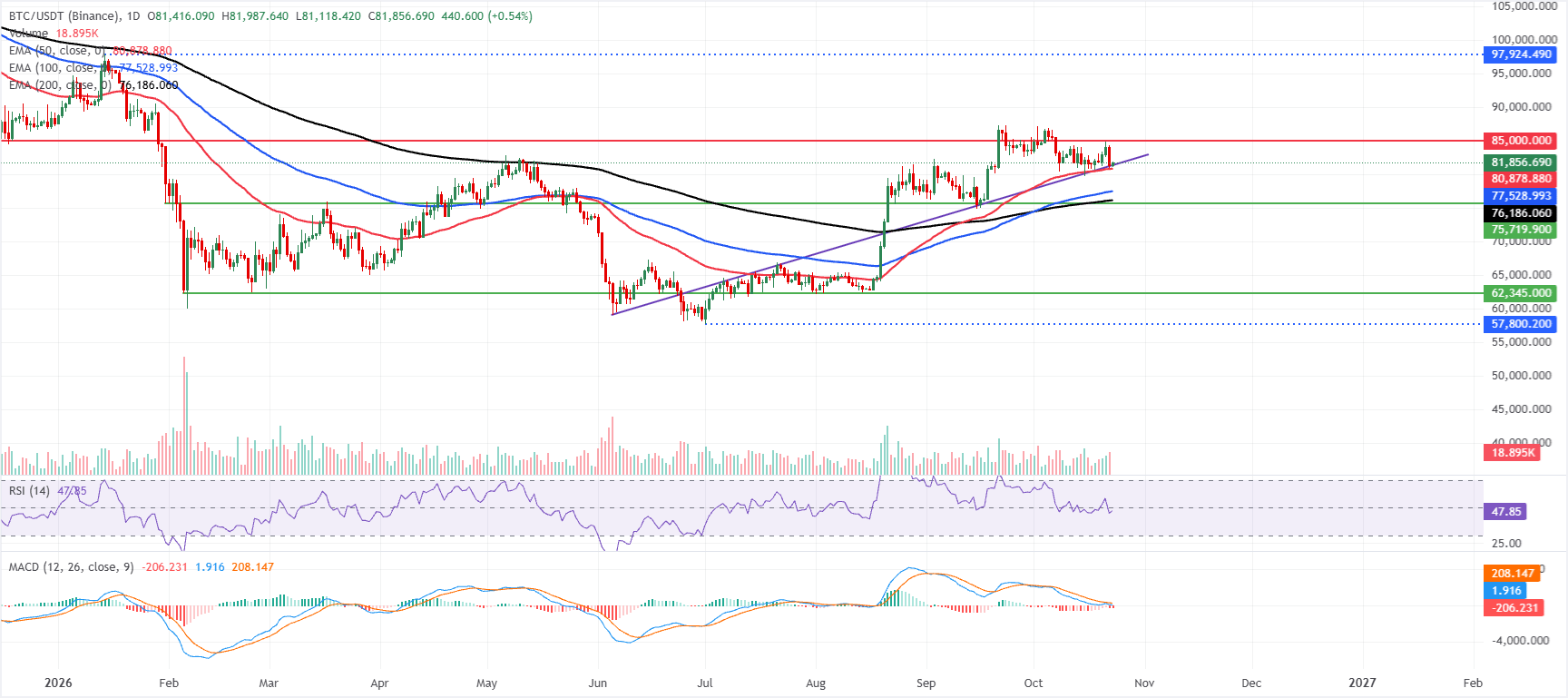
- Bitcoin rebounds modestly, trading above $81,800 on Friday after finding support around the 50-day EMA at $80,878.
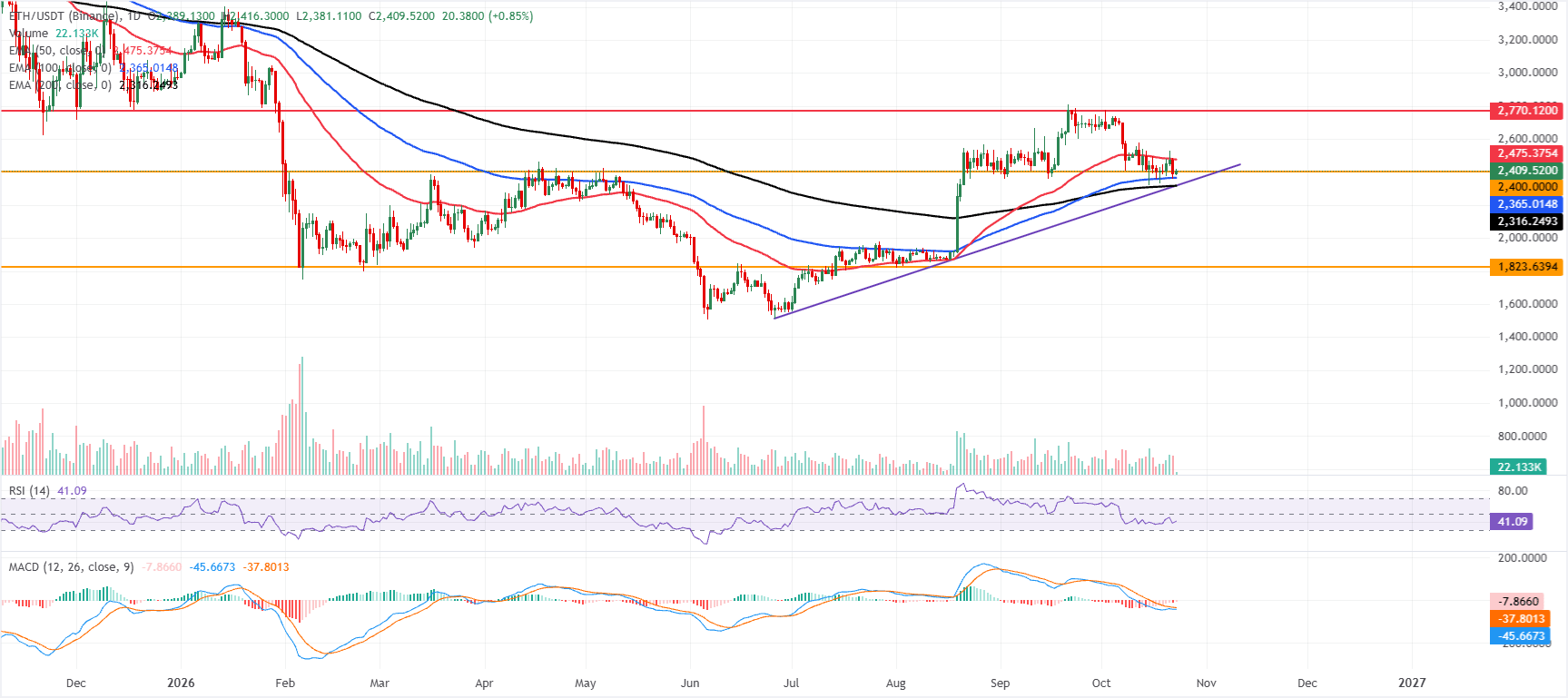
- Ethereum finds support around the 100-day EMA at $2,365, stabilizing after recent selling pressure.
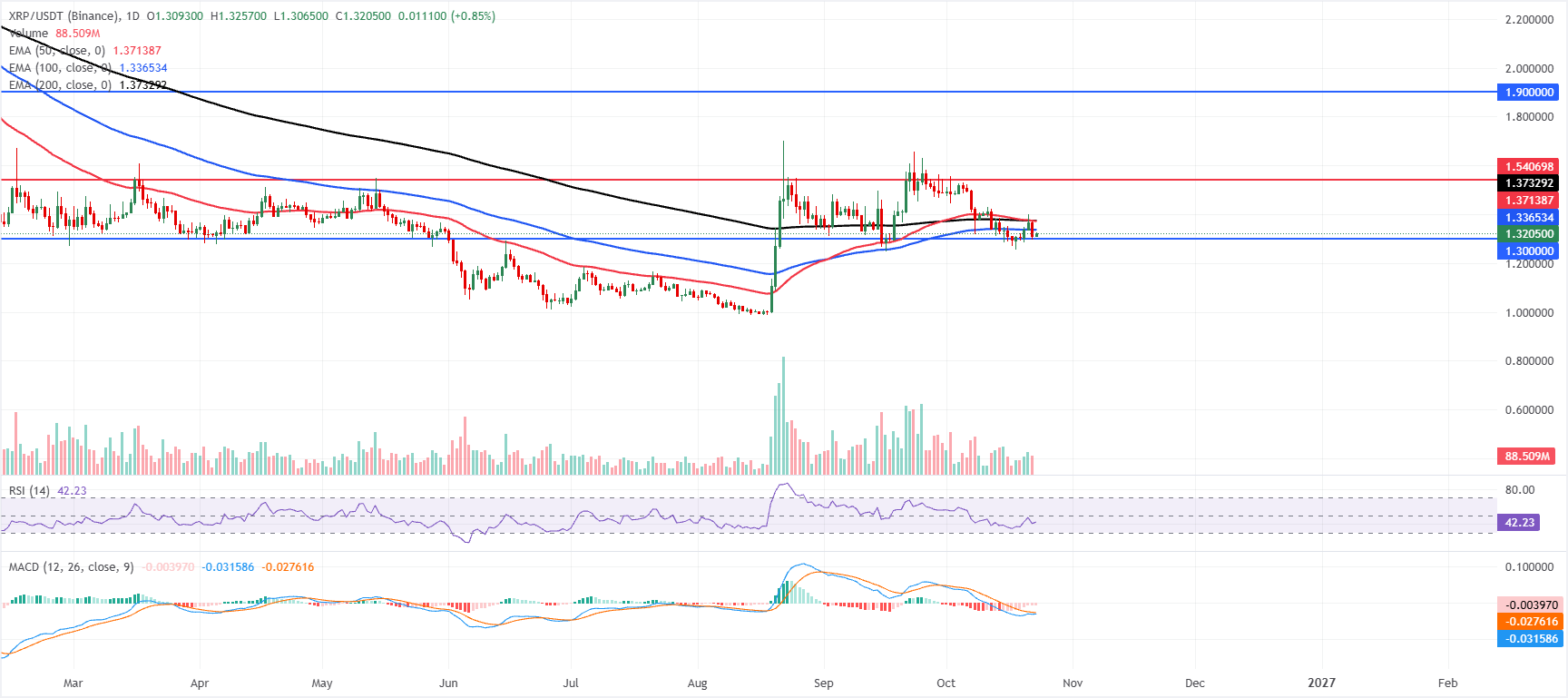
- XRP approaches horizontal support at $1.30, which continues to hold, trading around $1.32 on Friday.
Bitcoin (BTC), Ethereum (ETH) and Ripple (XRP) rebound modestly on Friday after correcting and testing their key support zone the previous day. BTC holds the 50-day Exponential Moving Average (EMA), ETH finds support around the 100-day EMA, while XRP holds the horizontal floor near $1.300. The price action of these top three cryptocurrencies suggests a recovery if this critical support zone holds; a decisive close below these levels suggests a deeper correction.

Bitcoin finds support around 50-day EMA
Bitcoin price trades at $81,856 on Friday, holding above the short- and medium-term Exponential Moving Averages (EMAs), which keeps the near-term bias mildly bullish despite the recent consolidation. The 50-day EMA at $80,878, together with the 100-day EMA at $77,528 and the 200-day EMA at $76,186, sit below price and suggest an underlying constructive trend, even as the Relative Strength Index (RSI) around 47 leans neutral. The Moving Average Convergence Divergence (MACD) remains slightly negative, hinting that upside momentum is not yet fully convincing.
On the topside, immediate resistance is seen at the horizontal barrier near $85,000, where prior supply could cap advances.
On the downside, initial support is provided by the 50-day EMA at $80,878, followed by deeper structural demand around the 100-day EMA at $77,528 and the 200-day EMA at $76,186, levels that would be expected to attract buyers on any broader pullback within the prevailing uptrend.
Ethereum stabilizes around the $2,400 mark
Ethereum price trades at $2,409 on Friday, holding a constructive near-term bias as it sits above the 100-day and 200-day EMAs, which underpin the broader uptrend. ETH has recently pulled back from late-February highs, but the pair is stabilizing just over nearby horizontal support around $2,400.
Momentum conditions are subdued, with the RSI near 41 and the MACD still negative, suggesting upside attempts may remain gradual as the market digests prior gains.
On the topside, immediate resistance is seen at the 50-day EMA around $2,475, and a decisive daily close above this barrier would open the way toward the next key hurdle at the horizontal level near $2,770.
On the downside, initial demand is located at the $2,400 area, followed by a more important support cluster defined by the reclaimed trendline region and the 100-day and 200-day EMAs between roughly $2,365 and $2,316; a break beneath this zone would weaken the bullish structure and expose deeper losses toward the $1,823 horizontal floor.
XRP holds the horizontal floor near $1.300
XRP price trades at $1.320 on Friday, maintaining a bearish near-term bias as price holds beneath the 100-day, 50-day and 200-day EMAs clustered between roughly $1.336 and $1.373.
This configuration suggests rallies remain capped by the broader downtrend, while the RSI at 42 keeps momentum in mildly negative territory. The MACD stays marginally below zero, hinting that downside pressure persists even as recent selling has moderated.
On the topside, initial resistance emerges at the 100-day EMA around $1.336, ahead of a dense hurdle formed by the 50-day EMA at $1.371 and the 200-day EMA at $1.373, with a stronger barrier further up at the horizontal level of $1.540 and then $1.900.
On the downside, immediate support is seen at the horizontal floor near $1.300, and a daily close below this level would likely open the door for a deeper pullback. At the same time, any sustained recovery above the EMA cluster would be needed to ease the current bearish tone.
(The technical analysis of this story was written with the help of an AI tool. Know more.)
Cryptocurrency prices FAQs
Token launches influence demand and adoption among market participants. Listings on crypto exchanges deepen the liquidity for an asset and add new participants to an asset’s network. This is typically bullish for a digital asset.
A hack is an event in which an attacker captures a large volume of the asset from a DeFi bridge or hot wallet of an exchange or any other crypto platform via exploits, bugs or other methods. The exploiter then transfers these tokens out of the exchange platforms to ultimately sell or swap the assets for other cryptocurrencies or stablecoins. Such events often involve an en masse panic triggering a sell-off in the affected assets.
Macroeconomic events like the US Federal Reserve’s decision on interest rates influence crypto assets mainly through the direct impact they have on the US Dollar. An increase in interest rate typically negatively influences Bitcoin and altcoin prices, and vice versa. If the US Dollar index declines, risk assets and associated leverage for trading gets cheaper, in turn driving crypto prices higher.
Halvings are typically considered bullish events as they slash the block reward in half for miners, constricting the supply of the asset. At consistent demand if the supply reduces, the asset’s price climbs.
Top Articles
1Top 3 Price Predictions: Bitcoin, Ethereum, Ripple – BTC, ETH and XRP rebound as major support levels cap recent sell-off2Swiss Franc inches lower as US Dollar recovers recent losses3Why Hyperliquid is losing RWA market share to centralized exchanges4Cardano Price Forecast: Whale selling deepens ADA correction5Gold rebounds from three-month low; not out of the woods yet amid Fed hike bets6EUR/JPY Price Forecast: Trades around 176.00 after rebounding from fresh 12-month lows7New Zealand Dollar gains ground to near 0.5700 on RBNZ rate hike prospects 8United States Dollar Index struggles due to weak tech earnings9Silver Price Forecast: XAG/USD slides further below $54.00, fresh YTD low and counting
LIVE QUOTES


ALL ABOUT TECHNICAL
Order Block in Trading: What It Is and How to Trade It
Average True Range (ATR) Indicator: Formula, How to Read It, and How to Use It
Judas Swing: Meaning, ICT Trading Strategy and Examples
Butterfly Pattern Trading: How to Identify and Trade the Butterfly Harmonic Pattern
What Is a Rising Wedge Pattern and How Do You Trade It?
What Is a Descending Triangle Pattern and How Do You Trade It?
Accumulation, Manipulation and Distribution (AMD): ICT Power of 3 Trading Guide
Backtesting in Trading: What It Is and How to Backtest a Strategy
RSI Divergence: Bullish, Bearish and Hidden Divergence Explained
Get Started!
Sign up and access the Global Markets in less than 3 minutes

Connect With Us












The information provided on this website is of a general nature only and does not constitute personal financial advice. Before acting on any information on this website, you should consider the suitability of the information in relation to your objectives, financial situation and needs. Investing in CFDs and FX Margin Contracts carries significant risks and is not suitable for all investors. You may lose more than your initial deposit. You do not own, or have, any interest in the underlying asset. We recommend that you seek independent advice and ensure you fully understand the risks involved before trading. It is important that you read and consider the disclosure document before you acquire any product listed on the website. The information and advertisements offered on this website are not intended for use by any person in any country or jurisdiction where such use would be contrary to local laws and regulations. The Products and Services offered on this website are not intended for residents of the United States, Malaysia and Thailand.
TMGM is authorized and regulated in various jurisdictions.
Trademax Australia Limited, trading as TMGM, is regulated by the Australian Securities and Investments Commission (ASIC), AFSL no. 436416 and is located at Level 28, One International Tower, 100 Barangaroo Avenue, 2000 Sydney, NSW Australia.
Email: [email protected]
Trademax Global Limited, trading as TMGM, is authorized and regulated by the Vanuatu Financial Services Commission (VFSC), registration number 40356 and registered at 1276, Kumul Highway, Port Vila, Vanuatu, Republic of Vanuatu.
Email: [email protected]
Trademax Global Markets (SE) Limited, trading as TMGM, is authorized and regulated by the Financial Services Authority (FSA) of Seychelles, with license number SD224. The company is registered at Office No 13, Providence Estate ABIS Centre, Mahe, Seychelles.
Email: [email protected]
Trademax Global Markets (International) Pty Ltd, trading as TMGM, is authorized and regulated by the Financial Services Commission, Mauritius (FSC) with license no. GB22201012, and registered at 33, Edith Cavell Street C/o IQ EQ Fund Services (Mauritius) Ltd Port Louis, 11324 Mauritius.
Email: [email protected]
Copyright © TMGM. All rights reserved