

Trading
Explore a wide range of markets with competitive pricing, deep liquidity, and advanced trading tools.
Learn More 
Platform
Trade seamlessly with TMGM's powerful platform, built for speed, precision, and a superior trading experience.
Learn More Trading Platform
Academy
Learn the fundamentals of trading with beginner-friendly resources, including guides, webinars, and market insights.
Learn More News & Analysis
Get real-time market updates and expert analysis to stay ahead of trading opportunities
Learn More News & Analysis
About
Learn what sets TMGM apart — our global presence, regulatory strength, and commitment to innovation in trading.
Learn More Why Choose TMGM
Sponsorship
Above $4,130: Gold recovers as Oil eases ahead of Fed decision
- 0.15% higher: Gold reaches $4,132 following a rebound from $4,106.
- Oil prices decline as the US permits the unloading of blocked cargoes.
- 14% odds of an October Fed rate hike remain unchanged, against 89% for December.
$4,133 is Gold’s (XAU/USD) price at the time of writing. The metal is up 0.25% on Wednesday, having recovered from the daily low of $4,106. Its modest advance comes as Oil prices ease following US authorisation to unload cargo from some blocked vessels, which prompted a decline in Oil markets.

XAU/USD rebounds on softer Oil and stable Treasury yields
Improved market sentiment is limiting bullion’s gains, even as developments in the US-Iran war continue. According to newswires, Pakistani Army chief Asim Munir presented a “compromise proposal,” during a meeting with Iranian officials in Tehran. N12 news reported that Munir conveyed the US “final warning” to Tehran: attacks could resume unless Iran agrees to a peace deal.
According to Al Hadath, Iran's Secretary of the Supreme National Security Council, Mohsen Rezaei, told Munir that Iran explicitly rejected the American demands.
A positive development also emerged in the Russia-Ukraine war. The Kremlin agreed that Abu Dhabi may host another round of trilateral talks involving the United States, Russia, and Ukraine.
With few US economic releases on the calendar, market participants are taking their cue from US equities. Stocks have extended their advance as AI hype drives a surge in technology shares.
Stable US Treasury yields are underpinning Gold’s rise. The benchmark US 10-year note yield is unchanged at 5.111%, while the Greenback is posting marginal losses.
At 101.67, the US Dollar Index (DXY) is 0.05% lower. The index tracks the US currency against a basket of six currencies.
The near-term policy outlook for the Federal Reserve (Fed) is another factor behind Gold’s gains. According to Prime Terminal, markets assign a 14% probability to a 25-basis-point hike in October, while December’s probability remains elevated at near 89%.
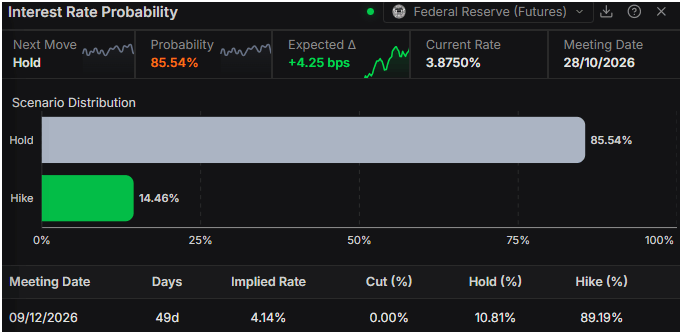
Next week’s Fed meeting is coming into focus for traders, alongside the release of the Core Personal Consumption Expenditures (PCE) Price Index, the US central bank’s preferred inflation measure.
For this week, attention centres on US Initial Jobless Claims and October’s University of Michigan Consumer Sentiment release.
$4,100-$4,200 range holds: XAU/USD technical analysis
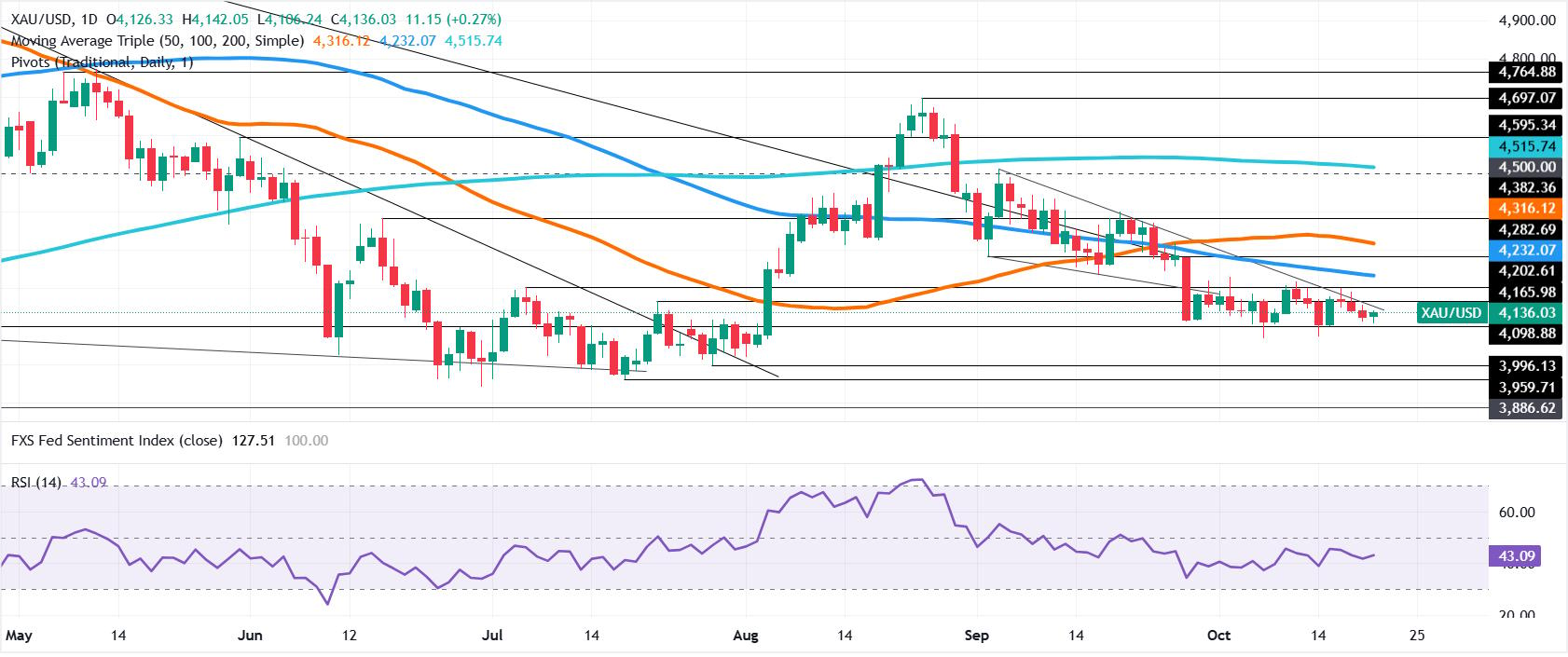
For the sixteenth consecutive day, Gold remains in a sideways trading range of $4,100-$4,200. Although there is no clear directional bias, its decline of nearly 26% from the record high near $5,600 points to a medium-term downtrend.
The Relative Strength Index (RSI) shows bearish momentum but is edging higher. That mixed signal suggests consolidation is likely to continue.
The downside therefore remains the path of least resistance for XAU/USD, with initial support at $4,100. A break below would bring the October 14 low of $4,073 into view, immediately followed by the July 29 cycle low of $3,996. Further support sits at the July 17 low of $3,959, then the year-to-date (YTD) low of $3,941.
A bullish reversal would encounter resistance at $4,200, followed by the 100-day Simple Moving Average (SMA) at $4,235, the 50-day SMA at $4,316 and then $4,500.
Gold: key questions
Widely used as both a store of value and a medium of exchange, Gold has held an important place throughout human history. Beyond its lustre and use in jewellery, the precious metal is now widely regarded as a safe-haven asset, or a good investment in periods of turmoil. Because it does not depend on a particular issuer or government, Gold is also commonly viewed as a hedge against inflation and currency depreciation.
The largest holders of Gold are central banks. To support their currencies during turbulent periods, they typically diversify reserves and purchase Gold, reinforcing perceptions of economic and currency strength. Substantial Gold reserves can bolster confidence in a country’s solvency. World Gold Council data show that central banks increased their reserves by 1,136 tonnes of Gold, worth around $70 billion, in 2022. That represents the largest annual purchase since records began. Emerging-economy central banks, including those in China, India and Turkey, are rapidly expanding their Gold reserves.
Both the US Dollar and US Treasuries are major reserve and safe-haven assets, and Gold is inversely correlated with them. A depreciating Dollar tends to lift Gold, allowing investors and central banks to diversify their holdings during turbulent periods. The metal also has an inverse relationship with risk assets: stock-market rallies tend to weigh on Gold, whereas selling in riskier markets tends to support it.
Many factors can influence Gold prices. Its safe-haven role means geopolitical instability or fears of a deep recession can trigger a rapid price rise. Gold pays no yield, so lower interest rates tend to support it, while higher borrowing costs generally weigh on the metal. Most price movements, however, hinge on the US Dollar (USD), as Gold is quoted in dollars (XAU/USD). Dollar strength tends to restrain Gold prices; a weaker Dollar is likely to lift them.
POPULAR ARTICLES
1Colombian Peso: Further tightening expected from BanRep – Standard Chartered2Asia FX: Safe havens in focus amid risk-off bias – MUFG36.50% through 2027: Banxico expected to stay on hold, Citi Mexico Survey shows4Above $4,130: Gold recovers as Oil eases ahead of Fed decision5Forex Today: Markets keep watch on US data and geopolitics6XRP and XLM Regain Momentum: Ripple and Stellar Outlook as Derivatives Activity Increases7One-month high for Australian Dollar as hawkish RBA lends support81.3400 remains out of reach as British Pound stalls despite hot UK CPI and BoE rate-hike bets9$84K in Focus: Bitcoin vs Gold Forecast as BTC gathers pace and XAU jumps above $4,100
LIVE QUOTES


ALL ABOUT GOLD & PRECIOUS METALS
Get Started!
Sign up and access the Global Markets in less than 3 minutes

Connect With Us












The information provided on this website is of a general nature only and does not constitute personal financial advice. Before acting on any information on this website, you should consider the suitability of the information in relation to your objectives, financial situation and needs. Investing in CFDs and FX Margin Contracts carries significant risks and is not suitable for all investors. You may lose more than your initial deposit. You do not own, or have, any interest in the underlying asset. We recommend that you seek independent advice and ensure you fully understand the risks involved before trading. It is important that you read and consider the disclosure document before you acquire any product listed on the website. The information and advertisements offered on this website are not intended for use by any person in any country or jurisdiction where such use would be contrary to local laws and regulations. The Products and Services offered on this website are not intended for residents of the United States, Malaysia and Thailand.
TMGM is authorized and regulated in various jurisdictions.
Trademax Australia Limited, trading as TMGM, is regulated by the Australian Securities and Investments Commission (ASIC), AFSL no. 436416 and is located at Level 28, One International Tower, 100 Barangaroo Avenue, 2000 Sydney, NSW Australia.
Email: [email protected]
Trademax Global Limited, trading as TMGM, is authorized and regulated by the Vanuatu Financial Services Commission (VFSC), registration number 40356 and registered at 1276, Kumul Highway, Port Vila, Vanuatu, Republic of Vanuatu.
Email: [email protected]
Trademax Global Markets (SE) Limited, trading as TMGM, is authorized and regulated by the Financial Services Authority (FSA) of Seychelles, with license number SD224. The company is registered at Office No 13, Providence Estate ABIS Centre, Mahe, Seychelles.
Email: [email protected]
Trademax Global Markets (International) Pty Ltd, trading as TMGM, is authorized and regulated by the Financial Services Commission, Mauritius (FSC) with license no. GB22201012, and registered at 33, Edith Cavell Street C/o IQ EQ Fund Services (Mauritius) Ltd Port Louis, 11324 Mauritius.
Email: [email protected]
Copyright © TMGM. All rights reserved