

Trading
Explore a wide range of markets with competitive pricing, deep liquidity, and advanced trading tools.
Learn More 
Platform
Trade seamlessly with TMGM's powerful platform, built for speed, precision, and a superior trading experience.
Learn More Trading Platform
Academy
Learn the fundamentals of trading with beginner-friendly resources, including guides, webinars, and market insights.
Learn More News & Analysis
Get real-time market updates and expert analysis to stay ahead of trading opportunities
Learn More News & Analysis
About
Learn what sets TMGM apart — our global presence, regulatory strength, and commitment to innovation in trading.
Learn More Why Choose TMGM
Sponsorship
New Zealand Dollar extends winning streak ahead of inflation report
- 0.5700 cleared as NZD/USD extends gains into a fifth consecutive session.
- October 28 remains an open decision, says RBNZ Chief Economist Conway.
- 3.8% annual inflation forecast exceeds the RBNZ's 1%-3% target range.
NZD/USD is trading just above 0.5700. Five consecutive daily advances have taken it to its highest since September 23, just below its 50-day average. Stats NZ releases the third-quarter Consumer Price Index (CPI) at 21:45 GMT on Wednesday, ahead of the Reserve Bank of New Zealand (RBNZ) decision on October 28. With swaps assigning about an 80% probability to an Official Cash Rate (OCR) increase from 2.75% to 3.00%, the inflation figures could make a hike a certainty or reopen doubts.

80% hike probability contrasts with Conway's open October decision
A broadly softer US Dollar helped place the New Zealand Dollar among Wednesday's stronger major currencies. Domestic card spending increased 6.9% year on year in September, accelerating from 3.5% in August. Stronger spending supports the case for another rate rise. Following RBNZ increases in July and on September 2, a third hike would lift the OCR to 3.00%, within a point of the midpoint of the Fed's 3.75%-4.00% range.
Although RBNZ Chief Economist Conway described the October decision as wide open, he said rates would most likely move higher. The record of the September 2 increase to 2.75% showed that he and one other committee member considered inflation risks balanced; the remaining four judged them skewed to the upside. One of those two previously balanced voices now sees a rate increase as the most likely direction.
Crude Oil prices and the exchange rate were also among the upside inflation risks identified by Chief Economist Conway, directly linking the policy decision to NZD/USD. When the Kiwi weakens, New Zealand pays more for everything it purchases overseas. Its five-session advance has therefore reduced one of the upside risks he highlighted.
Two tenths above projection: last quarter's RBNZ inflation miss
Annual inflation is expected to ease from 4.1% to 3.8%, while the quarterly CPI increase is forecast at 0.8%, down from 1.5%. The RBNZ projects quarterly inflation of 0.8% and an annual rate of 3.9%. Even a reading in line with the market forecast would leave annual inflation 0.8 points above the ceiling of its 1%-3% target band. The bank expects inflation to return to that band by mid-2027 and reach the 2% midpoint later that year.
Unless CPI falls substantially short of forecasts, analysts expect the RBNZ to raise rates on October 28. A third-quarter undershoot of the bank's projection remains possible, although second-quarter inflation reached 4.1% against its 3.9% estimate. An annual reading of 3.9% or higher would leave a hike almost fully priced into NZD/USD. The first test would then be the 50-day average immediately overhead. Some analysts already judge the Kiwi undervalued relative to its short-term fair value.
90% probability priced for a Fed hike by December
US jobless claims are forecast at 200K, compared with the previous 199K, when Thursday's figures arrive at 12:30 GMT. On Friday at 13:45 GMT, S&P Global releases its preliminary US Purchasing Managers Index (PMI) readings. Manufacturing is expected to ease from 55.9 to 55.6, with services forecast to fall from 58.8 to 57.9.
Futures imply unchanged Fed rates on October 28 and about a 90% probability of an increase by December. For the Kiwi, the significance is that the two central banks influence the same rate differential from opposite sides. An October RBNZ increase of a quarter-point would narrow the gap by a quarter-point; a December Fed rise of a quarter-point would restore the original gap. US figures that strengthen the case for a December hike consequently reduce the value of an October RBNZ increase for NZD/USD.
50-day average caps NZD/USD: key levels
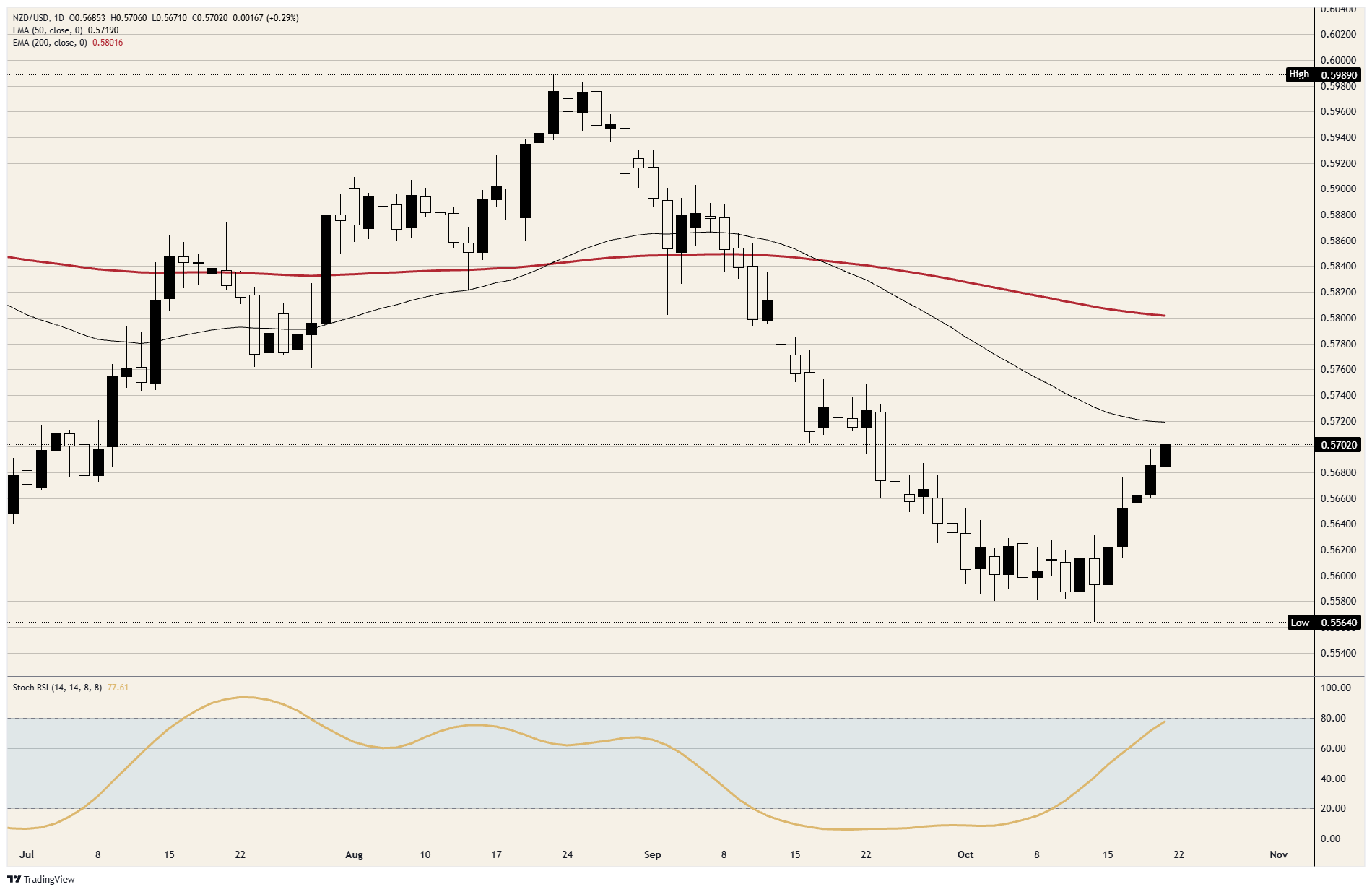
Resistance: Wednesday's high, slightly above 0.5700, fell just short of the 50-day Exponential Moving Average (EMA). NZD/USD has remained below that average since early September. The September 22 rebound peaked at 0.5750, while the September 18 high lies just below 0.5800.
Support: Just above 0.5650, Wednesday's low remained higher than Tuesday's. The five-session advance began at 0.5600 on October 15.
Bias: The long bias remains valid while daily closes hold above 0.5650, with targets at 0.5750 followed by 0.5800. At about 78, the daily Stochastic Relative Strength Index (Stoch RSI) is approaching overbought territory. A CPI disappointment would therefore hit an already stretched advance. A daily close below 0.5600 invalidates the long position.
Daily NZD/USD price chart
New Zealand Dollar: frequently asked questions
Economic conditions in New Zealand and the country's central bank policy broadly determine the value of the New Zealand Dollar (NZD), a widely recognised traded currency also called the Kiwi. Several distinctive factors also influence its movements. China is New Zealand's largest trading partner, making Chinese economic performance an important driver. Negative economic news from China is likely to reduce demand for New Zealand exports, weighing on the domestic economy and, in turn, the currency. Dairy prices are another influence, as the dairy industry is New Zealand's main export sector. Higher prices lift export earnings, supporting both the economy and NZD.
A medium-term inflation rate of between 1% and 3%, kept close to the 2% midpoint, is the Reserve Bank of New Zealand's (RBNZ) objective. The bank adjusts interest rates to an appropriate level to achieve and maintain that goal. Excessive inflation prompts rate increases to slow economic activity. Higher rates also raise bond yields, making investment in New Zealand more attractive and supporting NZD. Lower rates, by contrast, generally weaken the currency. NZD/USD can also respond strongly to the rate differential: the gap between actual or expected New Zealand interest rates and those set by the US Federal Reserve.
New Zealand's macroeconomic releases provide important evidence of economic health and can alter the New Zealand Dollar's (NZD) valuation. Strong growth, low unemployment and high confidence underpin a healthy economy, which supports NZD. Robust growth draws foreign investment and, when accompanied by elevated inflation, may encourage the Reserve Bank of New Zealand to raise rates. Weak economic figures, in contrast, are likely to lead to NZD depreciation.
Risk-on conditions generally support the New Zealand Dollar (NZD). When investors see limited risks across markets and feel optimistic about growth, the outlook for commodities and so-called ‘commodity currencies’ such as the Kiwi tends to improve. Market turbulence or economic uncertainty usually has the opposite effect: investors sell higher-risk assets in favour of more stable safe havens, tending to weaken NZD.
POPULAR ARTICLES
11400 Against US Dollar: South Korean Won Faces Mounting Downside Risks – TD Securities2DOGE Price Forecast: Resistance ahead as Dogecoin Labs makes its debut3New Zealand Dollar extends winning streak ahead of inflation report4Strong exports contrast with Taiwan Dollar FX pressure – Commerzbank5$57 at risk: Silver Price Forecast as rebound fails6$2,500 retest for Ethereum as SpaceX rally boosts tech stocks7Singapore Dollar: Upward bias remains intact within range against US Dollar – UOB8Indonesian Rupiah: MSCI risk weighs as BI keeps rates unchanged – BBH918.70 draws closer for USD/MXN as Iran tensions intensify Mexican Peso sell-off
LIVE QUOTES


Get Started!
Sign up and access the Global Markets in less than 3 minutes

Connect With Us












The information provided on this website is of a general nature only and does not constitute personal financial advice. Before acting on any information on this website, you should consider the suitability of the information in relation to your objectives, financial situation and needs. Investing in CFDs and FX Margin Contracts carries significant risks and is not suitable for all investors. You may lose more than your initial deposit. You do not own, or have, any interest in the underlying asset. We recommend that you seek independent advice and ensure you fully understand the risks involved before trading. It is important that you read and consider the disclosure document before you acquire any product listed on the website. The information and advertisements offered on this website are not intended for use by any person in any country or jurisdiction where such use would be contrary to local laws and regulations. The Products and Services offered on this website are not intended for residents of the United States, Malaysia and Thailand.
TMGM is authorized and regulated in various jurisdictions.
Trademax Australia Limited, trading as TMGM, is regulated by the Australian Securities and Investments Commission (ASIC), AFSL no. 436416 and is located at Level 28, One International Tower, 100 Barangaroo Avenue, 2000 Sydney, NSW Australia.
Email: [email protected]
Trademax Global Limited, trading as TMGM, is authorized and regulated by the Vanuatu Financial Services Commission (VFSC), registration number 40356 and registered at 1276, Kumul Highway, Port Vila, Vanuatu, Republic of Vanuatu.
Email: [email protected]
Trademax Global Markets (SE) Limited, trading as TMGM, is authorized and regulated by the Financial Services Authority (FSA) of Seychelles, with license number SD224. The company is registered at Office No 13, Providence Estate ABIS Centre, Mahe, Seychelles.
Email: [email protected]
Trademax Global Markets (International) Pty Ltd, trading as TMGM, is authorized and regulated by the Financial Services Commission, Mauritius (FSC) with license no. GB22201012, and registered at 33, Edith Cavell Street C/o IQ EQ Fund Services (Mauritius) Ltd Port Louis, 11324 Mauritius.
Email: [email protected]
Copyright © TMGM. All rights reserved