

Trading
Explore a wide range of markets with competitive pricing, deep liquidity, and advanced trading tools.
Learn More 
Platform
Trade seamlessly with TMGM's powerful platform, built for speed, precision, and a superior trading experience.
Learn More Trading Platform
Academy
Learn the fundamentals of trading with beginner-friendly resources, including guides, webinars, and market insights.
Learn More News & Analysis
Get real-time market updates and expert analysis to stay ahead of trading opportunities
Learn More News & Analysis
About
Learn what sets TMGM apart — our global presence, regulatory strength, and commitment to innovation in trading.
Learn More Why Choose TMGM
Sponsorship
0.8200 Area: USD/CHF Price Forecast as Bulls Defend 50-Day SMA
- 0.8191 marks the USD/CHF rebound point. The pair holds 50-day SMA support around 0.8193.
- The bullish market structure holds, but a bearish RSI points to fading momentum.
- 0.8250 must be regained to open the way to 0.8300; a break below 0.8193 puts 0.8134 at risk.
USD/CHF is down 0.46%. Trading at 0.8205, the pair is moving towards 0.8200. The Swiss Franc and Japanese Yen, both safe-haven currencies, are the only currencies gaining against the Greenback on the day.
USD/CHF Price Forecast: Key Technical Levels

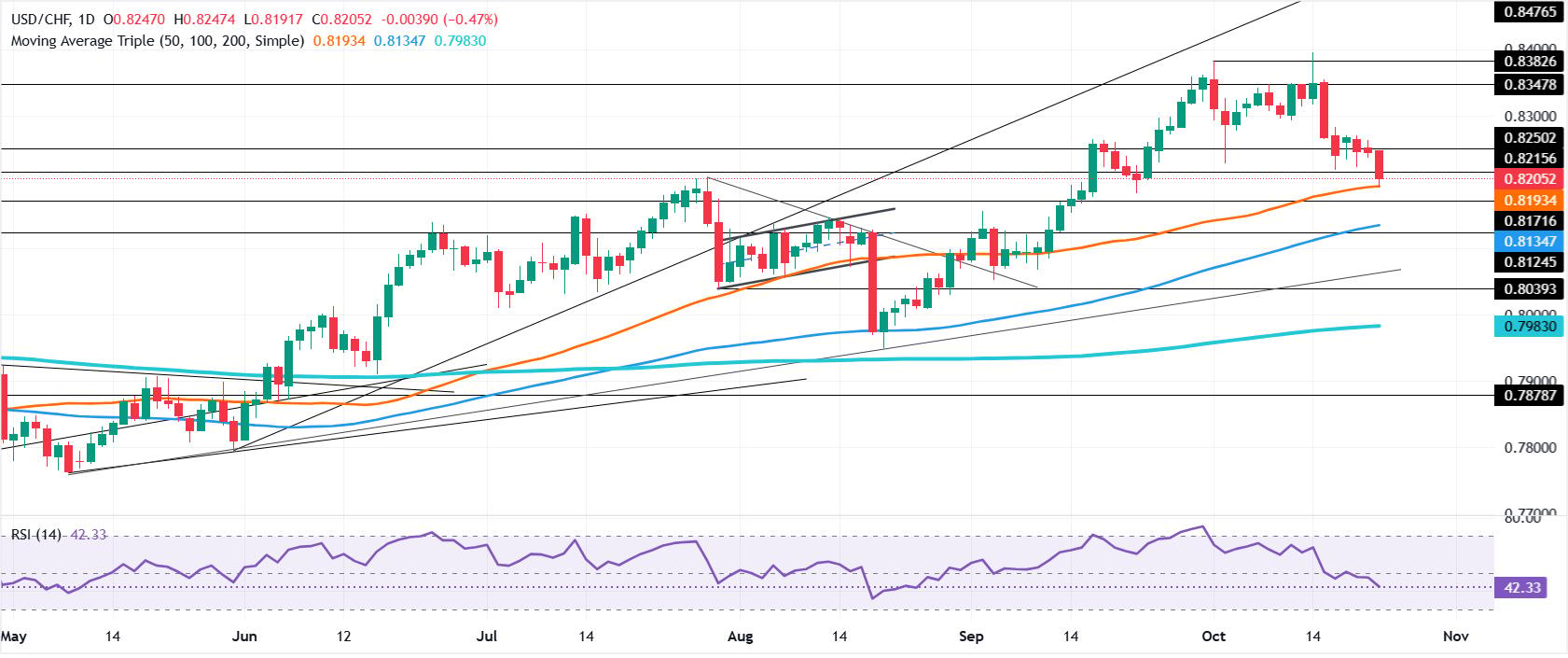
The upward trend in USD/CHF remains intact despite the pullback. Buyers lifted the pair back above 0.82 after a brief break below the 50-day Simple Moving Average (SMA) at 0.8193. The low of the day (LOD), at 0.8191, was close to that average.
Further gains are expected on the basis of market structure, although the Relative Strength Index (RSI) points to bearish momentum.
A return above the 0.8250 area is required for buyers to restart the advance. Beyond that, 0.8300 comes into view, with the 15 October high at 0.8354 next, before a test of the 14 October high at 0.8395. Attention would then turn to 0.8400, followed by the 1 April 2025 high of 0.8847.
Initial support for USD/CHF sits at 0.8200, ahead of the 50-day SMA. Below that, the 100-day SMA at 0.8134 provides the next support, with 0.8100 further down.
USD/CHF Daily Price Chart
Swiss Franc: Key Questions
Among the world’s ten most actively traded currencies, the Swiss Franc (CHF) is Switzerland’s official currency, with trading volumes far exceeding the size of its economy. Broad market sentiment, domestic economic conditions and Swiss National Bank (SNB) actions are among the factors shaping its value. From 2011 to 2015, the Swiss Franc was pegged to the Euro (EUR). The abrupt removal of that peg sent the Franc more than 20% higher and triggered market turmoil. Although the peg no longer applies, CHF movements tend to remain closely correlated with those of the Euro, reflecting the Swiss economy’s heavy reliance on the neighbouring Eurozone.
Investors tend to buy the Swiss Franc (CHF) during periods of market stress, giving it the status of a safe-haven asset. That appeal reflects perceptions of Switzerland’s stable economy, strong export sector, substantial central bank reserves and longstanding political neutrality in global conflicts. Together, these characteristics make its currency attractive to investors seeking to avoid risk. During turbulent periods, CHF is likely to appreciate against currencies regarded as riskier investments.
Monetary policy decisions at the Swiss National Bank (SNB) are taken four times a year, once each quarter, a less frequent schedule than at other major central banks. Its objective is annual inflation below 2%. If inflation exceeds the target, or is forecast to do so in the foreseeable future, the bank will seek to curb price growth by increasing its policy rate. Higher rates generally support the Swiss Franc (CHF): the resulting higher yields make Switzerland more attractive to investors. Lower rates, by contrast, tend to weaken CHF.
Assessing Switzerland’s economic health depends heavily on its macroeconomic releases, which can also influence the Swiss Franc’s (CHF) valuation. Although the economy is generally stable, abrupt shifts in growth, inflation, the current account or central bank currency reserves can trigger CHF movements. Strong economic growth, low unemployment and robust confidence usually support CHF. Data signalling a loss of economic momentum, however, is likely to leave the currency weaker.
The health of neighbouring Eurozone economies matters greatly to Switzerland, a small, open economy. Switzerland’s main economic partner and an important political ally is the broader European Union. Stability in Eurozone macroeconomic conditions and monetary policy is therefore essential to Switzerland and, in turn, the Swiss Franc (CHF). Reflecting this dependence, some models put the correlation between movements in the Euro (EUR) and CHF at more than 90%, close to a perfect correlation.
POPULAR ARTICLES
1Indonesian Rupiah stabilises despite MSCI risks - DBS20.8200 Area: USD/CHF Price Forecast as Bulls Defend 50-Day SMA36.6640: Chinese Yuan edges towards this level against US Dollar – UOB4$55 breached: XAG/USD bears eye $50 in Silver Price Forecast5Gold falls despite lower yields as US Treasuries attract safe-haven flows6Hawkish BoK hold underpins South Korean Won gains against US Dollar – Societe Generale7December hike indicated by gradual European Central Bank tightening – Rabobank8Forex Today: PMI Data in Focus!9Third-quarter inflation slowdown weighs on New Zealand Dollar
LIVE QUOTES


Get Started!
Sign up and access the Global Markets in less than 3 minutes

Connect With Us












The information provided on this website is of a general nature only and does not constitute personal financial advice. Before acting on any information on this website, you should consider the suitability of the information in relation to your objectives, financial situation and needs. Investing in CFDs and FX Margin Contracts carries significant risks and is not suitable for all investors. You may lose more than your initial deposit. You do not own, or have, any interest in the underlying asset. We recommend that you seek independent advice and ensure you fully understand the risks involved before trading. It is important that you read and consider the disclosure document before you acquire any product listed on the website. The information and advertisements offered on this website are not intended for use by any person in any country or jurisdiction where such use would be contrary to local laws and regulations. The Products and Services offered on this website are not intended for residents of the United States, Malaysia and Thailand.
TMGM is authorized and regulated in various jurisdictions.
Trademax Australia Limited, trading as TMGM, is regulated by the Australian Securities and Investments Commission (ASIC), AFSL no. 436416 and is located at Level 28, One International Tower, 100 Barangaroo Avenue, 2000 Sydney, NSW Australia.
Email: [email protected]
Trademax Global Limited, trading as TMGM, is authorized and regulated by the Vanuatu Financial Services Commission (VFSC), registration number 40356 and registered at 1276, Kumul Highway, Port Vila, Vanuatu, Republic of Vanuatu.
Email: [email protected]
Trademax Global Markets (SE) Limited, trading as TMGM, is authorized and regulated by the Financial Services Authority (FSA) of Seychelles, with license number SD224. The company is registered at Office No 13, Providence Estate ABIS Centre, Mahe, Seychelles.
Email: [email protected]
Trademax Global Markets (International) Pty Ltd, trading as TMGM, is authorized and regulated by the Financial Services Commission, Mauritius (FSC) with license no. GB22201012, and registered at 33, Edith Cavell Street C/o IQ EQ Fund Services (Mauritius) Ltd Port Louis, 11324 Mauritius.
Email: [email protected]
Copyright © TMGM. All rights reserved