

Gold tumbles as high US inflation supports Fed hawkish bets
- Gold drops below $4,600 as sticky PCE lifts yields.
- Core PCE holds steady, keeping December Fed hike bets alive.
- Jobless claims, sentiment and Warsh speech drive the next catalyst.
Gold (XAU/USD) price drops over 1.37% on Wednesday as economic data from the United States (US) broadly aligned with estimates. Meanwhile, inflation remains close to the 4% threshold, increasing the likelihood of higher interest rates. At the time of writing, XAU/USD trades below $4,600 after reaching a daily high of $4,625.

XAU/USD retreats as firm inflation revives Fed hike expectations
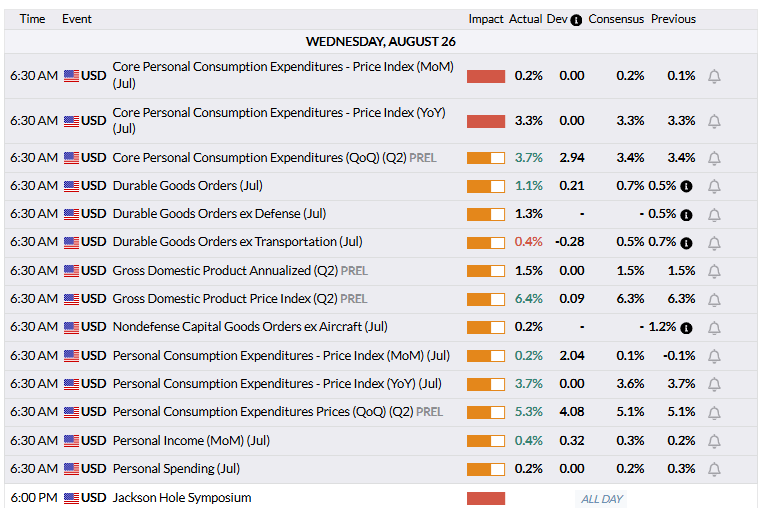
The sudden trend change in bullion was triggered by the release of the Federal Reserve’s (Fed) preferred inflation gauge, the Core Personal Consumption Expenditures (PCE) Price Index for July, which came in line with estimates and matched June’s reading of 3.3% YoY. For the same period, headline inflation was unchanged at 3.7% YoY for the second straight month, exceeding forecasts of 3.6%.
The data has increased the chances for a rate hike by the Fed, towards the end of 2026, according to Prime Terminal. The odds stand near 77% for a December increase. Also, energy prices had shot up amid rumors that Russia is considering escalating its conflict with Ukraine, at a time when hostilities in the Middle East seem far from being resolved.
The US economy steadied, according to the US Bureau of Economic Analysis (BEA). The Gross Domestic Product in Q2 2026 met estimates, with the Q1 print at 1.5%. US Durable Goods Orders doubled June’s print of 0.5%, coming in at 1.1% MoM and exceeding forecasts.
Geopolitics continued to influence Gold’s price. Iran and Oman reportedly reached an agreement on the Strait of Hormuz and its revenues. However, the reopening depends on Washington accepting Tehran’s conditions, which could pave the way.
Bullion prices were also affected by the reaction of US bond yields, which resumed their uptrend amid growing speculation of higher interest rates. The US Dollar Index (DXY), which tracks the buck’s performance against a basket of six peers, is up 0.25% at 99.14, a headwind for the dollar-denominated, non-yielding metal.
The US economic docket will feature Initial Jobless Claims on Thursday, followed by the University of Michigan Consumer Sentiment Index, and Fed Chair Kevin Warsh's speech at the Jackson Hole Symposium.
XAU/USD technical outlook: Gold retreats below $4,600 after failing to crack $4,700
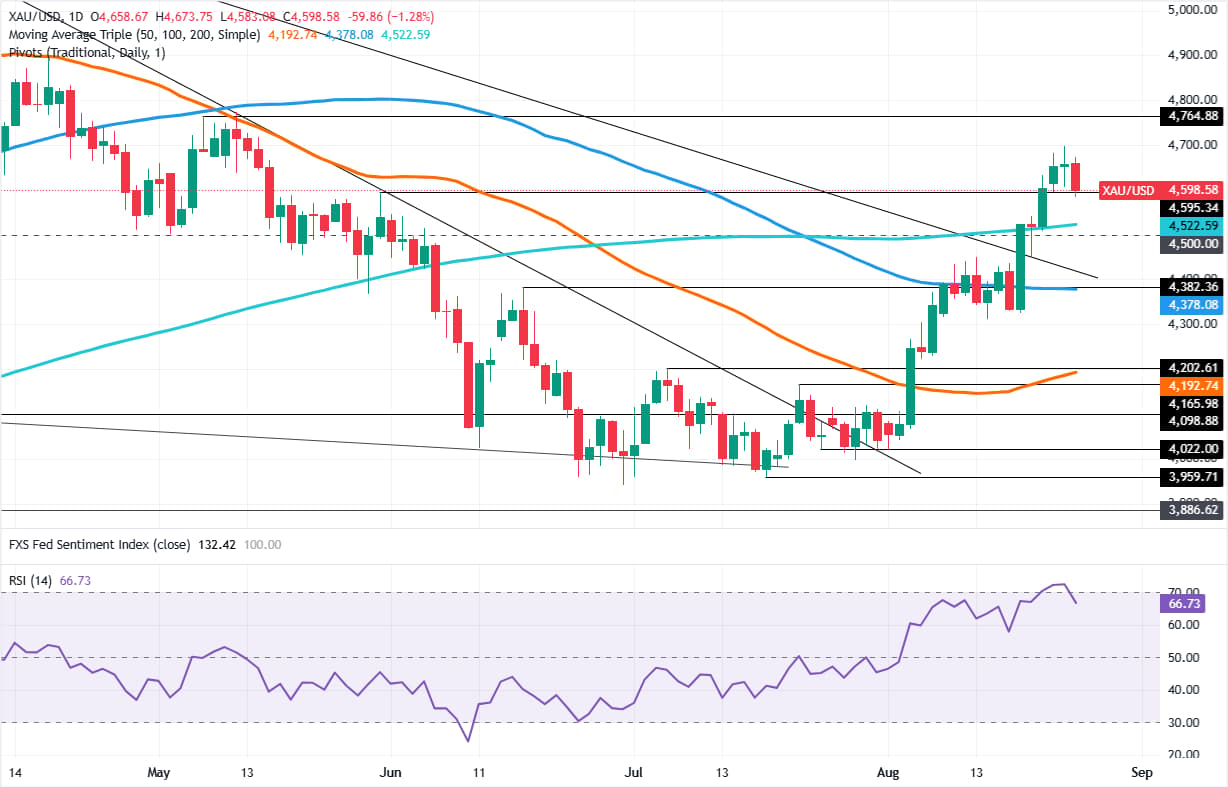
From a technical perspective, Gold is forming an ‘evening star’ three-candle chart pattern, with bearish implications, as the bearish candle pushes prices below the August 24 daily low of $4,594. If XAU/USD achieves a daily close beneath the latter, this clears the path for a move to the 200-day Simple Moving Average (SMA) at $4,378.
In that outcome, the next support would be the August 19 swing low of $4,324, ahead of $4,300.
Upward, XAU/USD must reclaim $4,600. If buyers succeed, a move to the psychological $4,650 and $4,700 is on the cards. The next area of interest above would be the May 7 peak at $4,764.
Gold FAQs
Gold has played a key role in human’s history as it has been widely used as a store of value and medium of exchange. Currently, apart from its shine and usage for jewelry, the precious metal is widely seen as a safe-haven asset, meaning that it is considered a good investment during turbulent times. Gold is also widely seen as a hedge against inflation and against depreciating currencies as it doesn’t rely on any specific issuer or government.
Central banks are the biggest Gold holders. In their aim to support their currencies in turbulent times, central banks tend to diversify their reserves and buy Gold to improve the perceived strength of the economy and the currency. High Gold reserves can be a source of trust for a country’s solvency. Central banks added 1,136 tonnes of Gold worth around $70 billion to their reserves in 2022, according to data from the World Gold Council. This is the highest yearly purchase since records began. Central banks from emerging economies such as China, India and Turkey are quickly increasing their Gold reserves.
Gold has an inverse correlation with the US Dollar and US Treasuries, which are both major reserve and safe-haven assets. When the Dollar depreciates, Gold tends to rise, enabling investors and central banks to diversify their assets in turbulent times. Gold is also inversely correlated with risk assets. A rally in the stock market tends to weaken Gold price, while sell-offs in riskier markets tend to favor the precious metal.
The price can move due to a wide range of factors. Geopolitical instability or fears of a deep recession can quickly make Gold price escalate due to its safe-haven status. As a yield-less asset, Gold tends to rise with lower interest rates, while higher cost of money usually weighs down on the yellow metal. Still, most moves depend on how the US Dollar (USD) behaves as the asset is priced in dollars (XAU/USD). A strong Dollar tends to keep the price of Gold controlled, whereas a weaker Dollar is likely to push Gold prices up.













