

Perdagangan
Terokai pelbagai pasaran dengan harga yang kompetitif, kecairan yang mendalam, dan alat perdagangan yang canggih.
Ketahui Lebih Lanjut 
Platform
Berdagang dengan lancar menggunakan platform berkuasa TMGM, dibina untuk kelajuan, ketepatan, dan pengalaman perdagangan yang unggul.
Ketahui Lebih Lanjut Platform Perdagangan
Akademi
Pelajari asas perdagangan dengan sumber yang mesra pemula, termasuk panduan, webinar, dan wawasan pasaran.
Ketahui Lebih Lanjut Akademi TMGM
Berita & Analisis
Dapatkan kemas kini pasaran masa nyata dan analisis pakar untuk kekal mendahului peluang perdagangan
Ketahui Lebih Lanjut Berita & Analisis
Tentang
Ketahui apa yang membezakan TMGM — kehadiran global kami, kekuatan kawal selia, dan komitmen terhadap inovasi dalam perdagangan.
Ketahui Lebih Lanjut Mengapa Pilih TMGM
Indian Rupee gets relief from likely RBI’s intervention
- The Indian Rupee attracts slight bids against the US Dollar due to suspected RBI intervention.
- Hawkish Fed bets are expected to keep the US Dollar stronger against the Indian Rupee.
- The RBI hiked its key Repo Rate by 25 bps to 5.5%.
The Indian Rupee (INR) opens mildly higher against the US Dollar (USD) on Thursday due to possible Reserve Bank of India’s (RBI) intervention. According to a Reuters report, Indian central bank likely sold US dollars near the market open on Thursday to support the Indian rupee, four traders said.

The RBI intervention was highly anticipated by financial markets, as the Indian currency fell sharply against the US Dollar on Wednesday, following the RBU’s monetary policy announcement.
As of writing, the USD/INR pair is mildly lower at around 96.72, but is close to Wednesday’s high of 96.85 and within striking distance of its all-time high at around 97.00.
What happens at RBI meeting?
Economists at ING reported that the RBI’s Monetary Policy Committee (MPC) “unanimously voted to raise the policy repo rate by 25bp to 5.50%, marking its first rate hike in four years.” At the same time, the MPC “shifted its policy stance to calibrated tightening, signalling that rate cuts are off the table in the near term,” and stressed that “future policy choices would be limited to either a rate hike or a pause, depending on evolving economic conditions and the inflation outlook.”
ING notes that “the pace and extent of further tightening will hinge on growth and inflation dynamics,” with particular focus on “the trajectory of underlying inflation, the broadening of price pressures, the risk of second-round effects from supply shocks, and the strength of demand conditions.” Much of that assessment, they add, “will depend on external inflation drivers,” where “key risks stem from international oil prices, exchange rate dynamics, and global monetary conditions.”
What to expect from INR in near-term?
Regarding the Indian currency’s outlook against the US Dollar, ING said that the external backdrop remains challenging for the Rupee, with “further Fed tightening” likely to “keep the US Dollar stronger for longer, maintaining depreciation pressure on the INR and increasing the risk of imported inflation.”
This reinforces their view that currency weakness and higher global rates could complicate the Reserve Bank of India’s gradual tightening path.
Recovery signs in oil prices
There have been some signs of a recovery in oil prices after remaining under pressure for weeks. Oil prices rebound after a tanker north of Qatar was struck by multiple projectiles, causing casualties, the United Kingdom Maritime Trade Operations agency said on Wednesday, Reuters reported.
Oil prices came under pressure in the past few weeks as the outflow of energy products from the Middle East increased, with United States (US) military supporting ships a safe passage.
Higher oil prices bode poorly for currencies from nations, such as India, which rely heavily on oil imports to meet their energy needs.
USD/INR Technical Analysis
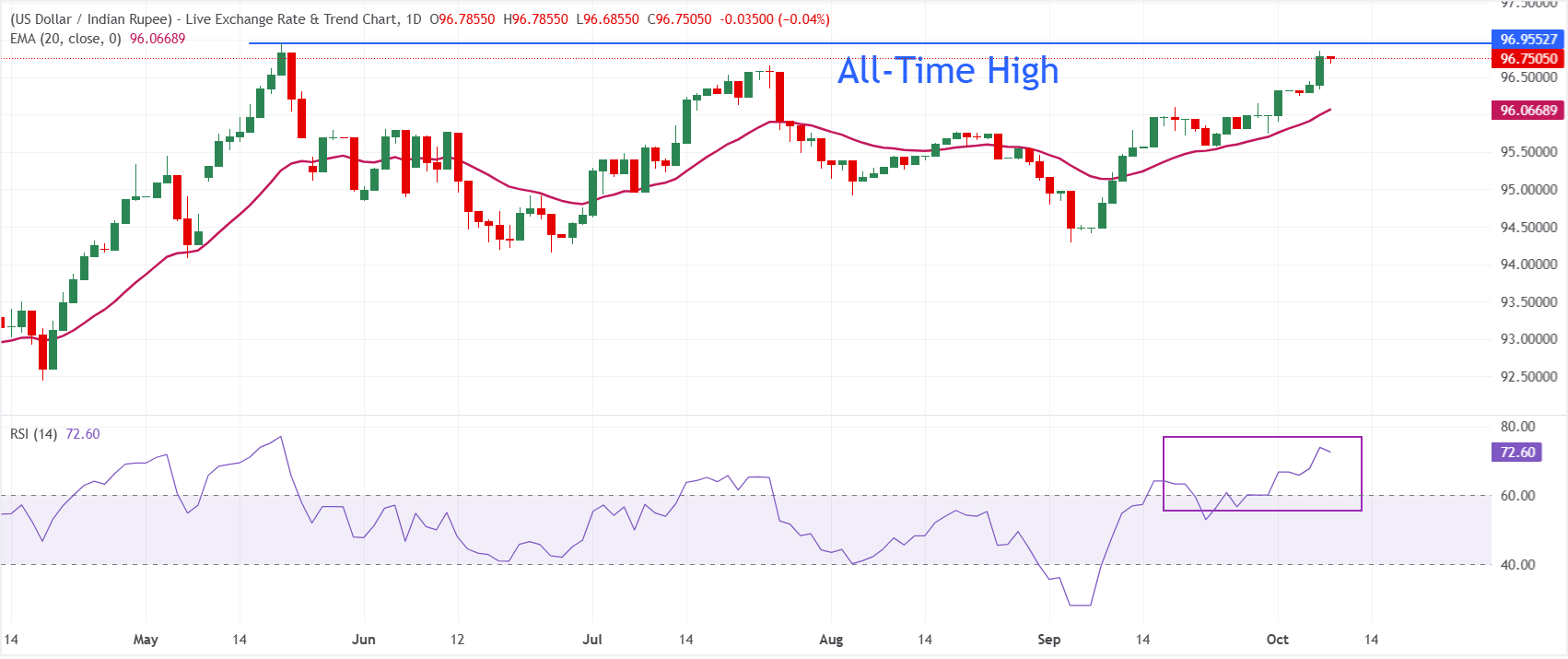
In the daily chart, USD/INR trades at 96.7505, holding a bullish near-term bias as spot remains above the 20-day exponential moving average (EMA) at 96.0669. The pair has extended its recovery from late-August lows, and the elevated Relative Strength Index (RSI) at 72.6 hints at overbought conditions, suggesting upside momentum may be stretched even as the broader structure stays supportive.
On the downside, initial support is seen at the 20-day EMA at 96.0669, where any pullback could find fresh buying interest while this level holds. With no nearby technical resistances mapped just above the market, traders may look for price action signals or a moderation in the overbought RSI to gauge whether the current advance is pausing or preparing for another leg higher.
(The technical analysis of this story was written with the help of an AI tool. Know more.)
Indian Rupee FAQs
The Indian Rupee (INR) is one of the most sensitive currencies to external factors. The price of Crude Oil (the country is highly dependent on imported Oil), the value of the US Dollar – most trade is conducted in USD – and the level of foreign investment, are all influential. Direct intervention by the Reserve Bank of India (RBI) in FX markets to keep the exchange rate stable, as well as the level of interest rates set by the RBI, are further major influencing factors on the Rupee.
The Reserve Bank of India (RBI) actively intervenes in forex markets to maintain a stable exchange rate, to help facilitate trade. In addition, the RBI tries to maintain the inflation rate at its 4% target by adjusting interest rates. Higher interest rates usually strengthen the Rupee. This is due to the role of the ‘carry trade’ in which investors borrow in countries with lower interest rates so as to place their money in countries’ offering relatively higher interest rates and profit from the difference.
Macroeconomic factors that influence the value of the Rupee include inflation, interest rates, the economic growth rate (GDP), the balance of trade, and inflows from foreign investment. A higher growth rate can lead to more overseas investment, pushing up demand for the Rupee. A less negative balance of trade will eventually lead to a stronger Rupee. Higher interest rates, especially real rates (interest rates less inflation) are also positive for the Rupee. A risk-on environment can lead to greater inflows of Foreign Direct and Indirect Investment (FDI and FII), which also benefit the Rupee.
Higher inflation, particularly, if it is comparatively higher than India’s peers, is generally negative for the currency as it reflects devaluation through oversupply. Inflation also increases the cost of exports, leading to more Rupees being sold to purchase foreign imports, which is Rupee-negative. At the same time, higher inflation usually leads to the Reserve Bank of India (RBI) raising interest rates and this can be positive for the Rupee, due to increased demand from international investors. The opposite effect is true of lower inflation.
ARTIKEL POPULAR
1Indian Rupee: RBI tightening cycle resumes – Commerzbank2Silver Price Forecasts: XAG/USD dips to $59.00 amid high yields, geopolitical tensions3Euro: Downside risks persist toward 1.1140 against US Dollar - UOB4Canadian Dollar weakens despite higher oil prices5EUR/USD Price Forecast: Holds below 1.1200, bearish tone prevails amid oversold conditions6Germany Trade Balance s.a. came in at €19.5B, above expectations (€19B) in August7Germany Exports (MoM) below expectations (0.8%) in August: Actual (-0.8%)8Germany Imports (MoM) below expectations (2.8%) in August: Actual (0.9%)9USD/JPY Price Forecast: 20-day EMA provides cushion near 157.55


Berhubung Dengan Kami









Hubungan
Telefon: +61 2 8036 8388
Faks: +61 2 8036 8388
E-mel: [email protected]
Laman Web: https://www.tmgm-asia.com



Maklumat yang disediakan di laman web ini adalah bersifat umum sahaja dan tidak merupakan nasihat kewangan peribadi. Sebelum bertindak berdasarkan sebarang maklumat di laman web ini, anda harus mempertimbangkan kesesuaian maklumat tersebut berhubung dengan objektif, keadaan kewangan dan keperluan anda. Pelaburan dalam CFD dan Kontrak Margin FX melibatkan risiko yang ketara dan tidak sesuai untuk semua pelabur. Anda mungkin mengalami kerugian melebihi deposit awal anda. Anda tidak memiliki, atau mempunyai, sebarang kepentingan dalam aset pendasar. Kami mengesyorkan agar anda mendapatkan nasihat bebas dan memastikan anda memahami sepenuhnya risiko yang terlibat sebelum berdagang. Adalah penting untuk anda membaca dan mempertimbangkan dokumen pendedahan sebelum anda memperoleh sebarang produk yang disenaraikan di laman web ini. Maklumat dan iklan yang ditawarkan di laman web ini tidak bertujuan untuk digunakan oleh mana-mana individu di mana-mana negara atau bidang kuasa yang penggunaan sedemikian akan bercanggah dengan undang-undang dan peraturan tempatan. Produk dan Perkhidmatan yang ditawarkan di laman web ini tidak ditujukan kepada penduduk Amerika Syarikat, Malaysia dan Thailand.
TMGM diberi kuasa dan dikawal selia dalam pelbagai bidang kuasa.
Trademax Australia Limited, berdagang sebagai TMGM, dikawal selia oleh Suruhanjaya Sekuriti dan Pelaburan Australia (ASIC), AFSL no. 436416 dan terletak di Aras 28, One International Tower, 100 Barangaroo Avenue, 2000 Sydney, NSW Australia.
E-mel: [email protected]
Trademax Global Limited, berdagang sebagai TMGM, diberi kuasa dan dikawal selia oleh Suruhanjaya Perkhidmatan Kewangan Vanuatu (VFSC), nombor pendaftaran 40356 dan didaftarkan di 1276, Kumul Highway, Port Vila, Vanuatu, Republik Vanuatu.
E-mel: [email protected]
Trademax Global Markets (SE) Limited, yang beroperasi sebagai TMGM, dilesenkan dan dikawal selia oleh Pihak Berkuasa Perkhidmatan Kewangan (FSA) Seychelles, dengan nombor lesen SD224. Syarikat ini didaftarkan di Pejabat No. 13, Providence Estate ABIS Centre, Mahe, Seychelles.
E-mel: [email protected]
Trademax Global Markets (International) Pty Ltd, berdagang sebagai TMGM, diberi kuasa dan dikawal selia oleh Suruhanjaya Perkhidmatan Kewangan, Mauritius (FSC) dengan lesen no. GB22201012, dan didaftarkan di 33, Edith Cavell Street C/o IQ EQ Fund Services (Mauritius) Ltd Port Louis, 11324 Mauritius.
E-mel: [email protected]
Hak Cipta © TMGM. Semua hak terpelihara