

Trading
Tuklasin ang malawak na hanay ng mga merkado na may competitive na presyo, malalim na liquidity, at advanced na trading tools.
Matuto Pa 
Platform
Mag-trade nang walang sagabal gamit ang malakas na platform ng TMGM, na ginawa para sa bilis, katumpakan, at superior na trading experience.
Matuto Pa Trading Platform
Mga Trading Tools
Academy
Matuto ng mga pangunahing kaalaman sa trading gamit ang mga beginner-friendly na resources, kasama ang mga gabay, webinars, at market insights.
Matuto Pa TMGM Academy
Balita at Analysis
Makakuha ng real-time na mga update sa merkado at expert analysis upang manatiling nangunguna sa mga trading opportunities
Matuto Pa Balita at Analysis
Tungkol
Alamin kung ano ang nagpapangiiba sa TMGM — ang aming global presence, regulatory strength, at commitment sa innovation sa trading.
Matuto Pa Bakit Piliin ang TMGM
Sponsorship
Silver Price Forecast: XAG/USD slides below $60 as sellers retain control
- Silver remains on the back foot despite a modest pullback in the US Dollar and Treasury yields.
- XAG/USD holds below its key daily SMAs, keeping sellers in control.
- The RSI drifts toward oversold territory, while the MACD remains negative.
Silver (XAG/USD) remains under pressure on Thursday even as the US Dollar (USD) and US Treasury yields ease. Sellers remain in control after a break below the $60 psychological mark, with the Relative Strength Index (RSI) drifting toward oversold territory. At the time of writing, XAG/USD trades around $58.83, down 1.87% on the day and hovering near two-month lows.
The benchmark 10-year US Treasury yield eases toward 5.30% after reaching 5.36% on Wednesday, its highest level since 2002. Despite the pullback, yields remain elevated near multi-year highs amid persistent inflation risks and expectations of additional rate hikes by the Federal Reserve (Fed). Higher borrowing costs increase the opportunity cost of holding non-yielding assets such as Silver.
Technical analysis
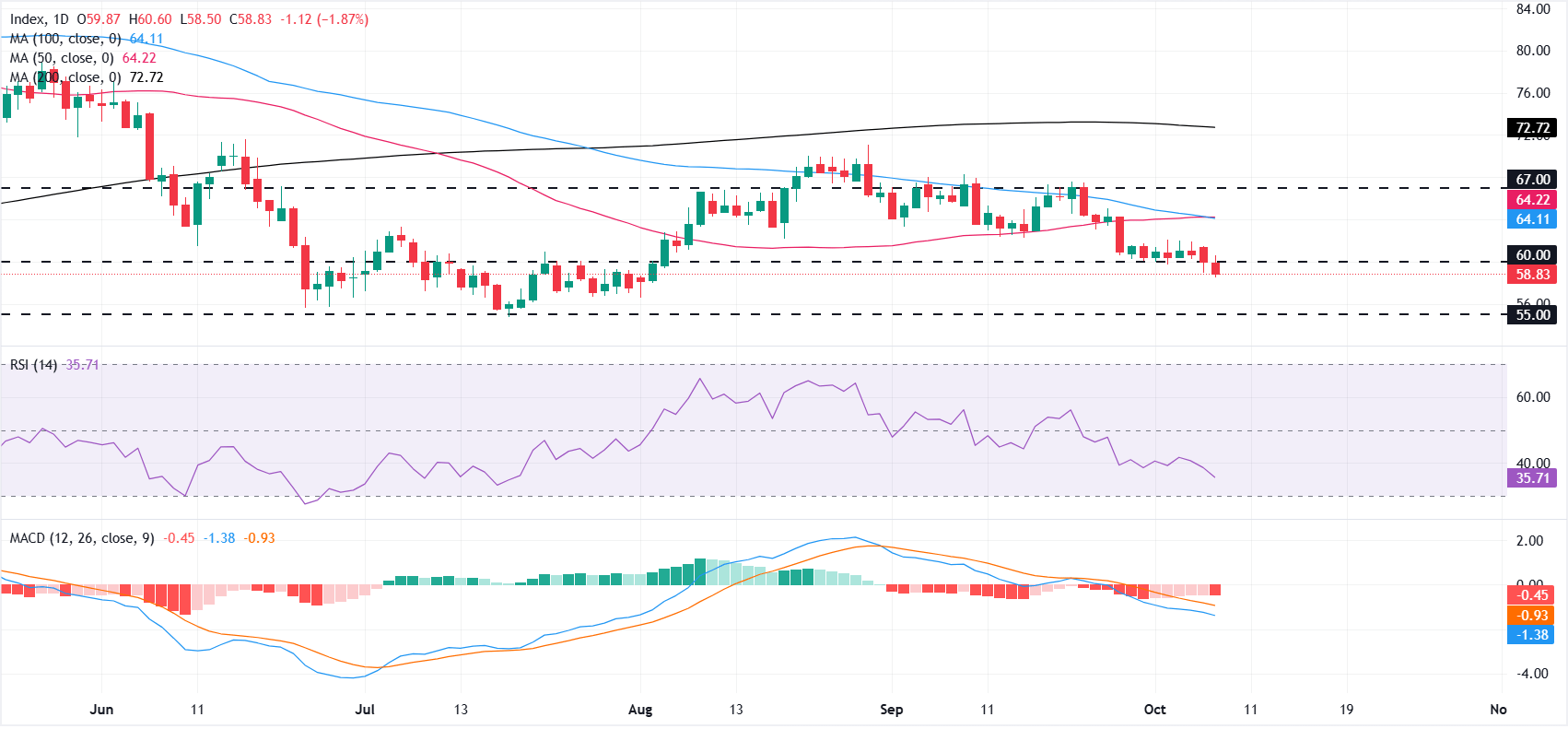
On the daily chart, XAG/USD maintains a bearish near-term bias as it trades below the 50-day, 100-day and 200-day Simple Moving Averages (SMAs). Momentum conditions reinforce this tone, with the Relative Strength Index (RSI) slipping toward the mid-30s, while the Moving Average Convergence Divergence (MACD) stays below zero with a negative line, suggesting persistent downside pressure.
On the topside, initial resistance emerges at the $60 horizontal level, before the clustered band of the 100-day and 50-day SMAs around $64.11-64.23, which would likely limit any corrective bounce, ahead of the higher barrier at $67. On the downside, firm support lies at the $55.00 horizontal level. A break below this level could open the door toward the $50.00 psychological mark. As long as price trades below the nearby $60.00 level, the technical outlook would continue to favor sellers on rallies rather than a sustained recovery.
(The technical analysis of this story was written with the help of an AI tool. Know more.)
Silver FAQs
Silver is a precious metal highly traded among investors. It has been historically used as a store of value and a medium of exchange. Although less popular than Gold, traders may turn to Silver to diversify their investment portfolio, for its intrinsic value or as a potential hedge during high-inflation periods. Investors can buy physical Silver, in coins or in bars, or trade it through vehicles such as Exchange Traded Funds, which track its price on international markets.
Silver prices can move due to a wide range of factors. Geopolitical instability or fears of a deep recession can make Silver price escalate due to its safe-haven status, although to a lesser extent than Gold's. As a yieldless asset, Silver tends to rise with lower interest rates. Its moves also depend on how the US Dollar (USD) behaves as the asset is priced in dollars (XAG/USD). A strong Dollar tends to keep the price of Silver at bay, whereas a weaker Dollar is likely to propel prices up. Other factors such as investment demand, mining supply – Silver is much more abundant than Gold – and recycling rates can also affect prices.
Silver is widely used in industry, particularly in sectors such as electronics or solar energy, as it has one of the highest electric conductivity of all metals – more than Copper and Gold. A surge in demand can increase prices, while a decline tends to lower them. Dynamics in the US, Chinese and Indian economies can also contribute to price swings: for the US and particularly China, their big industrial sectors use Silver in various processes; in India, consumers’ demand for the precious metal for jewellery also plays a key role in setting prices.
Silver prices tend to follow Gold's moves. When Gold prices rise, Silver typically follows suit, as their status as safe-haven assets is similar. The Gold/Silver ratio, which shows the number of ounces of Silver needed to equal the value of one ounce of Gold, may help to determine the relative valuation between both metals. Some investors may consider a high ratio as an indicator that Silver is undervalued, or Gold is overvalued. On the contrary, a low ratio might suggest that Gold is undervalued relative to Silver.
Sikat na Artikulo
1Banxico minutes flags upside inflation risks despite 6.50% rate hold2Australian Dollar slips as hawkish Fed, elevated US yields sustain USD3British Pound catches bid as Fed’s Waller eyes a pause in October4Silver Price Forecast: XAG/USD slides below $60 as sellers retain control5Mexican Peso: Watching support for reversal signal against US Dollar – Societe Generale6Ripple Price Forecast: XRP risks losing the 50-day EMA support as exchange reserves rise7Euro steadies as US yields retreat, traders assess Fed and ECB signals8Germany: Gradual recovery with energy risks – Deutsche Bank9Canadian Dollar: Consolidation near 1.42s against US Dollar – Scotiabank
LIVE QUOTES

LAHAT TUNGKOL SA FOREX
Magsimula!
Mag-sign up at ma-access ang Global Markets sa loob ng 3 minuto

Makipag-ugnayan sa Amin












Ang impormasyong ibinigay sa website na ito ay pangkalahatang impormasyon lamang at hindi bumubuo ng personal na payong pinansyal. Bago kumilos batay sa anumang impormasyon sa website na ito, dapat mong isaalang-alang ang pagiging angkop ng impormasyon kaugnay ng iyong mga layunin, kalagayang pinansyal, at mga pangangailangan. Ang pag-iinvest sa CFDs at FX Margin Contracts ay may kaakibat na malalaking panganib at hindi angkop para sa lahat ng mamumuhunan. Maaari kang mawalan ng higit pa sa iyong paunang deposito. Wala kang pagmamay-ari o anumang interes sa pinagbabatayang asset. Inirerekomenda namin na humingi ka ng independiyenteng payo at tiyaking lubos mong nauunawaan ang mga panganib na kasangkot bago makipagkalakalan. Mahalaga na basahin at isaalang-alang mo ang dokumento ng pagsisiwalat bago ka kumuha ng anumang produktong nakalista sa website. Ang impormasyon at mga patalastas na inaalok sa website na ito ay hindi nilalayong gamitin ng sinumang tao sa alinmang bansa o hurisdiksyon kung saan ang ganitong paggamit ay labag sa mga lokal na batas at regulasyon. Ang mga Produkto at Serbisyong inaalok sa website na ito ay hindi nilalayong para sa mga residente ng United States, Malaysia, at Thailand.
Ang TMGM ay awtorisado at pinangangasiwaan sa iba't ibang hurisdiksyon.
Ang Trademax Australia Limited, na nag-trading bilang TMGM, ay pinangangasiwaan ng Australian Securities and Investments Commission (ASIC), AFSL no. 436416 at matatagpuan sa Level 28, One International Tower, 100 Barangaroo Avenue, 2000 Sydney, NSW Australia.
Email: [email protected]
Ang Trademax Global Limited, na nag-trading bilang TMGM, ay awtorisado at pinangangasiwaan ng Vanuatu Financial Services Commission (VFSC), registration number 40356 at nakarehistro sa 1276, Kumul Highway, Port Vila, Vanuatu, Republic of Vanuatu.
Email: [email protected]
Ang Trademax Global Markets (SE) Limited, na kilala bilang TMGM, ay awtorisado at nire-regulahan ng Financial Services Authority (FSA) ng Seychelles, na may lisensya bilang SD224. Ang kumpanya ay nakarehistro sa Office Blg. 13, Providence Estate ABIS Centre, Mahe, Seychelles.
Email: [email protected]
Ang Trademax Global Markets (International) Pty Ltd, na nag-trading bilang TMGM, ay awtorisado at pinangangasiwaan ng Financial Services Commission, Mauritius (FSC) na may license no. GB22201012, at nakarehistro sa 33, Edith Cavell Street C/o IQ EQ Fund Services (Mauritius) Ltd Port Louis, 11324 Mauritius.
Email: [email protected]
Copyright © TMGM. Lahat ng karapatan ay nakalaan