

Trading
Explore a wide range of markets with competitive pricing, deep liquidity, and advanced trading tools.
Learn More 
Platform
Trade seamlessly with TMGM's powerful platform, built for speed, precision, and a superior trading experience.
Learn More Trading Platform
Academy
Learn the fundamentals of trading with beginner-friendly resources, including guides, webinars, and market insights.
Learn More News & Analysis
Get real-time market updates and expert analysis to stay ahead of trading opportunities
Learn More News & Analysis
About
Learn what sets TMGM apart — our global presence, regulatory strength, and commitment to innovation in trading.
Learn More Why Choose TMGM
Sponsorship
Can gold defend $4,000 after a sharp sell-off?
- Gold’s rebound from its lowest levels since July still leaves it heading for a weekly decline of more than 3%.
- With the Fed’s interest rate decision due next week, traders look to Friday’s US PMI and consumer sentiment releases.
- A bearish bias persists in XAU/USD below key moving averages as the RSI approaches oversold levels.
Dip buying is helping Gold (XAU/USD) regain ground above $4,000 on Friday, although a weekly decline of more than 3% remains in prospect. During Asian trading hours, the metal touched $3,986, its lowest level since July, before recovering to around $4,028 at the time of writing. The buying follows Thursday’s steep sell-off, which saw Gold shed 2.81%.

Thursday brought “a brutal day for markets on Thursday,” according to analysts at Rabobank, who reported that the S&P 500 declined “1.2% to $7663, dragged lower by the Philadelphia Stock Exchange Semiconductor index, which marched its way to the lowest level since July of this year.” Government bonds rallied strongly as equities slumped. Rabobank underscored the contrast, observing that “bad things for equities meant good things for US Treasuries, as the US 10-year yield moved back below 5% for the first time since September, despite higher energy prices, and the 2-year made its way back below 4.75%.”
Despite the fall in equities and US Treasury yields on Thursday, several headwinds prevented Gold from benefiting. Energy prices remain under upward pressure from Middle East tensions, with West Texas Intermediate Oil changing hands near five-week highs at around $100 per barrel. Inflationary pressures arising from higher energy costs bolster expectations of interest rates staying elevated for longer, raising the opportunity cost of holding the non-yielding metal.
Losses in equities may also have prompted some traders to sell precious metals to cover those losses. Gold’s breach of the $4,100-$4,200 band, which had largely held since the beginning of October, likely brought additional pressure from technical selling.
Rallies in Gold therefore remain susceptible to fresh selling, while both the US Dollar and Treasury yields are showing signs of settling after Thursday’s falls. Up 0.14%, the US Dollar Index (DXY) trades near 101.78. The index measures the Greenback against a basket of six major currencies. Meanwhile, the benchmark 10-year US Treasury yield is around 4.99%.
Friday’s upcoming releases include October’s preliminary S&P Global Purchasing Managers’ Index (PMI) figures and the final University of Michigan consumer sentiment survey. Traders will also scrutinise the survey’s inflation expectations.
What could next week’s Fed decision mean for Gold?
After September’s increase of 25 basis points (bps), the US central bank is widely expected to keep interest rates on hold. The focus for traders will be how policymakers weigh lingering inflation risks against worries that weaker AI-related investment could hurt economic growth. Gold’s rebound could be restrained by any indication that a further rate increase in December remains on the table.
Technical analysis: Can $4,000 hold as indicators favour sellers?
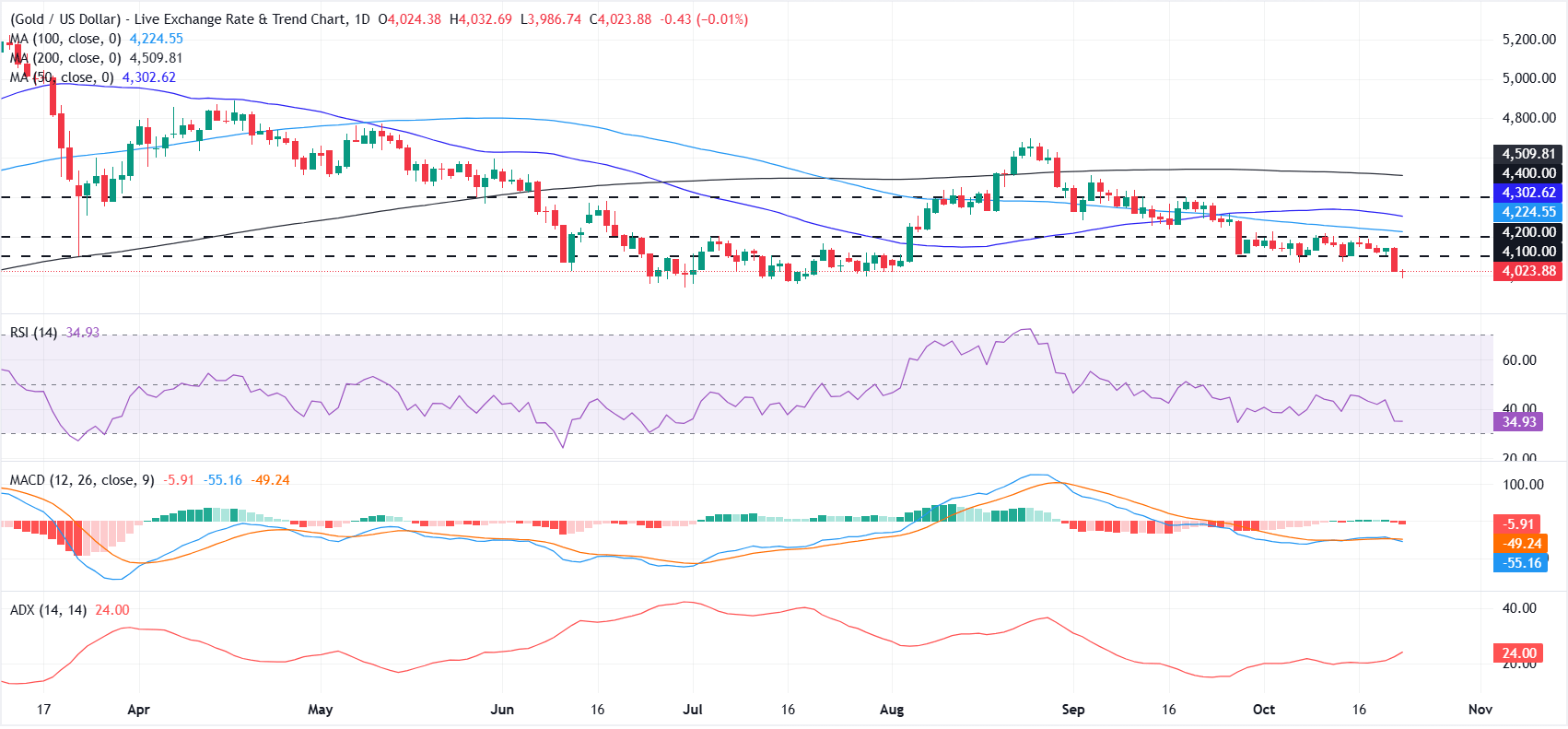
A bearish near-term outlook remains in place on the daily XAU/USD chart as the correction continues below all major moving averages. Weak momentum is evident in the Relative Strength Index (RSI), which sits near 35 and is moving towards oversold territory. The Moving Average Convergence Divergence (MACD) indicator also remains in negative territory below zero, suggesting that sellers still dominate. Meanwhile, a modest rise in the Average Directional Index (ADX) to around 24 signals that the trend is gradually gaining strength.
Any rebound first faces resistance at the psychological $4,100 mark, ahead of a horizontal barrier at $4,200. This barrier reinforces the nearby 100-day Simple Moving Average (SMA) at $4,224 as an important obstacle to recovery. Further up, the 50-day SMA at $4,302 stands between prices and the $4,400 zone, with the 200-day SMA at $4,509 forming the upper cap of the broader bearish structure.
If the psychological $4,000 threshold fails to hold, losses could deepen towards initial support at $3,950 and then the $3,900 zone. A decisive, sustained breach of $3,900 could pave the way for an additional slide towards $3,800.
(The technical analysis of this story was written with the help of an AI tool. Know more.)
Common questions about Gold
As a widely used store of value and medium of exchange, Gold has held an important place throughout human history. Beyond its lustre and use in jewellery, the precious metal is now widely regarded as a safe-haven asset, or a sound investment during periods of uncertainty. Its independence from any particular issuer or government also underpins its widespread role as a hedge against inflation and currency depreciation.
The largest holders of Gold are central banks. To support their currencies during unsettled periods, they typically diversify reserves and purchase Gold, strengthening perceptions of both the economy and the currency. Substantial Gold holdings can reinforce confidence in a country’s solvency. According to World Gold Council data, central banks increased their reserves by 1,136 tonnes of Gold, valued at around $70 billion, in 2022. That marked the largest annual purchase on record. Emerging-market central banks, including those in China, India and Turkey, are rapidly expanding their Gold reserves.
Both major reserve and safe-haven assets, the US Dollar and US Treasuries have an inverse correlation with Gold. A weakening Dollar generally supports Gold, allowing investors and central banks to diversify their holdings during uncertain periods. Gold also tends to move in the opposite direction to risk assets: stock market gains usually weigh on the metal, whereas selling in riskier markets generally supports it.
Several influences can drive movements in Gold prices. Its safe-haven appeal means geopolitical unrest or concerns about a severe recession can send prices sharply higher. Since Gold offers no yield, lower interest rates tend to support it, while more expensive borrowing usually puts pressure on the metal. Nevertheless, the US Dollar (USD) drives most price movements because Gold is quoted in dollars (XAU/USD). Dollar strength tends to restrain Gold prices, while a softer Dollar is likely to lift them.
POPULAR ARTICLES
1Can gold defend $4,000 after a sharp sell-off?2Brent: Prices rise as geopolitical tensions mount - Commerzbank3Australian Dollar: Is consolidation capping gains against US Dollar? – UOB4Australian Dollar posts modest gains against US Dollar as markets await US flash PMI data5Bitcoin Weekly Forecast: Can ETF inflows counter risk-off sentiment as BTC’s pullback continues?6Crypto Today: Can Bitcoin maintain its hold on the 50-day EMA as Ethereum and XRP encounter structural resistance?7Why is the British Pound lagging despite an upbeat UK flash PMI report?8Gold Price Forecast: Can XAU/USD extend its rebound from the $4,000 area while bears remain in control?9Japanese Yen: USD Expected to Remain Rangebound as Strong CPI Supports BoJ Hikes - BBH
LIVE QUOTES


ALL ABOUT GOLD & PRECIOUS METALS
Gold ETF Taxation: What Is the Tax on Gold ETF in India?
How Much Gold Is Allowed From Dubai to India?
How much is the Tax on Gold in India?
Gold Market Open Time: XAUUSD Trading Hours & Best Time to Trade
How to Trade Gold
Top 10 Most Traded Commodities in India & The Best Commodity to Trade
Gold Price Chart India 10 Years: An Overview
Why Invest in Gold: The Advantages of Trading Gold CFDs
4 Strategies for Investing in Gold for Beginners in 2025
Get Started!
Sign up and access the Global Markets in less than 3 minutes

Connect With Us












The information provided on this website is of a general nature only and does not constitute personal financial advice. Before acting on any information on this website, you should consider the suitability of the information in relation to your objectives, financial situation and needs. Investing in CFDs and FX Margin Contracts carries significant risks and is not suitable for all investors. You may lose more than your initial deposit. You do not own, or have, any interest in the underlying asset. We recommend that you seek independent advice and ensure you fully understand the risks involved before trading. It is important that you read and consider the disclosure document before you acquire any product listed on the website. The information and advertisements offered on this website are not intended for use by any person in any country or jurisdiction where such use would be contrary to local laws and regulations. The Products and Services offered on this website are not intended for residents of the United States, Malaysia and Thailand.
TMGM is authorized and regulated in various jurisdictions.
Trademax Australia Limited, trading as TMGM, is regulated by the Australian Securities and Investments Commission (ASIC), AFSL no. 436416 and is located at Level 28, One International Tower, 100 Barangaroo Avenue, 2000 Sydney, NSW Australia.
Email: [email protected]
Trademax Global Limited, trading as TMGM, is authorized and regulated by the Vanuatu Financial Services Commission (VFSC), registration number 40356 and registered at 1276, Kumul Highway, Port Vila, Vanuatu, Republic of Vanuatu.
Email: [email protected]
Trademax Global Markets (SE) Limited, trading as TMGM, is authorized and regulated by the Financial Services Authority (FSA) of Seychelles, with license number SD224. The company is registered at Office No 13, Providence Estate ABIS Centre, Mahe, Seychelles.
Email: [email protected]
Trademax Global Markets (International) Pty Ltd, trading as TMGM, is authorized and regulated by the Financial Services Commission, Mauritius (FSC) with license no. GB22201012, and registered at 33, Edith Cavell Street C/o IQ EQ Fund Services (Mauritius) Ltd Port Louis, 11324 Mauritius.
Email: [email protected]
Copyright © TMGM. All rights reserved