

Trading
Explore a wide range of markets with competitive pricing, deep liquidity, and advanced trading tools.
Learn More 
Platform
Trade seamlessly with TMGM's powerful platform, built for speed, precision, and a superior trading experience.
Learn More Trading Platform
Academy
Learn the fundamentals of trading with beginner-friendly resources, including guides, webinars, and market insights.
Learn More News & Analysis
Get real-time market updates and expert analysis to stay ahead of trading opportunities
Learn More News & Analysis
About
Learn what sets TMGM apart — our global presence, regulatory strength, and commitment to innovation in trading.
Learn More Why Choose TMGM
Sponsorship
Euro Surrenders Early Gains as US Dollar Rebounds
- A recovering US Dollar pushes the Euro back towards 1.1213.
- The US Dollar’s rebound appears to have drawn support from rising oil prices.
- Other Eurozone nations face spillover from France’s fiscal risks.
A sharp recovery in the US Dollar (USD), fuelled by a further rise in oil prices, erases the Euro’s (EUR) early advance during Tuesday’s European trading session. The major currency pair retreats to trade broadly flat around 1.1213.
Despite recovering from an intraday low of 101.74 to around 101.91 in European trading, the US Dollar Index (DXY) remains 0.13% lower. The index measures the Greenback against a basket of six major currencies.

A 2.15% surge takes WTI Oil to nearly $100.20, its highest price in over a month. Continuing conflict in the Middle East has lifted the risk premium in oil prices, with Iran threatening to expand its blockade to other sea routes.
By pushing global inflation expectations away from their anchors, rising oil prices increase the likelihood that central banks will raise interest rates.
Concerns surrounding Artificial Intelligence (AI)-related optimism weighed on the US Dollar’s performance over the past week.
In their assessment of US financial markets, MUFG analysts describe them as “a major beneficiary of strong foreign investor demand driven by AI-related optimism.” According to the analysts, foreign investors bought “USD942 billion of US equities in the twelve months to July, while purchases of US corporate bonds increased sharply to USD452 billion over the same period.” For MUFG, these “sizeable inflows highlight how the USD has become increasingly tied to investors’ search for higher returns in US financial markets, rather than benefiting from its traditional safe-haven status.” Their caution, however, is that “this dynamic also leaves the USD more exposed to a reversal if sentiment towards AI deteriorates.”
The Euro’s appeal has also weakened as fiscal turmoil in France spills over into other Eurozone countries.
Deutsche Bank analysts trace the impact of the latest French political turmoil across European markets, observing that “those market concerns around French debt cascaded across other countries and asset classes too.” Illustrating the spillover, they note that “the Italian 10yr spread over bunds was also up +4.7bps on the day to 111bps, whilst Spain’s was up +1.2bps to 62bps.”
EUR/USD Technical Analysis: Can the Pair Overcome Its Bearish Bias?
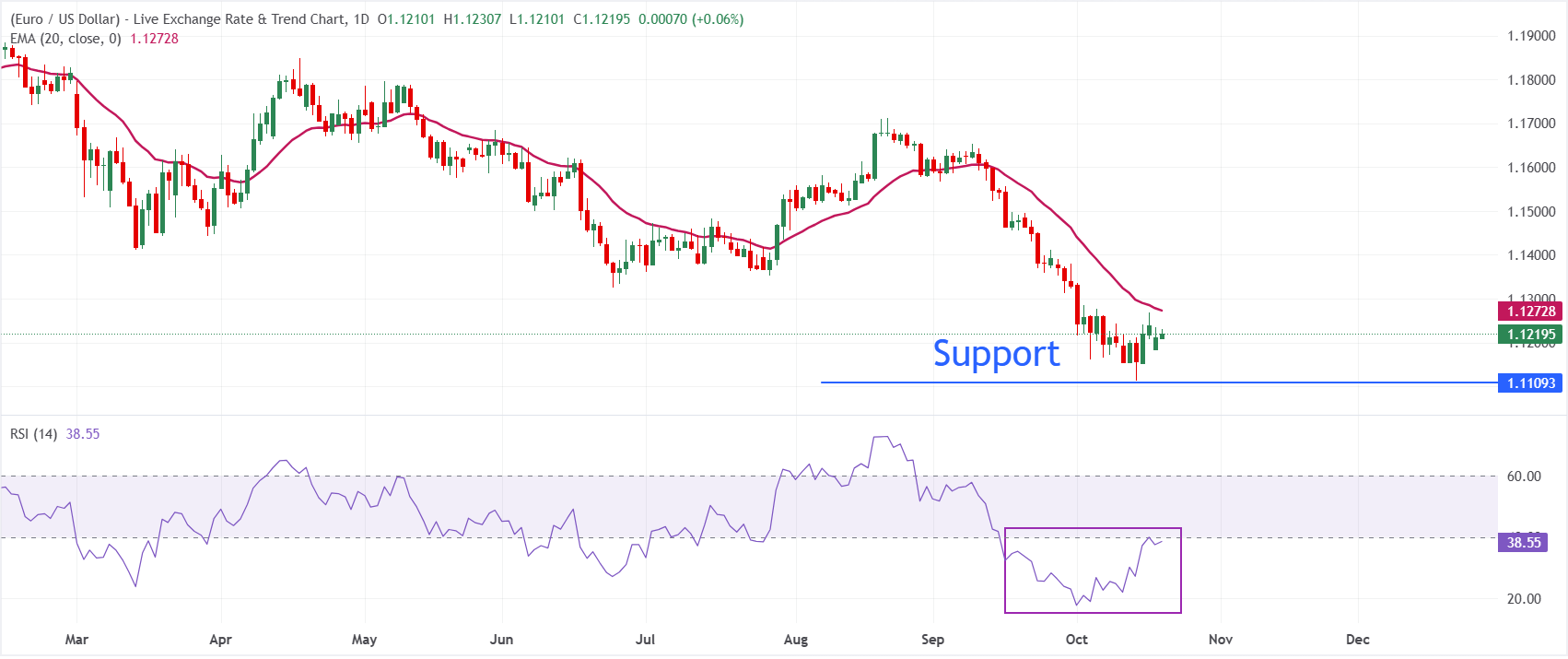
Trading at 1.1219 on the daily chart, EUR/USD retains a bearish near-term bias below its 20-period exponential moving average (EMA) of 1.1273. Failure to regain this short-term EMA indicates that overhead supply continues to limit rallies. Meanwhile, the Relative Strength Index (14), at 38.5, remains under the neutral 50 mark, pointing to persistent downward pressure rather than a convincing recovery.
For the bearish bias to ease and a more durable rebound to become possible, EUR/USD must first clear immediate resistance at the 20-period EMA of 1.1273. Until the pair regains that level, moves towards the EMA are likely to attract fresh selling. With no nearby technical support visible on the chart, a return of seller control would leave the pair exposed to further declines.
(The technical analysis of this story was written with the help of an AI tool. Know more.)
US Dollar: Frequently Asked Questions
Alongside its status as the official currency of the United States of America, the US Dollar (USD) serves as the ‘de facto’ currency in a significant number of other countries, circulating alongside their local banknotes. No currency is traded more widely: according to 2022 data, it represents over 88% of global foreign exchange turnover, equivalent to average daily transactions of $6.6 trillion. After the Second World War, the USD replaced the British Pound as the world’s reserve currency. Gold backed the US Dollar for most of its history, until the Bretton Woods Agreement in 1971 brought the Gold Standard to an end.
Monetary policy set by the Federal Reserve (Fed) is the single biggest influence on the US Dollar’s value. The Fed uses interest rate adjustments as its main means of meeting two mandates: maintaining price stability by controlling inflation, and promoting full employment. Inflation above the Fed’s 2% target, accompanied by excessively rapid price increases, prompts rate hikes that support the USD. Conversely, the Fed may cut interest rates if inflation drops below 2% or the Unemployment Rate is too high, putting pressure on the Greenback.
Printing additional Dollars and introducing quantitative easing (QE) are options available to the Federal Reserve in extreme circumstances. Through QE, the Fed substantially expands the supply of credit to a financial system that has become stuck. This unconventional policy is used when credit dries up because banks, fearing counterparty default, refuse to lend to one another. It is a last resort when interest rate cuts alone are unlikely to deliver the required outcome. During the Great Financial Crisis in 2008, the Fed chose QE to tackle the credit crunch. Under this process, it prints more Dollars to purchase US government bonds, mainly from financial institutions. The usual effect of QE is a weaker US Dollar.
Usually supportive of the US Dollar, quantitative tightening (QT) reverses the easing process. The Federal Reserve ceases bond purchases from financial institutions and, as bonds in its portfolio mature, does not reinvest the principal in further purchases.
POPULAR ARTICLES
1Euro Surrenders Early Gains as US Dollar Rebounds2Silver price today: FXStreet data shows gains in silver3Brazilian Real: Do election-driven gains outweigh the risks? – Commerzbank4Dow Jones futures gain as markets back tech recovery and a Fed rate hold5Germany ZEW Survey: October Economic Sentiment drops sharply to 28.16Euro: How is French political stress fuelling volatility? – Rabobank7US Dollar Index Price Forecast: Can the Ascending Channel Base Near 101.50 Withstand the Test?8Silver Price Forecast: Why Has XAG/USD Climbed to Near $57.30 as US Bond Yields Fall?9Canadian Dollar: Rising prices coincide with weaker business sentiment - RBC
LIVE QUOTES


ALL ABOUT OIL
5 Best Oil Trading Platforms 2026 (Brent and WTI)
Iran War and the Global Economy in 2026: Oil, Inflation, Trade and Markets
Should You Still Invest in Oil in 2026?
WTI vs Brent Crude
Gold to Oil Ratio: How does the Iran War affect Gold Prices?
Top 10 Most Traded Commodities in India & The Best Commodity to Trade
What is WTI Oil: Importance, Purpose, How To Trade
Trading Brent Crude Oil: A Comprehensive Guide
How to Trade Oil in India: Steps, Markets and Risks
Get Started!
Sign up and access the Global Markets in less than 3 minutes

Connect With Us












The information provided on this website is of a general nature only and does not constitute personal financial advice. Before acting on any information on this website, you should consider the suitability of the information in relation to your objectives, financial situation and needs. Investing in CFDs and FX Margin Contracts carries significant risks and is not suitable for all investors. You may lose more than your initial deposit. You do not own, or have, any interest in the underlying asset. We recommend that you seek independent advice and ensure you fully understand the risks involved before trading. It is important that you read and consider the disclosure document before you acquire any product listed on the website. The information and advertisements offered on this website are not intended for use by any person in any country or jurisdiction where such use would be contrary to local laws and regulations. The Products and Services offered on this website are not intended for residents of the United States, Malaysia and Thailand.
TMGM is authorized and regulated in various jurisdictions.
Trademax Australia Limited, trading as TMGM, is regulated by the Australian Securities and Investments Commission (ASIC), AFSL no. 436416 and is located at Level 28, One International Tower, 100 Barangaroo Avenue, 2000 Sydney, NSW Australia.
Email: [email protected]
Trademax Global Limited, trading as TMGM, is authorized and regulated by the Vanuatu Financial Services Commission (VFSC), registration number 40356 and registered at 1276, Kumul Highway, Port Vila, Vanuatu, Republic of Vanuatu.
Email: [email protected]
Trademax Global Markets (SE) Limited, trading as TMGM, is authorized and regulated by the Financial Services Authority (FSA) of Seychelles, with license number SD224. The company is registered at Office No 13, Providence Estate ABIS Centre, Mahe, Seychelles.
Email: [email protected]
Trademax Global Markets (International) Pty Ltd, trading as TMGM, is authorized and regulated by the Financial Services Commission, Mauritius (FSC) with license no. GB22201012, and registered at 33, Edith Cavell Street C/o IQ EQ Fund Services (Mauritius) Ltd Port Louis, 11324 Mauritius.
Email: [email protected]
Copyright © TMGM. All rights reserved