

Trading
Explore a wide range of markets with competitive pricing, deep liquidity, and advanced trading tools.
Learn More 
Platform
Trade seamlessly with TMGM's powerful platform, built for speed, precision, and a superior trading experience.
Learn More Trading Platform
Academy
Learn the fundamentals of trading with beginner-friendly resources, including guides, webinars, and market insights.
Learn More News & Analysis
Get real-time market updates and expert analysis to stay ahead of trading opportunities
Learn More News & Analysis
About
Learn what sets TMGM apart — our global presence, regulatory strength, and commitment to innovation in trading.
Learn More Why Choose TMGM
Sponsorship
Why is the Australian Dollar shrugging off Iran war jitters as RBA hike bets double?
- Gains in AUD/USD continue, with the pair advancing 0.44% to 0.7027.
- Restrictive policy has not prevented a worsening inflation outlook, RBA's Hauser cautions.
- Ahead of Flash PMIs, the probability of an RBA rate hike almost doubles to 60%.
Positive market sentiment is supporting a fourth consecutive day of gains for the Australian Dollar against the US Dollar, despite elevated Middle East tensions and recent reports pointing to renewed hostilities. Against this backdrop, AUD/USD is trading at 0.7027, a gain of 0.44%.

Can hawkish RBA expectations sustain AUD/USD's four-day advance despite geopolitical uncertainty?
An after-hours boost from AI-related trading followed a largely flat close for US equities, as Meta and Tesla reported earnings. Currency markets, however, saw the Greenback regain some ground after reports that the US State Department was preparing an order for some staff and family members at the US embassy in Saudi Arabia to leave.
While signalling readiness to give diplomacy another opportunity, Iran’s foreign minister warned that choosing war would bring an even greater strategic failure for the US. Separately, Fars reported that multiple explosions had been heard in Sirik; their source and nature are still unknown.
With no US economic releases on the calendar, traders were looking ahead to Thursday’s Initial Jobless Claims and the subsequent University of Michigan Consumer Sentiment release. The principal focus, however, remains next week’s Federal Reserve monetary policy decision, alongside the release of its preferred inflation measure, the Core Personal Consumption Expenditures (PCE) Price Index.
Australia’s otherwise empty calendar was punctuated by hawkish remarks from Reserve Bank of Australia (RBA) Deputy Governor Andrew Hauser. He said that “inflation outlook appears worse than forecast, slightly above expectations,” adding that signs of deterioration in the inflation outlook persist even though monetary policy is working.
According to Prime Terminal data, money markets put the likelihood of a 25 basis points RBA rate increase to 4.85% at nearly 60% after Hauser’s comments. That compares with a 30% probability a day earlier.
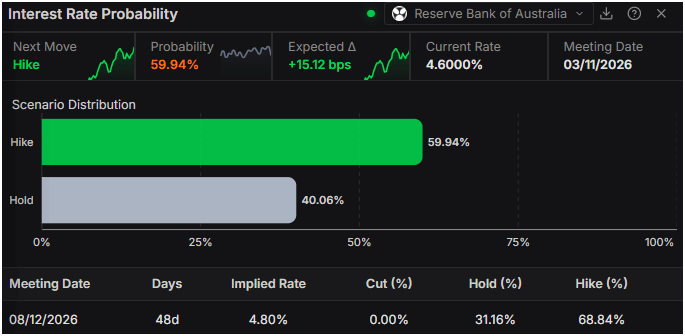
Next on Australia’s economic calendar is the October 22 release of S&P Global Flash PMIs.
AUD/USD Price Forecast: Can the pair overcome technical resistance?
A bearish short-term bias persists on the daily AUD/USD chart, where the pair trades near 0.7024. Spot remains below the cluster of three simple moving averages (SMAs) around 0.7077, as well as rising trend lines that now act as overhead resistance at 0.7086–0.7087 and 0.7111–0.7118. At 52.5, the Relative Strength Index (RSI) is slightly positive but remains near neutral. This points to limited recovery momentum, which has yet to overcome the pressure from those resistance levels.
Whether the pair can retain the current pivot zone near 0.7024 is the immediate downside consideration. Below it, the next significant structural support lies at a rising trend line around 0.6946, followed much further down by the longer-term falling trend-line anchor near 0.6246. Any advance would first encounter the three-SMA cluster around 0.7077, ahead of closely grouped former support trend lines at 0.7086–0.7087 and 0.7111–0.7118. A further horizontal resistance level stands at 0.7198.
(The technical analysis of this story was written with the help of an AI tool. Know more.)
Australian Dollar: Frequently asked questions
Interest rates determined by the Reserve Bank of Australia (RBA) are among the strongest influences on the Australian Dollar (AUD). Australia’s abundant resources also make the price of iron ore, its largest export, an important driver. Other influences include economic conditions in China, Australia’s biggest trading partner, along with domestic inflation, economic growth and the trade balance. Investor sentiment matters too: an appetite for riskier assets, known as risk-on, supports the AUD, whereas a preference for safe havens reflects risk-off conditions.
By determining the interest rate at which Australian banks lend to one another, the Reserve Bank of Australia (RBA) affects borrowing rates across the economy and, in turn, the Australian Dollar (AUD). Its primary objective is to keep inflation stable at 2-3%, using increases or reductions in interest rates. Rates that are relatively high compared with those of other major central banks tend to support the AUD; relatively low rates have the reverse effect. Quantitative easing and quantitative tightening offer the RBA additional ways to influence credit conditions. Easing is negative for the AUD, while tightening is supportive.
The Australian Dollar (AUD) is strongly influenced by China’s economic performance because China is Australia’s biggest trading partner. A healthy Chinese economy buys more Australian raw materials, goods and services, increasing demand for the AUD and raising its value. When Chinese growth falls short of expectations, the reverse applies. As a result, upside or downside surprises in China’s growth figures frequently affect the Australian Dollar and its currency pairs directly.
With China its main destination, iron ore ranks as Australia’s biggest export, worth $118 billion annually according to 2021 data. Its price can therefore influence the Australian Dollar. An increase in iron ore prices generally lifts overall demand for the currency and pushes the AUD higher, while a price decline has the reverse effect. Higher iron ore prices also make an Australian trade surplus more likely, providing further support to the AUD.
Another influence on the Australian Dollar is the trade balance: export earnings minus import expenditure. Strong overseas demand for Australian exports can lift the currency because foreign buyers generate more demand for it than Australia generates for foreign currencies through its import purchases. A net trade surplus therefore supports the AUD, while a trade deficit has the reverse effect.
POPULAR ARTICLES
1AUD/JPY Price Forecast: Can a Double Bottom Help Bulls Reach 113.50?2Chinese Yuan: Can gradual gains against US Dollar extend towards 6.6640? – UOB3GBP/JPY Price Forecast: Can bulls withstand the Doji challenge below 212.00?4How will the Euro respond to PMIs first and France’s credit rating over the weekend?5Why is the Australian Dollar shrugging off Iran war jitters as RBA hike bets double?6British Pound heads towards retail sales release with November rate hike already factored in7Below the 3.8% forecast: New Zealand’s Q3 CPI inflation slows to 3.7% YoY8Indonesian Rupiah: Bias towards depreciation amid MSCI risk – MUFG9South Korean Won: Are risks of losses towards 1400 against US Dollar mounting? – TD Securities
LIVE QUOTES


ALL ABOUT FOREX
Margin Call Meaning: What It Is, What Triggers It, and How to Avoid One
What Is an Islamic Account in Forex?
Best Indicators for Forex Trading and How to Use Them
The Top 10 Most Traded Currency Pairs in the World
What are the Major Forex Pairs? 7 Major Currency Pairs in the World
5 Best Forex Trading Apps In India In 2026
Top 15 Weakest Currencies in the World
Best Time to Trade Forex
Forex Trading Regulations in India
Get Started!
Sign up and access the Global Markets in less than 3 minutes

Connect With Us












The information provided on this website is of a general nature only and does not constitute personal financial advice. Before acting on any information on this website, you should consider the suitability of the information in relation to your objectives, financial situation and needs. Investing in CFDs and FX Margin Contracts carries significant risks and is not suitable for all investors. You may lose more than your initial deposit. You do not own, or have, any interest in the underlying asset. We recommend that you seek independent advice and ensure you fully understand the risks involved before trading. It is important that you read and consider the disclosure document before you acquire any product listed on the website. The information and advertisements offered on this website are not intended for use by any person in any country or jurisdiction where such use would be contrary to local laws and regulations. The Products and Services offered on this website are not intended for residents of the United States, Malaysia and Thailand.
TMGM is authorized and regulated in various jurisdictions.
Trademax Australia Limited, trading as TMGM, is regulated by the Australian Securities and Investments Commission (ASIC), AFSL no. 436416 and is located at Level 28, One International Tower, 100 Barangaroo Avenue, 2000 Sydney, NSW Australia.
Email: [email protected]
Trademax Global Limited, trading as TMGM, is authorized and regulated by the Vanuatu Financial Services Commission (VFSC), registration number 40356 and registered at 1276, Kumul Highway, Port Vila, Vanuatu, Republic of Vanuatu.
Email: [email protected]
Trademax Global Markets (SE) Limited, trading as TMGM, is authorized and regulated by the Financial Services Authority (FSA) of Seychelles, with license number SD224. The company is registered at Office No 13, Providence Estate ABIS Centre, Mahe, Seychelles.
Email: [email protected]
Trademax Global Markets (International) Pty Ltd, trading as TMGM, is authorized and regulated by the Financial Services Commission, Mauritius (FSC) with license no. GB22201012, and registered at 33, Edith Cavell Street C/o IQ EQ Fund Services (Mauritius) Ltd Port Louis, 11324 Mauritius.
Email: [email protected]
Copyright © TMGM. All rights reserved