

Trading
Explore a wide range of markets with competitive pricing, deep liquidity, and advanced trading tools.
Learn More 
Platform
Trade seamlessly with TMGM's powerful platform, built for speed, precision, and a superior trading experience.
Learn More Trading Platform
Academy
Learn the fundamentals of trading with beginner-friendly resources, including guides, webinars, and market insights.
Learn More News & Analysis
Get real-time market updates and expert analysis to stay ahead of trading opportunities
Learn More News & Analysis
About
Learn what sets TMGM apart — our global presence, regulatory strength, and commitment to innovation in trading.
Learn More Why Choose TMGM
Sponsorship
Below the 3.8% forecast: New Zealand’s Q3 CPI inflation slows to 3.7% YoY
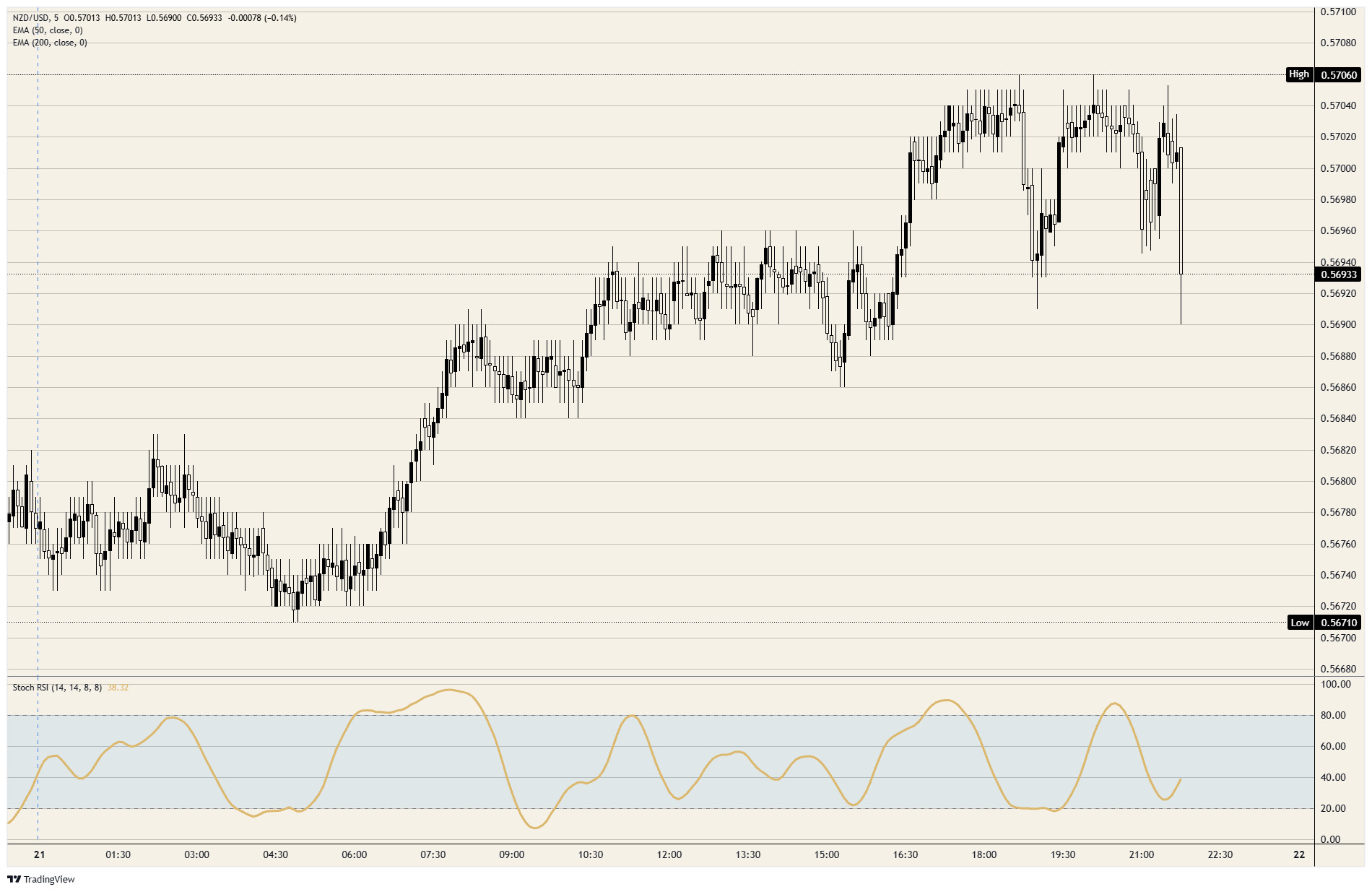
The Kiwi retreated from a four-week high after New Zealand's third-quarter Consumer Price Index (CPI) undershot forecasts by a tenth of a percentage point on both the quarterly and annual readings. On the release candle, NZD/USD slipped from marginally above 0.5700 to just below that mark, returning to where it had traded before breaking above the level earlier in the session.
Against expectations of 0.8%, prices increased 0.7% over the quarter. Annual inflation slowed from 4.1% to 3.7%, below the 3.8% forecast and the 3.9% projection made by the Reserve Bank of New Zealand (RBNZ) in September. During its five-session advance, the Kiwi had priced in an October 28 rate hike on the basis of that projection; the latest figures have weakened that case.

With non-tradable prices increasing 1.0% quarter-on-quarter and 3.3% year-on-year, the weakness was concentrated in tradable prices, which include petrol and diesel. According to Westpac, fuel reduced the quarterly inflation rate by about 0.4 percentage points. The only bank in the survey to predict 3.7%, Westpac had described the decline as a temporary reprieve ahead of the release.
How Has NZD/USD Responded?
About a tenth of the five-session advance from the October 14 low, just above 0.5550, has been erased following the data. The rally had stalled before reaching the 50-day Exponential Moving Average (EMA), which sits just above 0.5700. NZD/USD has remained below that average since early September, while daily momentum was nearing overbought territory ahead of the release.
NZD/USD: 5-minute price chart
Inflation: Common Questions
A rise in the prices of a representative basket of goods and services is measured as inflation. The headline measure is generally reported as a percentage change month-on-month (MoM) and year-on-year (YoY). By excluding more volatile components, including food and fuel, core inflation removes items whose prices can swing with geopolitical developments and seasonal factors. Economists concentrate on this core reading, which is also the measure targeted by central banks. Their mandate is to maintain inflation at a manageable rate, generally around 2%.
Changes in the prices of a basket of goods and services over time are tracked by the Consumer Price Index (CPI). The index is generally reported in terms of percentage changes month-on-month (MoM) and year-on-year (YoY). Central banks target Core CPI because it leaves out volatile food and fuel components. A Core CPI reading above 2% typically leads to higher interest rates, while a reading below 2% generally has the reverse effect. As higher rates support a currency, rising inflation usually strengthens it; falling inflation tends to have the opposite effect.
A country's currency tends to gain value when inflation is high and lose value when inflation is low, even though this may appear counter-intuitive. The reason lies in the central bank's usual response: raising interest rates to tackle elevated inflation. Those higher rates draw in more global capital from investors seeking attractive returns on their funds.
Investors historically sought Gold during periods of high inflation for its ability to retain value. They still frequently buy Gold as a safe haven during severe market turmoil, but this pattern does not hold most of the time. Elevated inflation prompts central banks to raise interest rates to bring it under control. For Gold, higher rates are unfavourable: they raise the opportunity cost of holding the metal rather than an interest-bearing asset or money in a cash deposit account. Conversely, lower inflation generally supports Gold by bringing interest rates down and making the precious metal a more attractive investment alternative.
POPULAR ARTICLES
1AUD/JPY Price Forecast: Can a Double Bottom Help Bulls Reach 113.50?2Chinese Yuan: Can gradual gains against US Dollar extend towards 6.6640? – UOB3GBP/JPY Price Forecast: Can bulls withstand the Doji challenge below 212.00?4How will the Euro respond to PMIs first and France’s credit rating over the weekend?5Why is the Australian Dollar shrugging off Iran war jitters as RBA hike bets double?6British Pound heads towards retail sales release with November rate hike already factored in7Below the 3.8% forecast: New Zealand’s Q3 CPI inflation slows to 3.7% YoY8Indonesian Rupiah: Bias towards depreciation amid MSCI risk – MUFG9South Korean Won: Are risks of losses towards 1400 against US Dollar mounting? – TD Securities
LIVE QUOTES


ALL ABOUT FOREX
Margin Call Meaning: What It Is, What Triggers It, and How to Avoid One
What Is an Islamic Account in Forex?
Best Indicators for Forex Trading and How to Use Them
The Top 10 Most Traded Currency Pairs in the World
What are the Major Forex Pairs? 7 Major Currency Pairs in the World
5 Best Forex Trading Apps In India In 2026
Top 15 Weakest Currencies in the World
Best Time to Trade Forex
Forex Trading Regulations in India
Get Started!
Sign up and access the Global Markets in less than 3 minutes

Connect With Us












The information provided on this website is of a general nature only and does not constitute personal financial advice. Before acting on any information on this website, you should consider the suitability of the information in relation to your objectives, financial situation and needs. Investing in CFDs and FX Margin Contracts carries significant risks and is not suitable for all investors. You may lose more than your initial deposit. You do not own, or have, any interest in the underlying asset. We recommend that you seek independent advice and ensure you fully understand the risks involved before trading. It is important that you read and consider the disclosure document before you acquire any product listed on the website. The information and advertisements offered on this website are not intended for use by any person in any country or jurisdiction where such use would be contrary to local laws and regulations. The Products and Services offered on this website are not intended for residents of the United States, Malaysia and Thailand.
TMGM is authorized and regulated in various jurisdictions.
Trademax Australia Limited, trading as TMGM, is regulated by the Australian Securities and Investments Commission (ASIC), AFSL no. 436416 and is located at Level 28, One International Tower, 100 Barangaroo Avenue, 2000 Sydney, NSW Australia.
Email: [email protected]
Trademax Global Limited, trading as TMGM, is authorized and regulated by the Vanuatu Financial Services Commission (VFSC), registration number 40356 and registered at 1276, Kumul Highway, Port Vila, Vanuatu, Republic of Vanuatu.
Email: [email protected]
Trademax Global Markets (SE) Limited, trading as TMGM, is authorized and regulated by the Financial Services Authority (FSA) of Seychelles, with license number SD224. The company is registered at Office No 13, Providence Estate ABIS Centre, Mahe, Seychelles.
Email: [email protected]
Trademax Global Markets (International) Pty Ltd, trading as TMGM, is authorized and regulated by the Financial Services Commission, Mauritius (FSC) with license no. GB22201012, and registered at 33, Edith Cavell Street C/o IQ EQ Fund Services (Mauritius) Ltd Port Louis, 11324 Mauritius.
Email: [email protected]
Copyright © TMGM. All rights reserved